Flourless Cottage Cheese Pancakes: Semolina & Gluten-Free
- Use ⅓ cup (60 g) of semolina for 1.1 lb (500 g) of farmer cheese and rest for 30 minutes to shape the dough without flour.
- Substitution chart: cornstarch, oat, rice, cornmeal, and almond flour options.
- Semolina contains gluten—separate gluten-free and egg-free variations included.
- Ingredients and How to Choose Them
- What to Use Instead of Flour: Substitution Chart
- How to Make Semolina Cottage Cheese Pancakes Step by Step
- Common Mistakes When Frying Without Flour
- Variations: With Cornstarch, Other Flours, and Gluten-Free
- Eggless Cottage Cheese Pancakes
- Using Ricotta, Cottage Cheese, or Cream Cheese
- Cottage Cheese Pancakes with Kefir
- Lighter Version
- How Many Calories Are in Flourless Cottage Cheese Pancakes
- How to Serve, Store, and Freeze
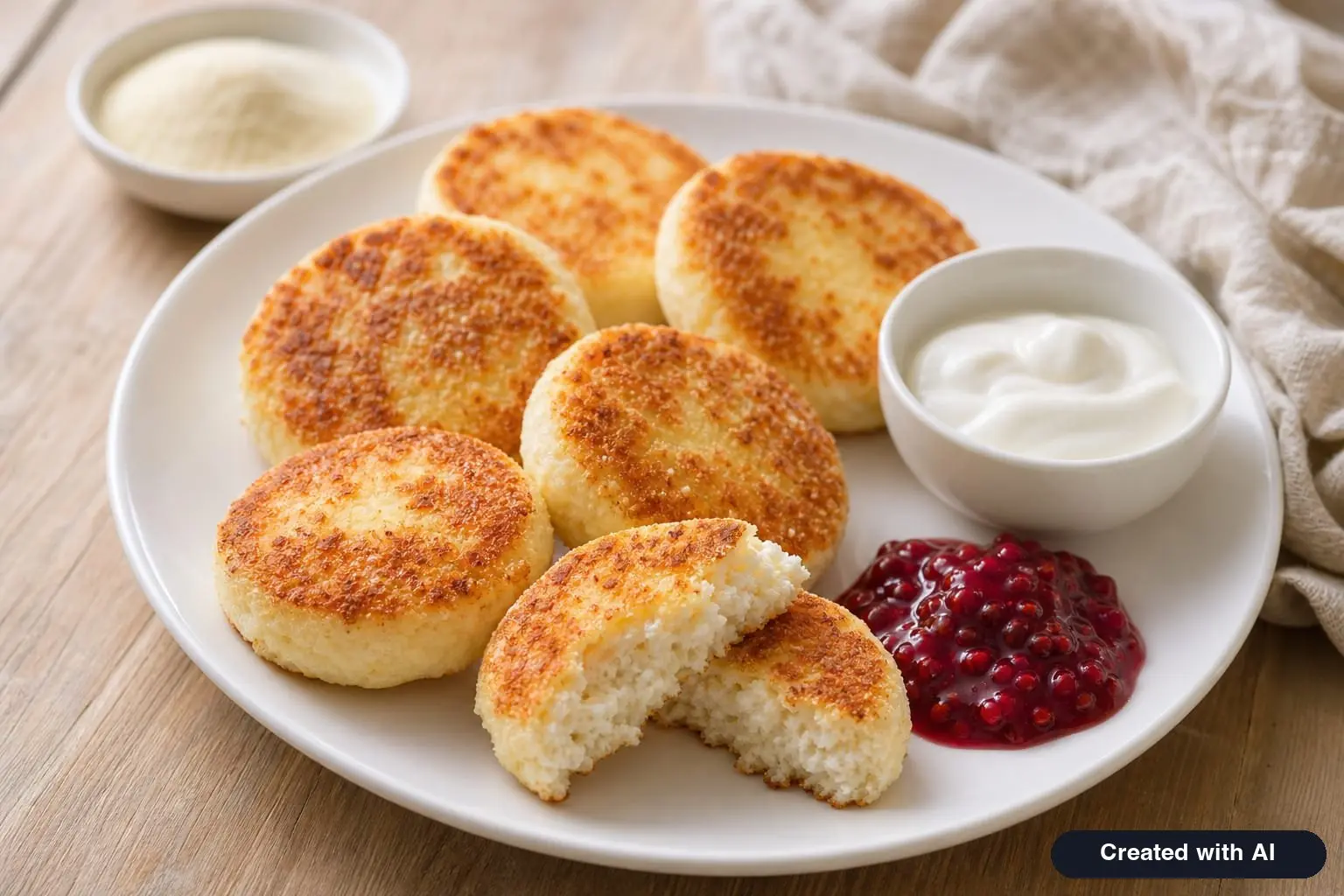
Flourless cottage cheese pancakes are the same classic fried pancakes, except the cheese is bound not by all-purpose flour, but by semolina, cornstarch, or other flours like oat, rice, cornmeal, or almond. This is usually done for taste and texture: flour dough can easily become heavy, making the pancakes tough and floury, whereas semolina absorbs moisture slowly, leaving the inside soft and almost creamy.
The main recipe on this page is for fried cottage cheese pancakes with semolina. It requires five ingredients: farmer cheese, an egg, semolina, a tablespoon or two of sugar, and a pinch of salt. The only condition is patience: the dough must rest for 30 minutes so the grains can swell. During this time, the soft, sticky mass turns into a dough that can be easily shaped into patties that won't fall apart in the pan.
It is important to distinguish two things that are often confused. "Flourless" does not mean "gluten-free": semolina is made from wheat, so it contains just as much gluten as all-purpose flour. If you need to avoid gluten entirely, replace the semolina with cornstarch, rice, cornmeal, buckwheat, or almond flour—exact amounts are listed in the substitution chart below. There you will also find how to make eggless pancakes, how to use ricotta, cottage cheese, or cream cheese, and how to make them with kefir.
The given amount yields 12 pancakes—four servings of three. The full recipe is in the card: you can adjust the quantities for a different number of servings, check off what you've already added, and print it. Below the card, each step is explained in more detail.
Flourless Cottage Cheese Pancakes with Semolina
No ratings yet – be the firstIngredients
For the dough
For coating and frying
Directions
- Mash the cheese. Mash the farmer cheese with a fork or potato masher for 2–3 minutes until no large curds remain. If it's wet, drain it in cheesecloth for 15–20 minutes beforehand.
- Mix the dough. Add the egg, sugar, salt, and ⅓ cup (60 g) of semolina. Mix with a spoon until combined—it will be soft and sticky, do not add extra semolina.
- Rest. Cover the bowl and refrigerate for 30 minutes to let the semolina swell and the dough thicken.
- Shape. With wet hands, take about 2 oz (55 g) of dough, roll it into a ball, coat it in semolina, and flatten it into a 2.5-inch (6 cm) wide and ⅝- to ¾-inch (1.5–2 cm) thick pancake.
- Fry. Heat 1 tbsp of oil in a skillet over medium-low heat. Fry six pancakes for 4–5 minutes, flip, cover with a lid, and fry for another 4 minutes. Fry the rest the same way, adding the second tablespoon of oil.
- Serve. Let the fried pancakes rest on a paper towel for 3–4 minutes to firm up, and serve with sour cream, jam, or berries.
- Calories
- 100 kcal
- Protein
- 6 g
- Fat
- 4.4 g
- of which saturated
- 1.1 g
- Carbohydrates
- 8.8 g
- of which sugars
- 3.6 g
- Fiber
- 0.3 g
Calculated with the Firmus Medicus calorie database (USDA, Fineli).
Ingredients and How to Choose Them
The cheese. More depends on it than on all the other ingredients combined. These pancakes are made from dry curd cheese (tvorog), so in the US buy farmer cheese or dry-curd cottage cheese, ideally whole-milk; Eastern European delis also sell it as tvorog. It should be dry and firm enough to crumble between your fingers. If you see whey in the package – or if you're using regular cottage cheese – wrap the cheese in cheesecloth or a clean towel and press it under a weighted plate for 15–20 minutes. The wetter the cheese, the more semolina you will need, and the more semolina you add, the more the pancakes will taste like semolina porridge patties rather than cheese.
Semolina. Regular fine semolina works perfectly; farina (Cream of Wheat) is the same thing for this recipe. For 1.1 lb (500 g) of farmer cheese, we add ⅓ cup (60 g)—this is enough for the dough to hold its shape without the grain flavor overpowering the cheese. Another 2 tbsp (20 g) is needed for coating: the semolina layer turns into a thin, crispy crust in the pan that you won't get with flour.
Egg. One medium egg is completely sufficient. Two eggs will make the dough too runny, requiring more grains, which hardens the pancakes. If the cheese is very dry and crumbly, it's better to add a tablespoon of sour cream instead of a second egg.
Sugar and salt. 2½ tbsp (30 g) of sugar yields a barely sweet dough—it is assumed the pancakes will be eaten with jam, honey, or sweetened sour cream. It's not worth adding more than ¼ cup (50 g): sugar thins the dough as it melts and burns quickly in the pan. A pinch of salt is essential—without it, the cheese tastes bland.
Fat for frying. Odorless sunflower or canola oil, about 2 tablespoons for two batches in the pan. Butter burns on its own, so only add a small piece at the end for flavor.
What to Use Instead of Flour: Substitution Chart
All amounts are calculated for 1.1 lb (500 g) of dry farmer cheese and one egg. The "For the dough" column indicates how much to add instead of ⅓ cup (60 g) of semolina; calories are per pancake (out of twelve), fried with the same amount of oil.
| Binder | For the dough | For coating | Resting time | Result | Gluten | Calories per pancake |
|---|---|---|---|---|---|---|
| Semolina (main recipe) | ⅓ cup (60 g) | semolina, 2 tbsp (20 g) | 30 min. | soft inside, thin crispy crust | yes | about 100 |
| Semolina and cornstarch | ¼ cup (40 g) semolina + 2 tbsp (15 g) cornstarch | semolina, 2 tbsp (20 g) | 30 min. | firmer, smoother surface | yes | about 98 |
| Cornstarch or potato starch | ¼ cup (30 g) | cornstarch, 2 tbsp (15 g) | 10 min. | very delicate, creamy, pale | no | about 90 |
| Oat flour (ground rolled oats) | ¾ cup (65 g) | ground oats, 3 tbsp (20 g) | 20 min. | more filling, slightly grainy, nutty flavor | only if certified gluten-free | about 102 |
| Cornmeal | ½ cup (60 g) | cornmeal, 2.5 tbsp (20 g) | 20 min. | yellowish, crispy crust, barely noticeable graininess | no | about 100 |
| Rice flour | ⅓ cup (55 g) | rice flour, 2.5 tbsp (20 g) | 15 min. | neutral flavor, the crispiest crust | no | not calculated |
| Almond flour | ¾ cup (70 g) + 2 tbsp (15 g) cornstarch | almond flour, 3 tbsp (20 g) | 15 min. | moist, rich, more fragile | no | about 124 |
| Coconut flour | ¼ cup (25–30 g) | cornstarch or shredded coconut | 15 min. | denser, strong coconut flavor | no | not calculated |
| Buckwheat flour | ⅓ cup (50 g) | buckwheat or rice flour | 15 min. | darker, strong buckwheat flavor | no | not calculated |
The cornstarch row is calculated using cornstarch; potato starch behaves the same way in the dough but thickens slightly more, so you can use 1 tsp (5 g) less. We do not list calories for rice, coconut, and buckwheat flours because they are not in our product database, and we prefer not to guess.
How to Make Semolina Cottage Cheese Pancakes Step by Step
1. Mash the cheese. Place the farmer cheese in a bowl and mash it with a fork or potato masher for 2–3 minutes until no large curds remain. It's better not to use a blender: it turns the cheese into a smeary paste that releases liquid, requiring more grains. If you want a perfectly smooth mass, press the cheese through a sieve.
2. Mix the dough. Add the egg, sugar, salt, and ⅓ cup (60 g) of semolina. Mix with a spoon just until the mass is uniform. At this point, it will look too soft and stick to the spoon—that's exactly how it should be. Do not add extra grains "by eye": they haven't had time to absorb a single drop of moisture yet.
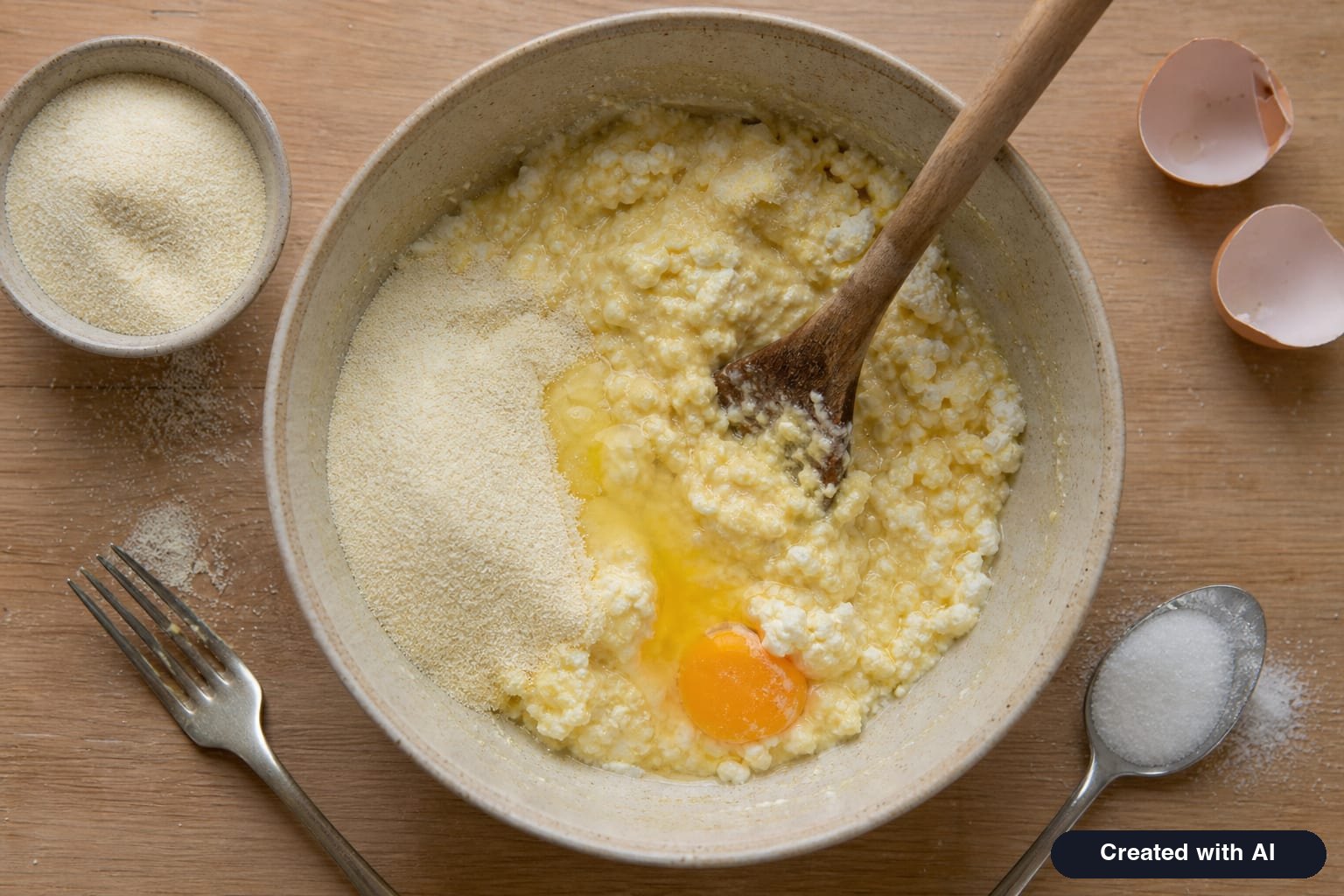
3. Let the semolina swell. Cover the bowl and refrigerate for 30 minutes. This is the most important step in the whole recipe. Semolina absorbs moisture slowly: the freshly mixed dough is runny, but after half an hour, it thickens enough that a spoon can stand upright in it. If you fry them immediately, the dry grains will crunch between your teeth, and the pancakes will fall apart in the pan. The dough can also be left overnight—in the morning, all you have to do is shape and fry them.
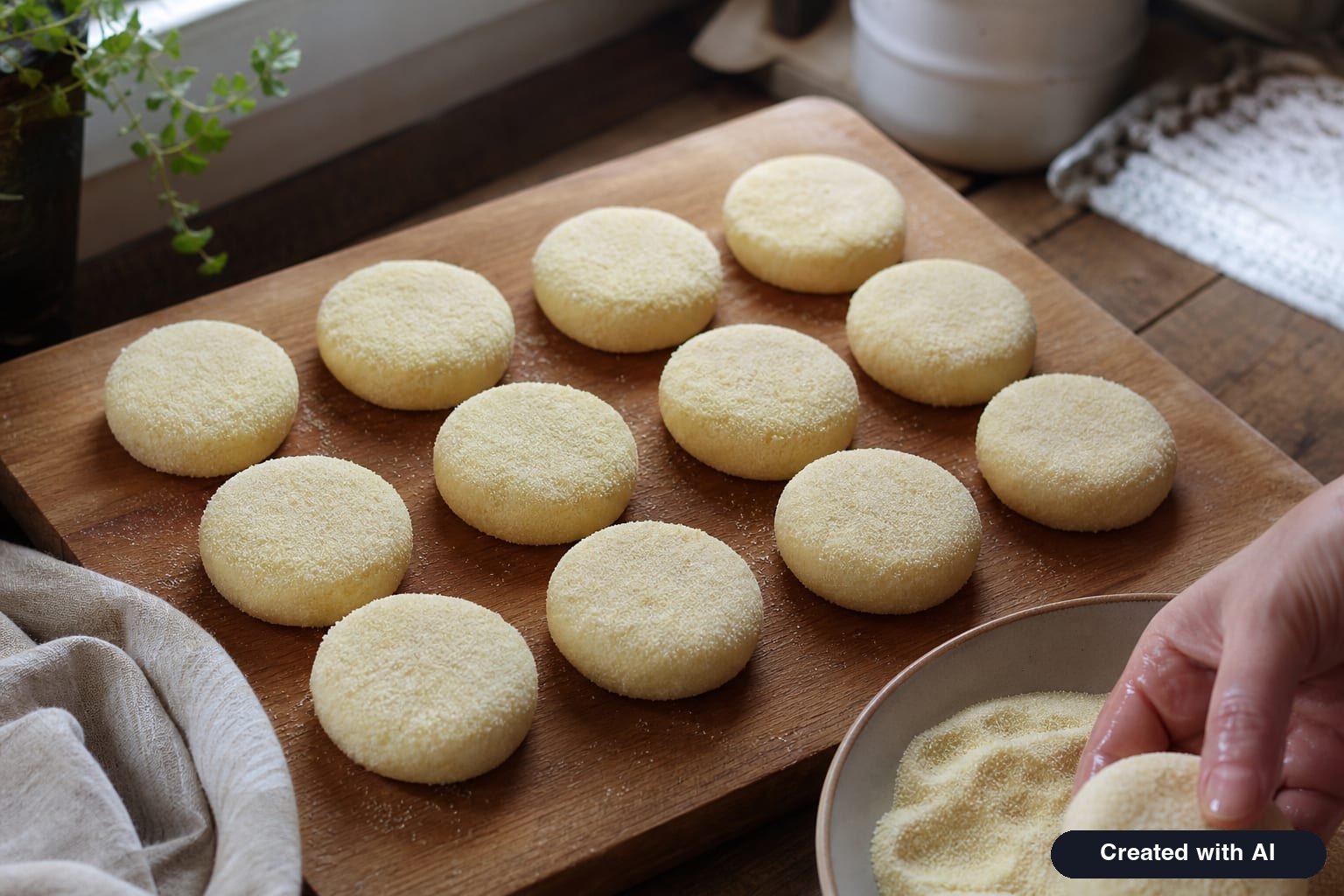
4. Shape the pancakes. Pour 2 tbsp (20 g) of semolina onto a plate. Wet your hands with cold water—the cheese won't stick to wet palms. Take about 2 oz (55 g) of dough with a spoon, roll it into a ball, coat it in semolina, and flatten it into a patty 2.5-inch (6 cm) wide and ⅝- to ¾-inch (1.5–2 cm) thick. Thicker ones won't heat through, thinner ones will dry out. Smooth the edges with the side of a knife—smooth sides won't crack in the pan.
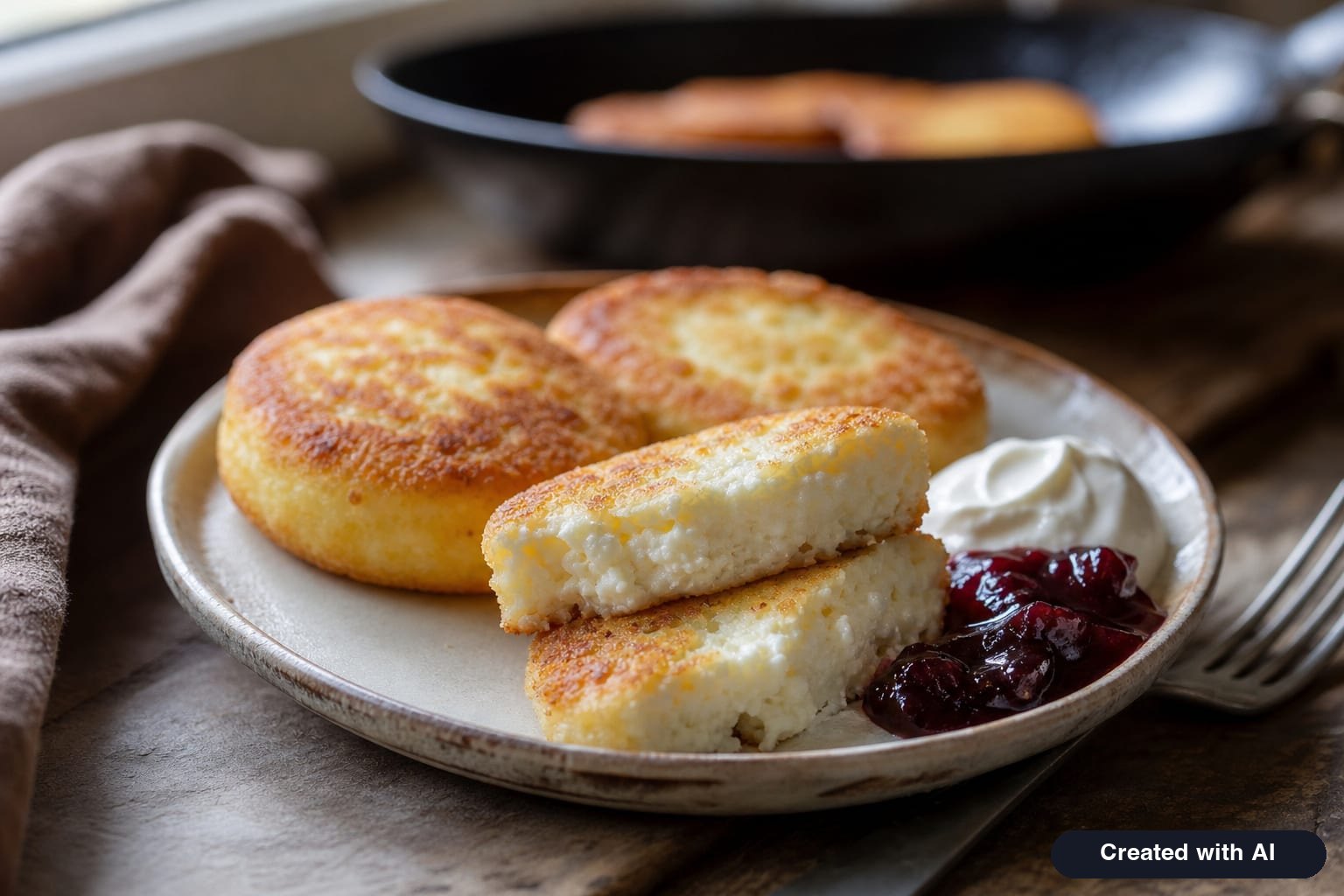
5. Fry over medium heat. Heat a tablespoon of oil in a skillet. The heat should be just below medium – medium-low on most stoves. Place six pancakes in the pan, leaving space between them, and fry for 4–5 minutes until the bottom is golden. Flip with a spatula, cover with a lid, and fry for another 4 minutes. The steam trapped under the lid heats the inside and finishes swelling the semolina, causing the pancakes to puff up slightly. Add the remaining oil for the second batch.
6. Let them rest. Transfer the fried pancakes to a paper towel and wait 3–4 minutes. When hot, they are very soft and might seem undercooked; as they cool slightly, they firm up while the inside remains delicate.
Common Mistakes When Frying Without Flour
The pancakes melt and fall apart. Usually, the dough didn't rest long enough, or the cheese was too wet. Let the dough rest for another 15 minutes; if it's still mushy, stir in a tablespoon of semolina or a teaspoon of cornstarch and wait again. The second reason is the heat being too low: a crust doesn't form, and the pancake tears when flipped.
You can feel the grains inside. The semolina didn't have time to swell. You cannot shorten the resting time, but you can change it: if you're in a hurry, replace the semolina with cornstarch—it only needs 10 minutes.
Tough and "rubbery". Too much binder. This happens when grains are added until the dough no longer sticks to your hands. The dough must remain soft; stickiness is solved by wet hands and coating, not by extra tablespoons of semolina.
The outside burns, the inside is cold. The heat is too high, or there's too much sugar. Lower the heat and make sure to fry the second side covered.
Sour taste. The tartness comes from the cheese, not the recipe. Choose fresh farmer cheese, and if yours is more tart, add an extra tablespoon of sugar and a splash of vanilla extract.
Variations: With Cornstarch, Other Flours, and Gluten-Free
Cottage cheese pancakes with cornstarch. This is the fastest way to fry without flour. For 1.1 lb (500 g) of cheese, add ¼ cup (30 g) of cornstarch or potato starch, and another 2 tbsp (15 g) for coating. Cornstarch has no flavor or graininess, so pancakes made with it turn out the most delicate of all—almost like a cheesecake filling. They are more fragile, so shape them smaller, about 1.5 oz (45 g), and flip them with a wide spatula.
Pancakes with semolina and cornstarch. A combination for those who find semolina-only pancakes too soft: ¼ cup (40 g) semolina and 2 tbsp (15 g) cornstarch. The cornstarch quickly firms up the mass, while the semolina adds fluffiness. This variation is the most reliable if the cheese is wetter than desired.
Pancakes with oat flour or rolled oats. Grind ¾ cup (65 g) of rolled oats in a blender into coarse flour and let the dough rest for 20 minutes. Whole rolled oats also work, but use the fine, "quick-cooking" kind and wait 30 minutes—large oats will remain hard. Oat flour pancakes are more filling and slightly darker.
Pancakes with cornmeal. Add ½ cup (60 g) of finely ground cornmeal (not coarse polenta—it stays hard). The color will be yellowish, and the crust will be crispy. Cornmeal binds the cheese less effectively than semolina, so do not omit the egg.
Pancakes with rice flour. ⅓ cup (55 g) for the dough and 2.5 tbsp (20 g) for coating. Rice flour has a neutral flavor, and it is the best for coating—the crust stays crispy the longest, even after cooling.
Pancakes with almond flour. Almond flour contains no starch, so it doesn't bind anything on its own—it only absorbs a little moisture. Add ¾ cup (70 g) of almond flour and 2 tbsp (15 g) of cornstarch. Fry over lower heat: nuts brown faster than grains. These pancakes are higher in calories—about 124 kcal each.
With coconut, buckwheat, and rye flours. Coconut flour absorbs several times more liquid than others, so ¼ cup (25–30 g) is enough; adding more will dry out the pancakes. Add ⅓ cup (50 g) of buckwheat flour—the flavor will be strong, better suited for savory pancakes with sour cream. Rye flour (½ cup / 60 g) is good for those who just want to avoid all-purpose wheat flour, but rye does contain gluten.
Gluten-free cottage cheese pancakes. Wheat, rye, and barley contain gluten, meaning semolina, rye, and spelt flours are not suitable. Naturally gluten-free options include cornstarch, rice, cornmeal, buckwheat, almond, and coconut flours. Oats themselves do not contain gluten, but regular rolled oats often cross-contaminate with wheat in mills, so choose only those labeled "gluten-free". If you are baking for someone who must strictly avoid gluten, read the labels on the cornstarch, flour, and vanilla extract, and coat the pancakes in the same product you added to the dough.
Eggless Cottage Cheese Pancakes
The egg in these pancakes does two jobs: it binds the mass and adds moisture. For dry cheese, you can omit it entirely if you use slightly more binder. Eggless recipe: 1.1 lb (500 g) farmer cheese, ⅓ cup plus 1 tbsp (70 g) semolina, 1.5 tbsp (20 g) cornstarch, 2½ tbsp (30 g) sugar, a pinch of salt, and 1–2 tablespoons of sour cream or plain yogurt if the mass is crumbly. Let the dough rest for 30–40 minutes, shape smaller patties, and fry them covered from the very beginning—this helps them crack less.
Eggless pancakes turn out whiter, denser, and the cheese flavor is more pronounced. The calories are almost the same—about 102 kcal each. If you are baking both egg-free and gluten-free, replace the semolina with ¼ cup (35 g) of cornstarch and 3 tbsp (30 g) of rice flour.
Using Ricotta, Cottage Cheese, or Cream Cheese
The wetter the dairy product, the more binder it needs and the longer the dough must rest. Approximate amounts for 1.1 lb (500 g) of product and one egg:
| Type of cheese | How to prepare | Semolina for dough | Resting time | What changes |
|---|---|---|---|---|
| Dry whole-milk farmer cheese | mash with a fork | ⅓ cup (60 g) | 30 min. | main recipe |
| Low-fat farmer cheese | mash, add 1 tbsp sour cream | ⅓ cup (55 g) | 30 min. | drier, slightly more tart |
| Regular cottage cheese | drain in a sieve for 20 min, press, mash | scant ½ cup (75 g) | 30–40 min. | saltier, add 1 extra tbsp of sugar |
| Ricotta | drain in cheesecloth for 30 min | ½ cup (90 g) | 40 min. | sweeter, very delicate, softer |
| Smooth quark or cream cheese | mix half and half with dry farmer cheese | ⅓ cup + 1 tbsp (70 g) | 40 min. | smooth, creamy texture |
Pancakes with regular cottage cheese. Regular cottage cheese sits in a creamy dressing, so it must first be drained and then mashed with a fork or briefly with a blender. Pancakes made with cottage cheese turn out slightly salty—it is salted at the factory, so do not add salt to the dough. If you want to leave the curds whole and fry thinner patties from a runnier batter, you're making cottage cheese kefir pancakes.
Pancakes with ricotta. Ricotta is softer and wetter than farmer cheese, so you cannot skip draining it, and you will need about ½ cup (90 g) of semolina. Ricotta pancakes are sweeter, without tartness, and very delicate—1.5 tbsp (20 g) of sugar is enough. Shape them small and flip them carefully. Calculated with ½ cup plus 2 tbsp (110 g) of semolina (including coating) and 1.5 tbsp (20 g) of sugar, one ricotta pancake has about 127 kcal, because ricotta is higher in fat.
With smooth quark and mascarpone. Pancakes made solely from smooth quark or cream cheese struggle to hold their shape, so mix it half and half with dry farmer cheese: 8.8 oz (250 g) + 8.8 oz (250 g) and ⅓ cup plus 1 tbsp (70 g) of semolina. Do the same with mascarpone—it is an addition here, not the base: 3.5 oz (100 g) of mascarpone and 14 oz (400 g) of dry farmer cheese yields a richer, creamy interior.
Lactose-free pancakes. Replacing the flour does not change the lactose content—only the cheese matters here. Use lactose-free farmer cheese; it behaves the same way in the dough as regular cheese, and the quantities do not change.
Cottage Cheese Pancakes with Kefir
Kefir is added to cottage cheese pancakes in two cases: when the cheese is very dry and when you want a fluffier inside. Add 3 tbsp (45 ml) of kefir and ¼ tsp of baking soda to the main recipe, and increase the semolina to a scant ½ cup (75 g). The acid in the kefir reacts with the baking soda, creating bubbles in the dough, and the fried pancakes puff up more than usual. The resting time is the same—30 minutes, but the baking soda is mixed in at the very end, right before shaping. One such pancake has about 106 kcal.
Do not add more than 3.5 tbsp (50 ml) of kefir: the dough will become too runny to shape and you will have to drop it into the pan with a spoon, which is a different dish—fluffy kefir cottage cheese pancakes.
Lighter Version
Semolina cottage cheese pancakes are already not a heavy dish, but the calories can be reduced further. The table shows how much each change individually affects one pancake (out of twelve).
| Change | How | kcal / pancake | Difference |
|---|---|---|---|
| Main recipe | as written above | 100 | – |
| Low-fat cheese | 1.1 lb (500 g) of low-fat farmer cheese instead of whole-milk + 1 tbsp sour cream if crumbly (not included) | 89 | −11 |
| Sugar-free dough | omit sugar, sweeten when serving | 90 | −10 |
| Cornstarch instead of semolina | ¼ cup (30 g) cornstarch for dough and 2 tbsp (15 g) for coating (gluten-free) | 90 | −10 |
| One teaspoon of oil | 1 tsp (5 g) of oil in a non-stick pan or baked in the oven | 85 | −15 |
| All three together | low-fat cheese, no sugar, 1 tsp (5 g) oil | 64 | −36 |
| Almond flour instead of semolina | ¾ cup plus 2 tbsp (90 g) almond flour (¾ cup / 70 g for dough, 2 tbsp / 20 g for coating) and 2 tbsp (15 g) cornstarch – gluten-free, but higher in calories | 124 | +24 |
Calculated with the Firmus Medicus calorie database, with the recipe divided into 12 pancakes.
Three changes provide almost equal benefits—saving 10–15 kcal per pancake: low-fat cheese (about 89 kcal instead of 100), sugar-free dough (about 90 kcal), and frying with just one teaspoon of oil in a non-stick pan or baking in the oven (about 85 kcal). Using cornstarch instead of semolina also saves about 10 kcal, because you only need half as much. Combining low-fat cheese, sugar-free dough, and minimal oil leaves about 64 kcal—more than a third less than the main recipe. Almond flour has the opposite effect: the pancake increases to about 124 kcal. How to bake completely without fat is described in the sections baked syrniki and air fryer syrniki, and flourless, sugar-free pancakes sweetened only with a banana are in the recipe for banana cottage cheese pancakes.
How Many Calories Are in Flourless Cottage Cheese Pancakes
One semolina pancake (about 2 oz / 58 g) has about 100 kcal, 6 g of protein, 4.4 g of fat, and 8.8 g of carbohydrates. A serving of three pancakes is about 300 kcal and 18 g of protein, not counting sour cream or jam. About 40% of the calories come from the cheese, a quarter from the semolina, and a fifth from the frying oil. Below you can see the share of each ingredient.
| Ingredient | Amount | kcal, whole recipe | Share |
|---|---|---|---|
| Cottage cheese | 500 g | 490 | 41 % |
| Sunflower oil | 25 g | 221 | 19 % |
| Semolina, dry | 60 g | 216 | 18 % |
| Granulated sugar | 30 g | 116 | 10 % |
| Egg | 55 g | 79 | 7 % |
| Semolina, dry | 20 g | 72 | 6 % |
| Table salt | 1 g | 0 | 0 % |
| Total | 691 g | 1194 | 100 kcal / pancake |
Ingredient values – Firmus Medicus calorie database.
Skipping flour does not significantly reduce calories: semolina, oat, and cornmeal are almost identical in calories to all-purpose flour. What differs is the texture and the total amount of binder needed—which is why the variation with cornstarch has the fewest calories, as only ¼ cup (30 g) is used.
How to Serve, Store, and Freeze
Semolina cottage cheese pancakes are best served warm, a few minutes after frying: with sour cream, jam, mashed berries, or honey. For a savory version (sugar-free dough with an extra pinch of salt), sour cream with dill is perfect. Sauces and serving ideas are described in more detail in the main cottage cheese pancakes recipe.
Fried pancakes will keep in an airtight container in the fridge for 2–3 days. Reheat them in a skillet under a lid over low heat for 3–4 minutes or in a 325°F (160°C) oven for 10 minutes; the microwave will soften the crust. Uncooked dough can be kept in the fridge for up to 24 hours—the semolina will only swell better.
It is more convenient to freeze them uncooked: place the shaped and coated patties on a cutting board, freeze them solid, and then transfer them to a bag. They will keep in the freezer for up to 2 months. Fry them without thawing, over lower heat and covered, for 6–7 minutes per side. Cornstarch pancakes and ricotta pancakes do not freeze as well—they become runny when thawed, so it's better to fry them fresh.
If you want to compare them with the classic, start with the main fried cottage cheese pancakes recipe with flour. The same semolina dough can be boiled instead of fried—yielding lazy vareniki (boiled cottage cheese dumplings), which are even more delicate and completely oil-free. And when you want to add apples, raisins, or berries to the dough, check out the section on apple cottage cheese pancakes and other add-ins.
Frequently asked questions
How much semolina do I need for cottage cheese pancakes?
For 1.1 lb (500 g) of dry farmer cheese and one egg, use about ⅓ cup (60 g) of semolina for the dough and 2 tbsp (20 g) for coating. Wetter cheese may need up to a scant ½ cup (75 g), but let the dough rest for 30 minutes first.
Are semolina cottage cheese pancakes gluten-free?
No. Semolina is made from wheat, so it contains gluten. For gluten-free pancakes, use cornstarch, rice flour, cornmeal, buckwheat, or almond flour. If using oats, ensure they are certified gluten-free.
What can I use instead of flour in cottage cheese pancakes?
For 1.1 lb (500 g) of cheese: ⅓ cup (60 g) semolina, ¼ cup (30 g) cornstarch, ¾ cup (65 g) oat flour, ½ cup (60 g) cornmeal, ⅓ cup (55 g) rice flour, or ¾ cup (70 g) almond flour with 2 tbsp (15 g) cornstarch. Cornstarch needs a 10-minute rest; semolina needs 30 minutes.
How do I make eggless cottage cheese pancakes?
Mix 1.1 lb (500 g) of dry farmer cheese with ⅓ cup plus 1 tbsp (70 g) semolina, 1.5 tbsp (20 g) cornstarch, 2½ tbsp (30 g) sugar, and salt. If crumbly, add 1-2 tbsp sour cream. Rest for 30–40 minutes, shape smaller pancakes, and fry covered.
Why do my semolina cottage cheese pancakes fall apart?
Usually, the dough didn't rest long enough for the semolina to swell, or the cheese was too wet. Chill the dough for 30 minutes, drain wet cheese, and fry over medium heat to form a crust.
Can I use ricotta or regular cottage cheese for pancakes?
Yes, but both must be drained. For 1.1 lb (500 g) of ricotta, use about ½ cup (90 g) semolina and rest for 40 minutes. For 1.1 lb (500 g) of regular cottage cheese, drain it, mash it, use a scant ½ cup (75 g) semolina, and skip the salt.
How do I make cottage cheese pancakes with kefir?
Add 3 tbsp (45 ml) of kefir and ¼ tsp of baking soda to the 1.1 lb (500 g) cheese dough, and increase the semolina to a scant ½ cup (75 g). The pancakes will be fluffier. Adding more kefir makes the dough too runny to shape.
How many calories are in flourless cottage cheese pancakes?
One semolina pancake (about 2 oz / 58 g) has about 100 calories and 6 g of protein; a serving of three is about 300 calories. Made with cornstarch instead of semolina, it's about 90 calories; with almond flour, about 124 calories each.
Log in to comment
No comments yet. Be the first.