Cottage Cheese Kefir Pancakes: Fluffy Recipe & 7 Variations
- The batter is scooped with a spoon—no need to shape by hand or roll in flour.
- Separate amounts for pancakes made with regular cottage cheese and for savory zucchini pancakes.
- One pancake is about 112 kcal, or around 92 kcal when baked in the oven without oil.
- How cottage cheese kefir pancakes differ from syrniki
- Ingredients and how to choose them
- How to make cottage cheese kefir pancakes step by step
- Common mistakes
- Pancakes with regular cottage cheese
- Zucchini and farmer cheese pancakes
- Other variations: banana, apple, flourless, baked
- Lighter version
- How many calories are in cottage cheese kefir pancakes
- What to serve with, how to store and freeze
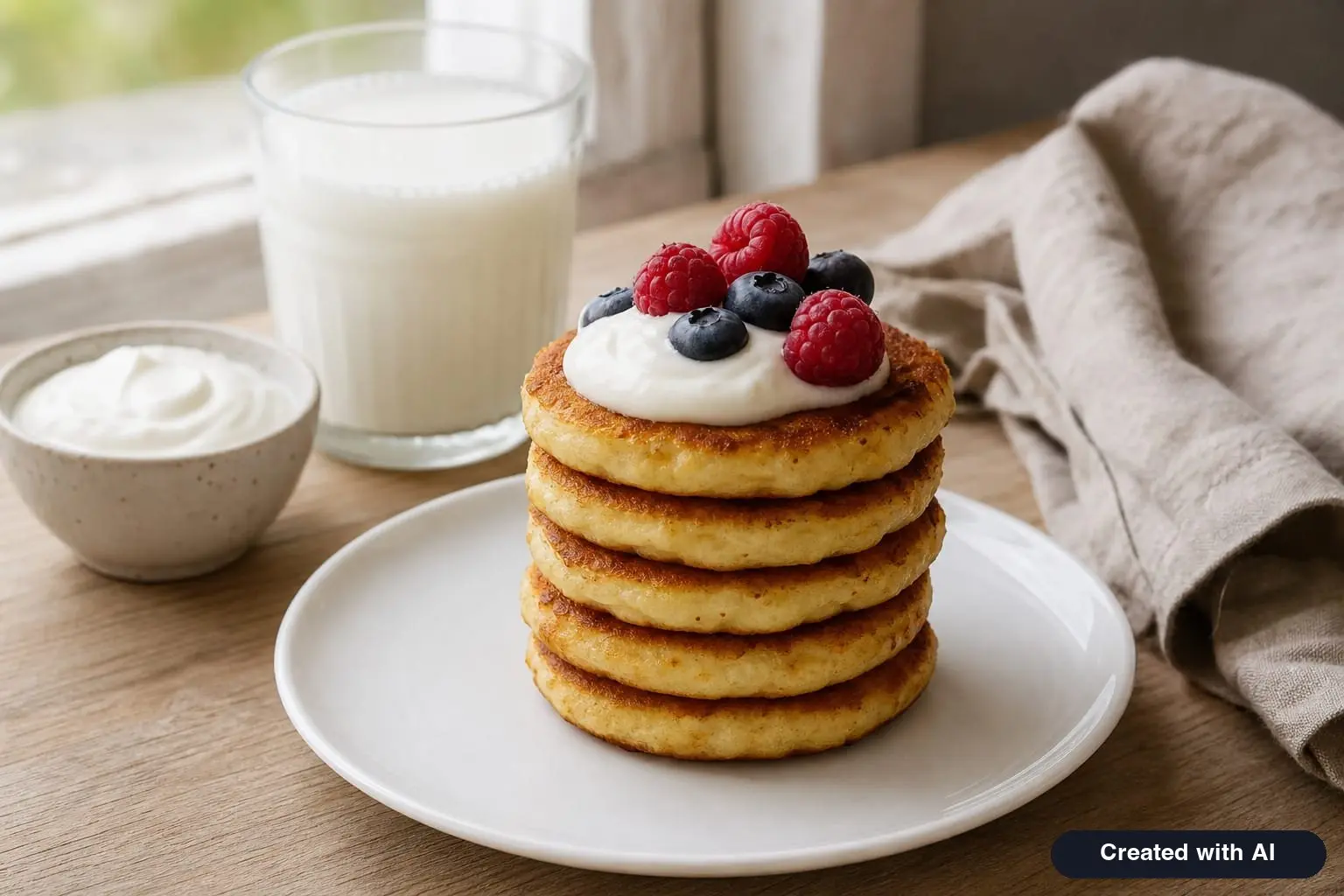
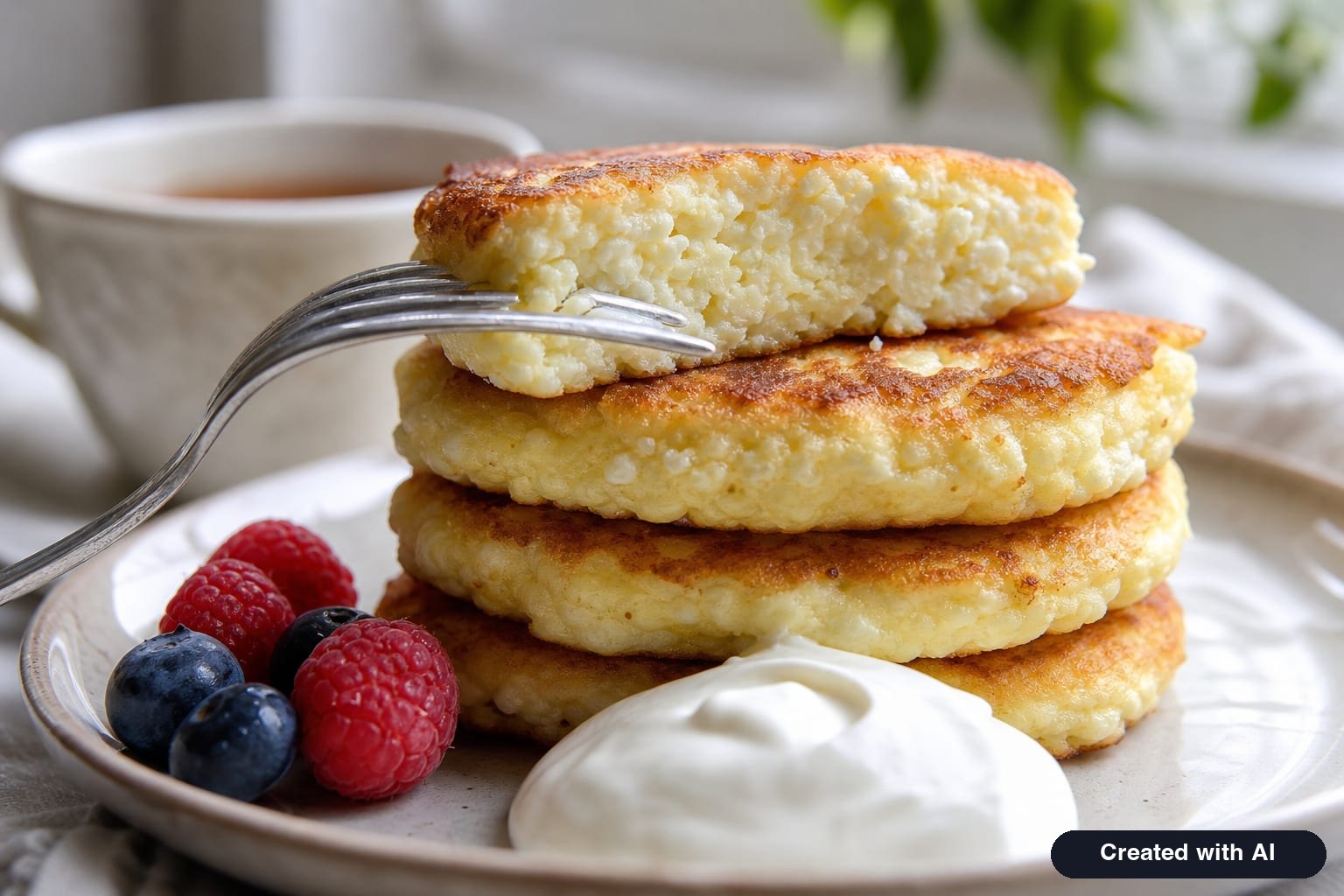
Cottage cheese kefir pancakes are not the same as syrniki (thick Eastern European cottage cheese patties), even though both use the same ingredients. Syrniki dough is thick; you can pick it up, shape it into a patty, and roll it in flour. Kefir pancake batter is thinner: it includes kefir, is scooped with a spoon, and spreads out in the pan on its own. As a result, these pancakes are thinner, softer, and more porous, with a milder cheese flavor that closely resembles fluffy kefir pancakes.
This recipe is for fluffy cottage cheese kefir pancakes. The farmer cheese provides satiety and moisture, the kefir and baking powder create a porous texture, and just enough flour is added to help the batter hold its shape. There's no need to get your hands messy or shape anything, making this one of the fastest ways to use up a package of farmer cheese: from bowl to plate takes about 35 minutes, 10 of which are just letting the batter rest.
The specified amounts yield 12 pancakes, each about 3.5 inches (9 cm) in diameter—four servings of three. It's a convenient breakfast option: you can mix the batter while the pan heats up and the coffee brews. Below, you'll also find separate amounts for pancakes made with regular cottage cheese, zucchini and farmer cheese pancakes, and variations with bananas, apples, and no flour. If you're looking for thick, hand-shaped patties, you need a classic syrniki recipe.
The full recipe is in the card below: you can adjust the quantities for a different number of servings, check off what you've already added, and print it. After the card, each step is explained in more detail.
Fluffy Cottage Cheese Kefir Pancakes
No ratings yet – be the firstIngredients
Directions
- Farmer cheese and eggs. Mash the farmer cheese with a fork, add the eggs, sugar, salt, and vanilla extract, and mix until smooth.
- Kefir. Pour in the room temperature kefir and mix.
- Flour. Mix the flour with the baking powder and fold it into the wet mixture in two additions. Stir only until no dry flour remains.
- Resting. Let the batter rest for 10 minutes to thicken. Do not stir after it has rested. The batter should fall from the spoon slowly in a thick ribbon.
- The pan. Heat a skillet over medium heat and add 1–2 teaspoons of oil.
- Cooking. Drop 2 tablespoons of batter per pancake, spreading it to 3–3½ inches (8–9 cm). Cook covered for 2–3 minutes, flip, and cook for another 2 minutes uncovered.
- Serving. Do not press the cooked pancakes with a spatula; stack them on top of each other. Add a drop of oil before each batch. Serve warm with sour cream, yogurt, or jam.
- Calories
- 112 kcal
- Protein
- 5.3 g
- Fat
- 4.2 g
- of which saturated
- 0.9 g
- Carbohydrates
- 13 g
- of which sugars
- 3.3 g
- Fiber
- 0.3 g
Calculated with the Firmus Medicus calorie database (USDA, Fineli).
How cottage cheese kefir pancakes differ from syrniki
When searching for a recipe, these names are often confused. The difference comes down to one thing: the amount of liquid and flour in the batter.
| Cottage cheese kefir pancakes (drop-style) | Syrniki | |
|---|---|---|
| Batter | Thick but pourable—like thick sour cream with cheese curds | Firm, sticky dough that holds together in a ball |
| Liquid | Kefir (⅔ cup / 150 ml per 8.8 oz / 250 g cheese) | None—just farmer cheese and egg |
| Flour | 1¼ cups (150 g) flour per 8.8 oz (250 g) cheese | About ⅔ cup (80 g) flour per 1.1 lb (500 g) cheese, plus some for rolling |
| How it goes in the pan | By the spoonful, batter spreads on its own | Shaped by hand, rolled in flour |
| Result | ⅜–½ inch (1–1.5 cm) thick, porous, soft pancake | ¾ inch (2 cm) thick patty with a strong cheese flavor |
In short, in kefir pancakes the cheese is an addition to the pancake batter, while in syrniki, the cheese is the batter. If you want as much cheese and as little flour as possible, make syrniki; if you want light, fluffy pancakes that you can quickly whip up for the whole family, stick around here.
Ingredients and how to choose them
The cheese. The main recipe is built on dry curd cheese (tvorog), so in the US buy farmer cheese or dry-curd cottage cheese, ideally whole-milk; Eastern European delis also sell it as tvorog. Regular cottage cheese is much wetter: it would thin this batter too much, so either drain and press it first or use the separate regular cottage cheese version below, which skips the kefir. Low-fat farmer cheese works too, but the pancakes will be slightly drier. Simply mashing the cheese with a fork is enough—the small curds melt into the batter as it cooks, leaving moist, soft pockets. If you want a completely smooth texture, blend it with the eggs using an immersion blender. If your cheese is sitting in whey, pour the liquid off first, otherwise the batter will be too thin.
Kefir. It does two jobs: thins the batter and provides the acid needed to activate the baking powder or baking soda, helping the pancakes rise. It's best if the kefir is at room temperature—take it out of the fridge when you start prepping. Buttermilk or plain drinkable yogurt are good substitutes; using regular milk will result in flatter pancakes.
Flour. Regular all-purpose flour, 1¼ cups (150 g). The exact amount of flour depends slightly on the moisture of your cheese, so add the last two tablespoons while keeping an eye on the batter: it should fall from the spoon slowly in a thick ribbon, not run off.
Eggs bind the batter and keep the pancakes from falling apart when flipped. Two large eggs weigh about 4.2 oz (120 g) without the shell.
Baking powder or baking soda. This recipe uses 1 teaspoon of baking powder. If you only have baking soda, use ½ teaspoon—the acid in the kefir is enough to activate it, no vinegar needed. Do not add more: excess will leave a soapy aftertaste.
Sugar. 2 tablespoons (25 g)—just enough so the pancakes brown nicely and aren't bland, but still pair well with both sour cream and jam. If you plan to eat them with a very sweet syrup or sauce, you can cut the sugar in half.
How to make cottage cheese kefir pancakes step by step
1. Farmer cheese and eggs. In a bowl, mash the farmer cheese with a fork, add the eggs, sugar, salt, and vanilla extract, and mix until smooth. There's no need to use an electric mixer—the fluffiness comes from the baking powder and kefir, not whipped eggs.
2. Kefir. Pour in the kefir and mix. At this stage, the mixture will look thin and lumpy—that's exactly how it should be.
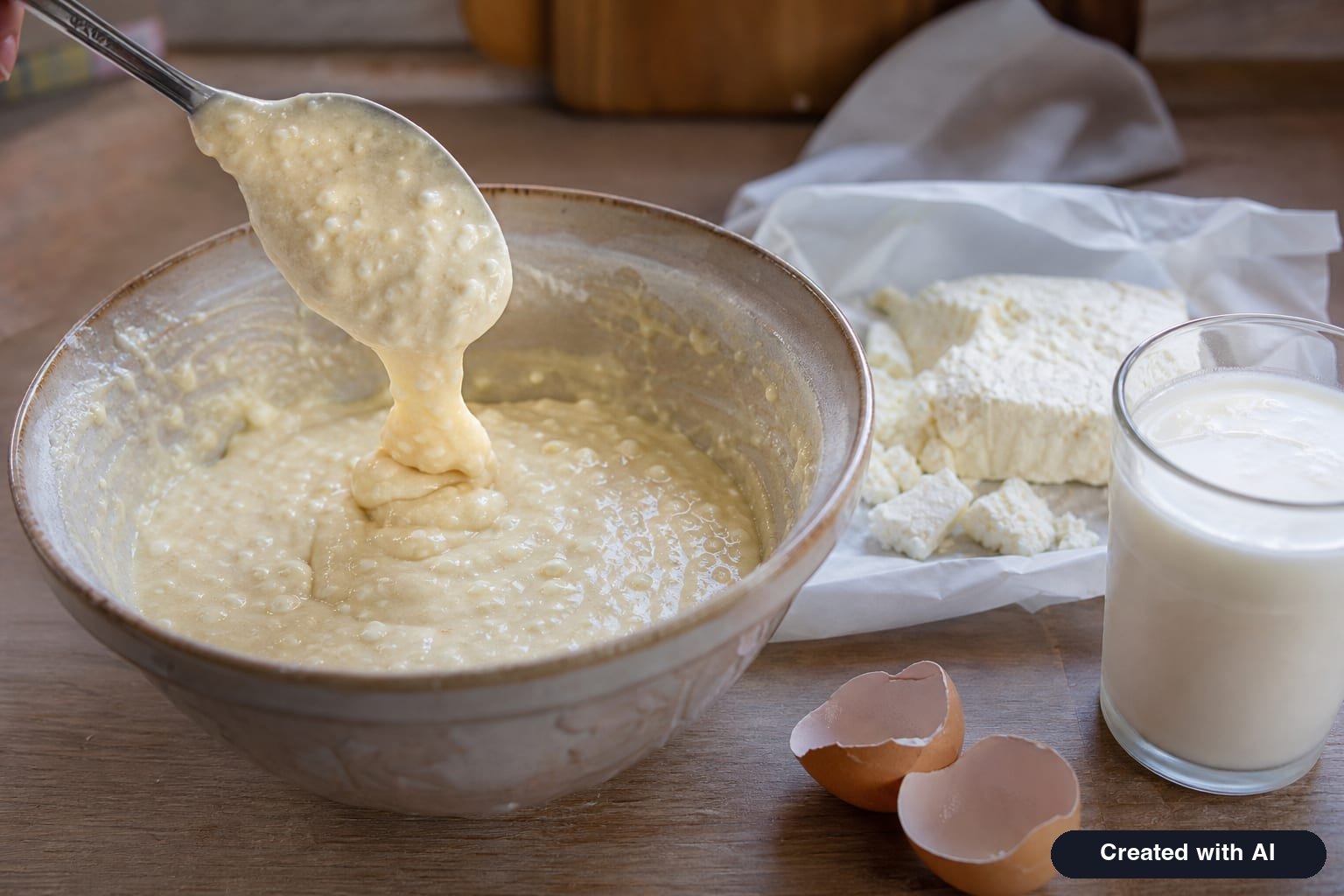
3. Flour. Mix the flour with the baking powder and fold it into the wet mixture in two additions. Stir with a spoon or spatula only until no dry flour remains. Overmixing develops gluten, resulting in rubbery rather than soft pancakes. A few lumps of cheese in the batter are perfectly fine.
4. Resting. Let the batter rest for 10 minutes. During this time, the flour absorbs the liquid, the batter noticeably thickens, and bubbles appear on the surface. Do not stir the batter after it has rested—stirring will knock out the air that makes the pancakes fluffy. If after 10 minutes the batter still runs off the spoon like milk, fold in another tablespoon of flour; if it stands stiff like porridge, add a tablespoon of kefir.
5. The pan. Heat a skillet over medium heat and add 1–2 teaspoons of oil—just enough to make the bottom shine. These pancakes cook more slowly than regular pancakes: over high heat, the cheese and sugar will brown in a minute while the inside remains raw.
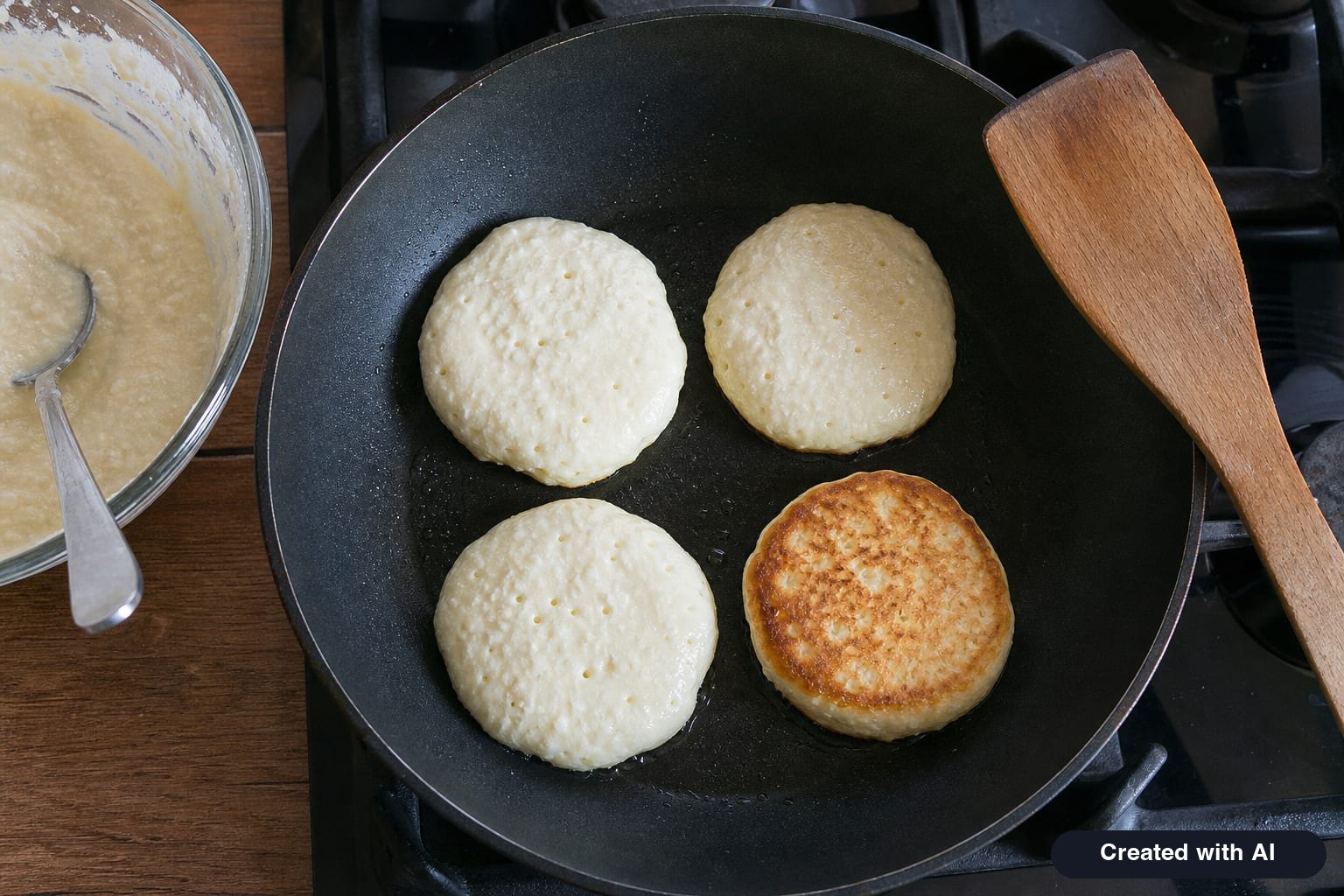
6. Cooking. For each pancake, drop 2 tablespoons of batter (about 2 oz / 60 g) and use the back of the spoon to gently spread it to a 3- to 3½-inch (8–9 cm) circle. A 10- to 11-inch (26–28 cm) skillet will fit 4 pancakes. Cover with a lid and cook for 2–3 minutes until the bottom is golden, the edges are matte, and holes appear on the surface. Flip and cook for another 2 minutes uncovered. The lid traps steam, helping the pancakes rise higher and cook all the way through.
7. Don't press. After flipping, do not press the pancake down with your spatula—you'll squeeze out the air and flatten it. Stack the cooked pancakes on a plate: this keeps them warm and soft longer. Add a drop of oil before each new batch.
Common mistakes
Pancakes are flat, don't rise. The batter was too thin, overmixed, or the baking powder is old. Fold in a tablespoon of flour, do not stir after resting, and test your baking powder: a pinch dropped in hot water should fizz immediately.
Dark outside, raw inside. The heat is too high or the pancakes are too thick. Reduce the heat to medium, cook with a lid, and use no more than 2 tablespoons of batter per pancake.
Tough, rubbery. Too much flour or the batter was beaten with a mixer. Soft kefir pancakes only come from batter that is mixed briefly and remains fairly moist.
Sticking to the pan. The pan isn't hot enough or the pancake was flipped too early. Wait until the bottom sets—then the spatula will slide under easily.
Greasy. Too much oil or the oil is too cold—the batter will soak it up like a sponge. Add oil sparingly, and if necessary, place cooked pancakes on a paper towel for a minute.
Pancakes with regular cottage cheese
Pancakes made with regular cottage cheese are prepared differently than those with farmer cheese: regular cottage cheese already contains its own liquid (the creamy dressing), so no kefir is needed at all, and much less flour is used. The curds don't completely melt during cooking, leaving soft, slightly chewy pockets of cheese inside the pancake.
Measurements for 8 pancakes (2 large or 4 small servings):
- 7 oz (200 g) cottage cheese (including the liquid dressing);
- 2 eggs;
- ½ cup (70 g) all-purpose flour;
- 1 tablespoon (12 g) sugar, or a pinch of salt for a savory version;
- ½ teaspoon baking powder;
- about 1 tablespoon oil for frying.
Mix the cottage cheese with the eggs and sugar, fold in the flour and baking powder, and let rest for 5–10 minutes. There's no need to mash the curds—if you want smoother pancakes, mash half the cheese with a fork and leave the rest whole. Cook over medium heat for 2–3 minutes per side, dropping a heaping tablespoon of batter for each. Regular cottage cheese pancakes are more delicate, so flip them with a wide spatula and only when the bottom has clearly set.
One such pancake has about 100 kcal and 5.6 g of protein. Cottage cheese dressing contains salt, so don't add extra for the sweet version. Savory cottage cheese pancakes are excellent with dill, scallions, and a dollop of sour cream.
Zucchini and farmer cheese pancakes
Zucchini and farmer cheese pancakes are a savory, more filling option for lunch or dinner. The cheese replaces some of the flour, making the pancakes softer and less watery than those made entirely of zucchini.
Measurements for 12 pancakes:
- 14 oz (400 g) zucchini (one medium);
- 7 oz (200 g) farmer cheese;
- 2 eggs;
- ⅔ cup (80 g) all-purpose flour;
- ½ teaspoon salt;
- a handful of chopped dill, 1 clove of garlic, a pinch of black pepper;
- about 2 tablespoons oil for frying.
Grate the zucchini on the large holes of a box grater, sprinkle with half the salt, and let sit for 10 minutes. Then, squeeze it out firmly by hand or through a clean kitchen towel. This is the most important step: un-squeezed zucchini will release water in the pan, causing the pancakes to steam and fall apart rather than fry. Mix the squeezed zucchini with the mashed farmer cheese, eggs, dill, minced garlic, remaining salt, and flour. Do not let this batter rest—cook it immediately, as the zucchini will continue to release juices. Drop a heaping tablespoon per pancake, spread to about ⅜ inch (1 cm) thick, and cook over medium heat for 3–4 minutes per side.
One zucchini and cheese pancake has about 80 kcal. Serve with sour cream or a yogurt-garlic sauce. We cover other savory combinations—with potatoes, spinach, or cheese—in apple cottage cheese pancakes and other add-ins.
Other variations: banana, apple, flourless, baked
Banana kefir pancakes. Mash one ripe banana (about 4.2 oz / 120 g peeled) with a fork and mix it into the cheese and egg mixture. Omit the sugar, and use ½ cup (125 ml) of kefir instead of ⅔ cup (150 ml), as the banana thins the batter. Banana pancakes brown faster, so cook them over slightly lower heat. One pancake is about 112 kcal, the same as the main recipe, just without added sugar. For a thicker, higher-protein version, see the healthy banana syrniki recipe.
Apple kefir pancakes. Grate one large apple (about 5.3 oz / 150 g peeled) on the large holes of a box grater and fold it into the prepared batter along with a pinch of cinnamon. A tart baking apple like Granny Smith works best—it balances the mildness of the cheese. One pancake will have about 119 kcal.
Flourless kefir pancakes. All-purpose flour is replaced by ground rolled oats: 8.8 oz (250 g) farmer cheese, 2 eggs, ¾ cup (70 g) rolled oats ground in a blender, 3 tablespoons (50 ml) kefir, 1 tablespoon sugar, and ½ teaspoon baking powder. You must let the batter rest for 10–15 minutes so the oats can absorb the liquid. This yields 10 smaller pancakes at about 93 kcal each. You can also replace part of the flour with semolina: swap ⅓ cup (50 g) of the flour for ⅓ cup (50 g) of semolina (farina or Cream of Wheat) and let the batter rest for 20 minutes. For more ways to skip wheat flour and eggs, check out the flourless syrniki section.
Eggless. Skip the eggs, use ¾ cup plus 2 tbsp (200 ml) kefir, 1⅓ cups (170 g) flour, and replace the baking powder with ½ teaspoon of baking soda. The pancakes will be slightly denser and more delicate, so make them smaller.
With cream cheese or ricotta. Creamy cheeses are wetter than farmer cheese, so use only ⅓ cup plus 1 tbsp (100 ml) kefir. The batter will be completely smooth, without curds, and the pancakes will be exceptionally soft.
Baked kefir pancakes. Make the batter thicker—use only ⅓ cup plus 1 tbsp (100 ml) kefir. Line a baking sheet with parchment paper, drop the batter by the spoonful leaving 1¼ inches (3 cm) of space between them, and bake in a 375°F (190°C) oven for 10 minutes. Then flip and bake for another 5–7 minutes. No oil is needed, so one pancake has about 92 kcal. You can also bake pumpkin and farmer cheese pancakes: fold ⅔ cup (150 g) of thick pumpkin purée into the batter and use only 3 tablespoons (50 ml) of kefir. The stovetop pumpkin pancakes recipe is covered separately, and more on baking without a skillet can be found in the baked syrniki section.
In an aebleskiver pan. A pan with round wells (an aebleskiver or pancake puff pan) works very well: put a spoonful of batter in each well, and all the pancakes will come out the same size and taller, since the batter has nowhere to spread.
For kids. Cook smaller pancakes for children (1 tablespoon of batter each) and over lower heat so the crust remains soft. For sweetness, a mashed banana works well instead of sugar, and you can omit the salt entirely. Always consult your pediatrician regarding when and what foods to introduce to babies.
| Variation | What changes | Yield | Kcal per pancake |
|---|---|---|---|
| Fluffy with kefir (main) | 8.8 oz (250 g) farmer cheese, ⅔ cup (150 ml) kefir, 1¼ cups (150 g) flour | 12 | about 112 |
| Regular cottage cheese | 7 oz (200 g) cottage cheese, no kefir, ½ cup (70 g) flour | 8 | about 100 |
| Zucchini and cheese | 14 oz (400 g) zucchini, 7 oz (200 g) farmer cheese, ⅔ cup (80 g) flour, no sugar | 12 | about 80 |
| With bananas | +1 banana, no sugar, ½ cup (125 ml) kefir | 12 | about 112 |
| With apples | +5.3 oz (150 g) grated apple | 12 | about 119 |
| Flourless | ¾ cup (70 g) ground rolled oats, 3 tbsp (50 ml) kefir | 10 | about 93 |
| Baked in oven | ⅓ cup plus 1 tbsp (100 ml) kefir, no oil | 12 | about 92 |
Lighter version
Cottage cheese kefir pancakes aren't a heavy dish to begin with, but if you want them healthier, here is exactly how much each substitution changes things, calculated for one of the 12 pancakes:
| Change | How | kcal / pancake | Difference |
|---|---|---|---|
| Main recipe | as written above | 112 | – |
| Less oil | 2 tsp (10 g) oil instead of 2 tbsp (25 g) – cook in a non-stick pan | 101 | −11 |
| Baked without oil | bake on parchment paper in a 375°F (190°C) oven, use ⅓ cup plus 1 tbsp (100 ml) kefir | 92 | −20 |
| No sugar | batter without sugar – sweetness comes from berries or sauce | 104 | −8 |
| Low-fat farmer cheese | 8.8 oz (250 g) low-fat farmer cheese instead of whole-milk | 107 | −5 |
| Whole wheat flour | 1¼ cups (150 g) whole wheat flour instead of all-purpose | 108 | −4 |
| Banana instead of sugar | 1 mashed banana (4.2 oz / 120 g), no sugar, ½ cup (125 ml) kefir | 112 | 0 |
Calculated with the Firmus Medicus calorie database, with the recipe divided into 12 pancakes.
The biggest factor isn't the cheese, but the oil: cooking in a non-stick pan with 2 teaspoons (10 g) of oil instead of 2 tablespoons (25 g) drops the calories to about 101 kcal instead of 112, and baking in the oven with no oil at all brings it down to about 92 kcal. Skipping the sugar saves about 8 kcal, and using low-fat farmer cheese cuts about 5 kcal. Whole wheat flour barely changes the calories (about 108 kcal)—its benefit is fiber, not a lower number. Using a banana instead of sugar also doesn't reduce calories, it just replaces added sugar with fruit sweetness. Combining three changes—low-fat cheese, no sugar, and less oil—brings each pancake down to about 88 kcal, which is a fifth lighter than the main recipe.
How many calories are in cottage cheese kefir pancakes
One kefir pancake (about 2 oz / 60 g of batter) has about 112 kcal, 5.3 g of protein, 4.2 g of fat, and 13 g of carbohydrates, of which 3.3 g are sugars. A serving of three pancakes is about 337 kcal and 16 g of protein. Most of the calories come from the flour, followed by the cheese and oil. Below is exactly how much each ingredient adds.
| Ingredient | Amount | kcal, whole recipe | Share |
|---|---|---|---|
| White wheat flour | 150 g | 546 | 41 % |
| Cottage cheese | 250 g | 245 | 18 % |
| Canola oil | 25 g | 221 | 16 % |
| Egg | 120 g | 172 | 13 % |
| Granulated sugar | 25 g | 97 | 7 % |
| Kefir, low-fat | 155 g | 67 | 5 % |
| Table salt | 1 g | 0 | 0 % |
| Total | 726 g | 1348 | 112 kcal / pancake |
Ingredient values – Firmus Medicus calorie database.
Don't forget the toppings: a tablespoon of sour cream (20 g) adds about 40 kcal, the same amount of Greek yogurt adds about 19 kcal, and jam adds about 56 kcal. The calories of one pancake are almost the same as one syrnik, except the pancake has more flour, while the syrnik has more cheese and protein.
What to serve with, how to store and freeze
Sweet kefir pancakes are best served warm—with sour cream, plain yogurt, jam, fresh or thawed berries, or honey. For savory ones (made without sugar and vanilla, and with an extra pinch of salt), serve them with sour cream and herbs, or with smoked salmon, dill, and a dollop of cream cheese for a hearty weekend breakfast.
Cooked pancakes can be stored in an airtight container in the fridge for 2 days. Reheat them in a skillet covered with a lid over low heat for 2–3 minutes, or in a 325°F (160°C) oven for 8–10 minutes—microwaving makes them soft but they lose their crust. It's not worth making the batter the night before: the baking powder will lose its potency overnight. If you want to save time in the morning, mix everything except the flour and baking powder the night before and keep it in the fridge.
You can also freeze the pancakes. Once completely cooled, arrange them in a single layer on a cutting board, freeze until solid, and then transfer them to a bag—this prevents them from sticking together. Store in the freezer for up to 2 months, and reheat without thawing: in a 350°F (180°C) oven for about 10 minutes or in a covered skillet.
If you still have farmer cheese left, try classic pan-fried syrniki, delicate lazy vareniki (boiled cottage cheese dumplings), or a cottage cheese casserole that doesn't require standing by the stove. And if you want to avoid frying in hot oil as much as possible, see how to make air fryer syrniki.
Frequently asked questions
How are cottage cheese kefir pancakes different from syrniki?
Kefir pancake batter is thinner: it uses kefir, is dropped by the spoonful, and spreads in the pan. Syrniki dough is thick, liquid-free, shaped by hand, and rolled in flour, making them thicker with a stronger cheese flavor.
How do I make fluffy cottage cheese kefir pancakes?
Mix 8.8 oz (250 g) farmer cheese with 2 eggs, ⅔ cup (150 ml) kefir, 1¼ cups (150 g) flour, and 1 tsp baking powder. Mix briefly and let rest for 10 minutes. Cook covered over medium heat for 2–3 minutes, flip, and cook 2 more minutes without pressing.
How do I make pancakes with regular cottage cheese?
Mix 7 oz (200 g) cottage cheese (with its liquid) with 2 eggs, ½ cup (70 g) flour, 1 tbsp sugar, and ½ tsp baking powder—no kefir needed. Yields 8 pancakes at about 100 kcal each; cook 2–3 minutes per side.
How do I make zucchini cottage cheese pancakes?
Salt 14 oz (400 g) grated zucchini, squeeze out the liquid after 10 minutes, and mix with 7 oz (200 g) farmer cheese, 2 eggs, ⅔ cup (80 g) flour, dill, and garlic. Cook immediately for 3–4 minutes per side; yields 12 pancakes at about 80 kcal each.
Why are my cottage cheese kefir pancakes flat or tough?
Flat pancakes result from batter that is too thin, overmixed, or made with old baking powder. Tough, rubbery pancakes happen when there is too much flour or the batter is beaten with a mixer. For soft pancakes, mix briefly and cook covered.
Can I make cottage cheese kefir pancakes without flour?
Yes. Replace the flour with ¾ cup (70 g) ground rolled oats, use 3 tbsp (50 ml) kefir, and let the batter rest for 10–15 minutes so the oats absorb the liquid. Using 8.8 oz (250 g) farmer cheese yields 10 pancakes at about 93 kcal each.
How many calories are in cottage cheese kefir pancakes?
One pancake has about 112 kcal and 5.3 g of protein; a three-pancake serving is about 337 kcal. A tablespoon of sour cream adds about 40 kcal. With low-fat farmer cheese, no sugar, and less oil, one pancake has about 88 kcal.
Are cottage cheese kefir pancakes good for breakfast, and can I prep them ahead?
Yes—from mixing to the plate takes about 35 minutes. You can mix everything except the flour and baking powder the night before. Cooked pancakes keep in the fridge for 2 days or in the freezer for up to 2 months.
Log in to comment
No comments yet. Be the first.