Baked Syrniki: Fluffy Oven-Baked Cottage Cheese Pancakes
- Farina and a 15-minute resting time keep the inside perfectly soft
- Bake at 375°F (190°C) for 25 minutes, flipping halfway through
- Includes lazy, flourless, old-fashioned sour cream, and kid-friendly versions
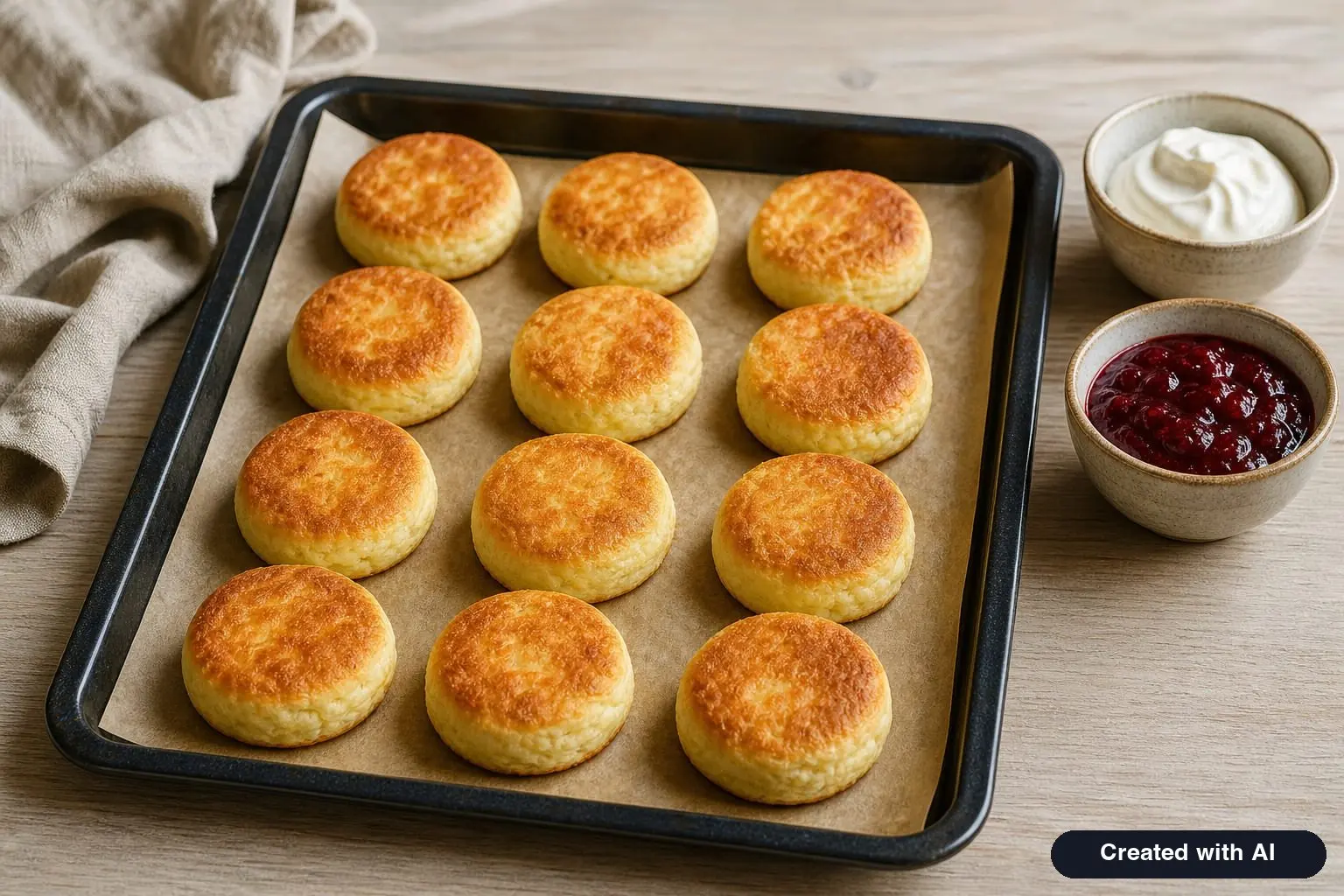
Baked syrniki are the same familiar Eastern European cottage cheese pancakes, just without standing by the stove or dealing with oil splatters. All twelve pancakes go onto a single sheet pan, bake at the same time, and arrive at the table warm together, rather than in batches from a skillet. You only need enough fat to brush the tops, making these oven-baked syrniki lighter and keeping your kitchen free of fried oil smells.
The taste and texture are slightly different from the pan-fried version. The crust is thinner and less crispy, but the inside is soft, moist, and almost like a mini cheesecake. To ensure your baked syrniki turn out fluffy rather than dry and rubbery, three things are key: dry, well-mashed farmer cheese (or dry-curd cottage cheese), semolina (farina or Cream of Wheat works) to absorb and hold moisture, and a sufficiently hot oven. We'll cover each of these below.
This recipe is perfect for breakfast, kids' lunchboxes, or a light dinner, and it's easy to make even on your first try. The dough comes together in one bowl without a mixer. The listed amounts yield 12 medium pancakes—enough for 4 servings of three. Expect about 15 minutes of hands-on prep, 15 minutes for the dough to rest, and 25 minutes of baking time.
Below, you'll find the complete baked syrniki recipe card. You can adjust the quantities for a different yield, check off ingredients as you go, and print it out. After the card, each step is explained in more detail.
Baked Syrniki
No ratings yet – be the firstIngredients
For the dough
For shaping and baking
Directions
- Cheese. Mash the farmer cheese with a fork or press it through a sieve until no large lumps remain. If the cheese is wet (or you're using regular cottage cheese), squeeze and press it dry in cheesecloth first.
- Dough. Crack in the egg, add the sugar, vanilla sugar, and salt, and mix well. Stir in the farina and ⅓ cup (50 g) of flour mixed with the baking powder. Mix just until no dry flour remains.
- Resting. Cover the dough and let it rest for 15 minutes so the farina swells and the dough thickens. Preheat the oven to 375°F (190°C) or 350°F (175°C) convection, and line a baking sheet with parchment paper.
- Shaping. With floured hands, divide the dough into 12 portions. Roll them into balls and flatten into patties about 2.5 inches (6 cm) wide and ¾ inch (2 cm) thick.
- Baking Sheet. Place the syrniki on the baking sheet, leaving 1 to 1.5 inches (3–4 cm) of space between them. Brush off any excess flour and brush the tops with half of the melted butter.
- Baking. Bake in the middle of the oven for 15 minutes. Flip them with a spatula, brush with the remaining butter, and bake for another 8–10 minutes until both sides are golden.
- Resting. Leave the baked syrniki on the pan for 5 minutes to firm up, then serve warm with sour cream, jam, or fresh berries.
- Calories
- 102 kcal
- Protein
- 6.1 g
- Fat
- 3.6 g
- of which saturated
- 1.7 g
- Carbohydrates
- 11 g
- of which sugars
- 4.5 g
- Fiber
- 0.3 g
Calculated with the Firmus Medicus calorie database (USDA, Fineli).
Ingredients and How to Choose Them
The cheese determines almost everything. Syrniki are made from dry curd cheese (tvorog), so in the US buy farmer cheese or dry-curd cottage cheese, ideally whole-milk; Eastern European delis also sell it as tvorog. Low-fat works too, though the pancakes will be slightly drier. Regular, creamy cottage cheese straight from the tub is too wet for this recipe: the dough soaks up too much flour and the pancakes come out tough. If that's all you can find – or if you see whey in the package – wrap the cheese in cheesecloth or a clean towel, squeeze and press out as much liquid as you can, then press it through a sieve. Moisture doesn't evaporate as quickly in the oven as it does in a skillet, so a wet dough will simply spread out into flat blobs.
Farina and flour. We use both in the dough: 2 tablespoons (30 g) of farina and ⅓ cup (50 g) of all-purpose flour. As the farina swells, it absorbs the cheese's moisture and retains it during baking, keeping the inside soft. The flour provides structure so the pancake holds its shape without the walls of a skillet. You'll need an additional 2½ tablespoons (20 g) of flour for dusting your hands and the board. If you want to bake using only farina, see the variations section.
Egg. One egg is enough for 2¼ cups (500 g) of cheese. A second egg makes the dough too wet, forcing you to add more flour, which masks the cheese flavor. If your egg is extra-large and the cheese is on the wetter side, use only the yolk.
Sugar and vanilla. 3 tablespoons (40 g) of sugar isn't much, because syrniki are usually served with jam, honey, or sweetened sour cream. Adding more sugar to the dough doesn't just make it sweeter; it also makes it wetter, as sugar draws moisture out of the cheese. Vanilla sugar (or 1 teaspoon of vanilla extract) adds an aroma, which baked syrniki need since they lack the scent of browned butter from a skillet.
Baking powder. Half a teaspoon helps the pancakes rise slightly. You don't need this in a skillet, but the oven's heat is slower, so a little lift helps. Don't add more, or the pancakes will puff up too much and then collapse and crack as they cool.
Butter. This isn't for the dough, but for the surface. Brushing the pancakes with melted butter helps them brown beautifully; without it, they remain pale with a dry, floury exterior.
How to Bake Syrniki Step by Step
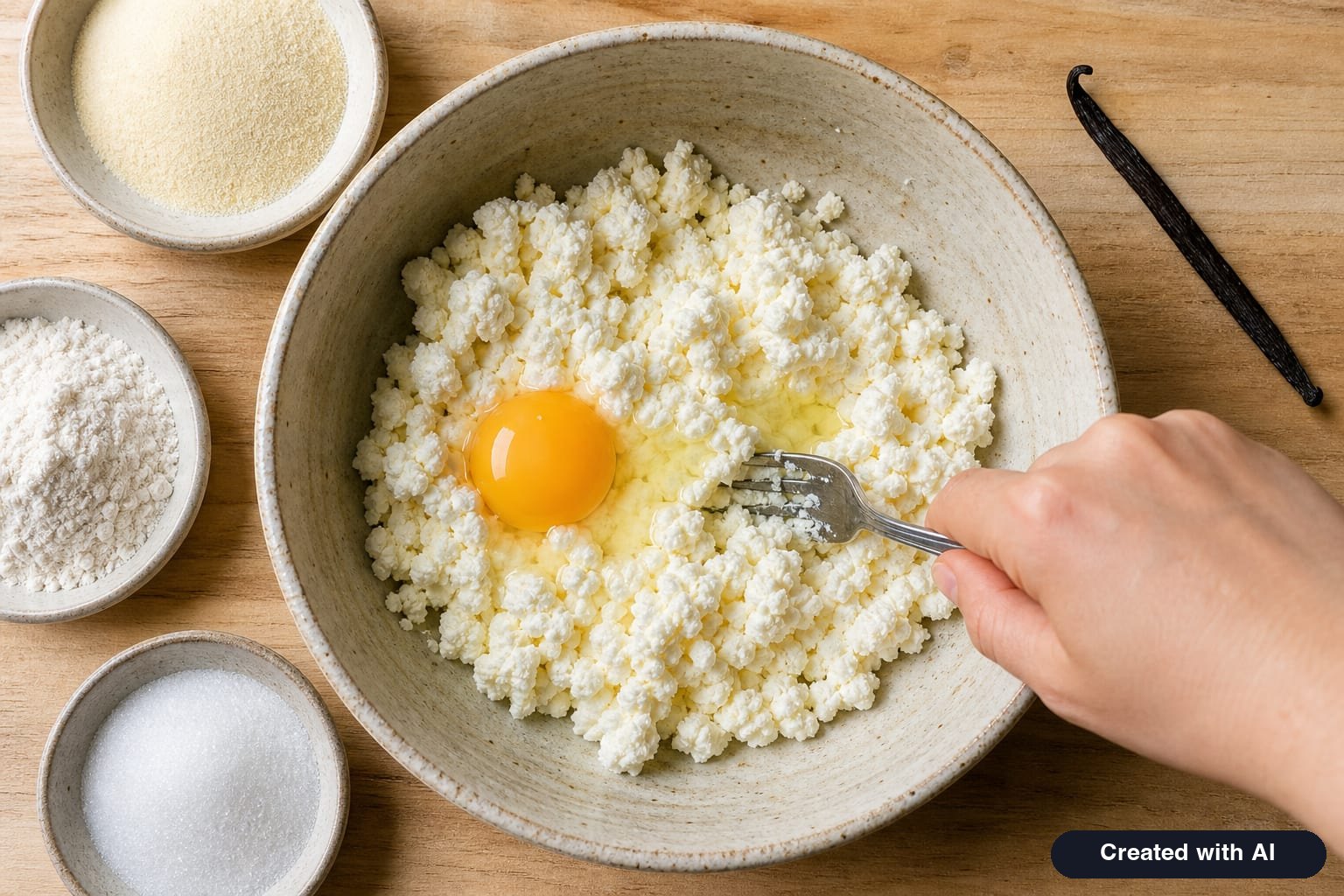
1. Mash the cheese. Place the farmer cheese in a bowl and mash it thoroughly with a fork or press it through a sieve. The smoother it is, the more even and soft your pancakes will be: large lumps don't bind well in the dough, forcing you to add more flour. Avoid using a blender or food processor, as it will turn the cheese into a cream and make the dough too runny.
2. Mix the dough. Crack the egg into the cheese, add the sugar, vanilla, and a pinch of salt, and mix well. Then stir in the farina and ⅓ cup (50 g) of flour mixed with the baking powder. Stir with a spoon just until no dry flour remains. The dough should be soft and slightly sticky, but hold its shape when scooped. Don't overmix, or the gluten will develop and make the pancakes tough.
3. Let it rest for 15 minutes. Cover the bowl and leave it at room temperature. During this time, the farina swells and the dough noticeably thickens—what seemed too wet becomes easy to shape. Don't skip this step: if you shape them immediately, you'll be tempted to add more flour, and farina that hasn't swelled will leave the baked pancakes grainy. Meanwhile, preheat your oven to 375°F (190°C) or 350°F (175°C) for convection, and line a baking sheet with parchment paper.
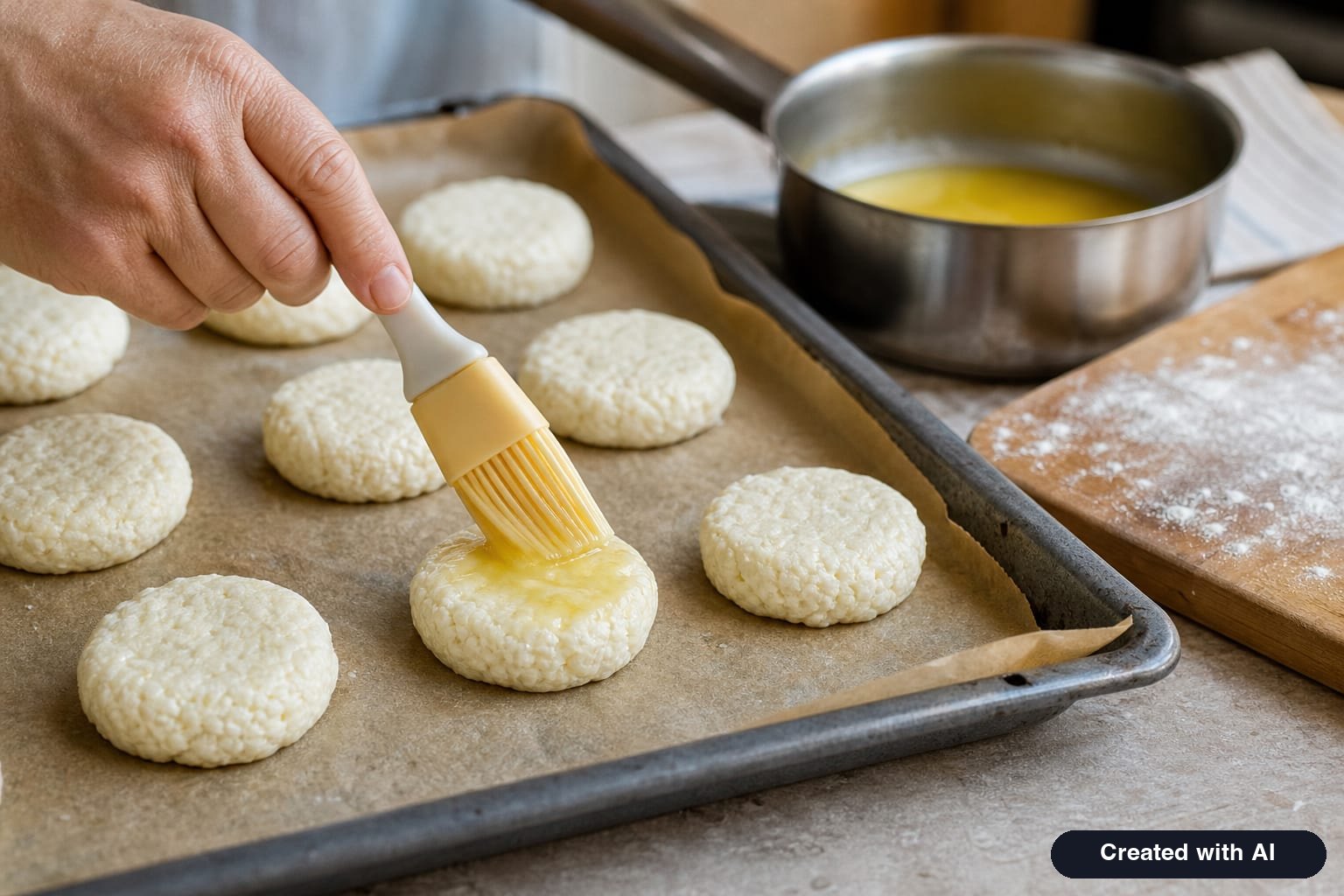
4. Shape the pancakes. Dust a cutting board and your hands with flour. Divide the dough into 12 portions (each weighing about 2 oz or 58 g—roughly a heaping tablespoon). Roll them into balls and flatten them with your palm into patties about 2.5 inches (6 cm) wide and ¾ inch (2 cm) thick. Thickness matters: anything thinner than ½ inch (1.5 cm) will dry out before browning, while anything thicker than 1 inch (2.5 cm) will remain raw inside. Smooth the edges with the side of a knife or your fingers—smooth edges won't crack during baking.
5. Arrange on the pan and brush with butter. Place the syrniki on the baking sheet, leaving 1 to 1.5 inches (3–4 cm) of space between them. Brush the tops with half of the melted butter. Before brushing, wipe off any excess flour with a pastry brush: in the oven, raw flour won't absorb into the dough and will leave white powdery spots.
6. Bake for 15 minutes, then flip. Place the pan in the middle of the oven. After 15 minutes, the bottoms should be set and light golden. Use a spatula to flip each pancake, brush the new tops with the remaining butter, and bake for another 8–10 minutes. Flipping is worth the effort because the side touching the pan browns the most; unflipped pancakes will be golden on the bottom but pale on top.
7. Check for doneness and let rest. Fully baked syrniki will be puffed up and golden on both sides. If you press the side with your finger, it should spring back and no longer feel wet. Once out of the oven, leave them on the pan for 5 minutes. When piping hot, they are very fragile and might break if moved, but they firm up as they cool slightly. It's completely normal for them to deflate a little as they cool—all farmer cheese bakes do this.
Baking Times by Size
Baking time depends on the thickness of the pancakes, not how many are on the pan. The table below provides estimated times at 375°F (190°C) or 350°F (175°C) convection.
| Size and shape | Dough per piece | Yield from recipe | Baking time |
|---|---|---|---|
| Small mini syrniki (1.5 inches / 4 cm wide, ½ inch / 1.5 cm thick) | about 1 oz (30 g) | 22–24 pcs. | 10 min. + flip + 5–6 min. |
| Medium (2.5 inches / 6 cm wide, ¾ inch / 2 cm thick) | about 2 oz (58 g) | 12 pcs. | 15 min. + flip + 8–10 min. |
| Large (3 inches / 8 cm wide, 1 inch / 2.5 cm thick) | about 3 oz (85 g) | 8 pcs. | 18 min. + flip + 10–12 min. |
| Lazy – dropped by spoon, unshaped | heaping tablespoon | 12–14 pcs. | 20–22 min., no flipping |
| Frozen, unthawed | about 2 oz (58 g) | 12 pcs. | 18 min. + flip + 12–14 min. |
Common Mistakes When Baking Syrniki
They spread into flat blobs. The cheese was too wet or the dough didn't rest. Next time, squeeze the moisture out of the cheese. If the dough still slides off the spoon after 15 minutes, stir in another tablespoon of farina and wait 10 more minutes. Add extra flour only as a last resort.
Tough and rubbery. Too much flour or overbaked. Syrniki dry out faster in the oven than you might think: 5 extra minutes can turn a soft center dry. Stick to the times in the table and check the sides with your finger rather than waiting for a dark crust.
Pale, even when fully baked. You skipped the butter wash or the oven temperature was too low. At 320–340°F (160–170°C), syrniki will dry out before they brown. If your oven runs cool, turn on the broiler for the last 2–3 minutes and watch them closely.
Cracked and collapsed. Too much baking powder or an oven that's too hot (over 400°F / 200°C). The surface sets while the inside is still expanding, causing them to tear.
Stuck to the pan. Baked on foil or an unlined pan. Always use parchment paper or a silicone baking mat, and don't try to flip them before the 15-minute mark—the bottoms need time to set.
If your syrniki fall apart while you're shaping them, the reasons are the same as when pan-frying. We cover these in detail in our main cottage cheese pancakes recipe.
Variations: Lazy, Flourless, Apple, and More
Lazy baked syrniki. These are pancakes you don't have to shape by hand. Make a slightly softer dough—use 3 tablespoons (30 g) of flour instead of ⅓ cup (50 g)—and after the 15-minute rest, use two spoons to drop mounds directly onto the parchment paper. Brush the tops with butter or a teaspoon of sour cream and bake for 20–22 minutes without flipping. They will have an irregular shape but will be softer than the shaped ones because there's less flour in the dough. For a neater look, you can bake them in a muffin tin, a method we describe in our air fryer syrniki guide.
Flourless baked syrniki. Replace the flour in the dough with farina: use a total of ½ cup (80 g) of farina and no flour, and shape them with wet hands or roll them in extra farina. Let the dough rest for 25–30 minutes, as there's more farina and it needs time to swell. These pancakes turn out very delicate and slightly grainy, with about 96 calories each. For gluten-free options using cornstarch, oat, or rice flour, check out our separate flourless cottage cheese pancakes recipe.
Old-fashioned baked syrniki with sour cream. In the old days, syrniki were often not just baked but also braised in sour cream. Bake the shaped pancakes for 15 minutes, flip them, and arrange them closely in a buttered baking dish. Top each one with a teaspoon of sour cream mixed with a little sugar (about ½ cup / 120 g of sour cream and 1 tablespoon / 15 g of sugar in total), and bake for another 10–12 minutes. The sour cream partially absorbs into the pancakes and partially thickens into a creamy glaze, leaving the syrniki incredibly soft. Read about Soviet-era canteen and vintage proportions in our old-fashioned syrniki section.
With apples. Fold one coarsely grated and well-squeezed apple (about 5 oz / 150 g) and a pinch of cinnamon into the dough. One pancake will then have about 108 calories. For more add-ins like raisins, berries, or pumpkin, see our apple cottage cheese pancakes recipe.
With bananas. Instead of sugar, mash in one ripe banana (about 3.5 oz / 100 g) and add an extra tablespoon of farina, as the banana adds moisture. Find the full sugar-free recipe in our healthy banana cottage cheese pancakes guide.
Mini syrniki for kids. It's often easier to bake bite-sized mini pancakes for children. They bake in just 15–16 minutes, are easy for little fingers to grab, and are perfect for lunchboxes. You can cut the sugar in half and add natural sweetness with mashed berries or a banana. Baked syrniki are especially kid-friendly because they aren't greasy and don't have a tough crust.
Savory syrniki. Omit the sugar and vanilla, add ½ teaspoon of salt, and fold in ½ cup (50 g) of grated cheese (like Gouda or Cheddar) along with chopped dill or scallions. Bake as directed and serve with sour cream or a yogurt sauce. We cover variations with potatoes, zucchini, or ham in our add-ins section.
Keto baked syrniki. For a low-carb diet, replace the flour and farina with almond or coconut flour, and swap the sugar for a sweetener. The dough proportions are different, so you'll find them in our flourless recipe.
Healthy Baked Syrniki: A Lighter Version
Baking in the oven is inherently lighter since you don't need a pan full of oil—the entire recipe uses only 1.5 tablespoons (20 g) of butter. If you want to make them even lighter, here is how common substitutions affect the calorie count per pancake:
| Change | How | kcal / pancake | Difference |
|---|---|---|---|
| Main recipe | as written above | 102 | – |
| With low-fat cheese | 2¼ cups (500 g) low-fat farmer cheese instead of whole-milk | 91 | −11 |
| Half the sugar | 1.5 tbsp (20 g) sugar instead of 3 tbsp (40 g) | 95 | −7 |
| No butter | tops are not brushed or brushed with a tablespoon of yogurt | 90 | −12 |
| With rolled oats | ⅔ cup (60 g) quick oats instead of flour and farina in the dough | 97 | −5 |
| Lightest version | low-fat cheese, 1.5 tbsp (20 g) sugar, no butter | 73 | −29 |
| With sour cream glaze | + ½ cup (120 g) sour cream and 1 tbsp (15 g) sugar on top (old-fashioned version) | 127 | +25 |
Calculated with the Firmus Medicus calorie database, with the recipe divided into 12 pancakes.
Individually, two changes make the biggest difference: using low-fat farmer cheese instead of whole-milk (about 91 calories instead of 102) and baking without butter (about 90 calories). Halving the sugar saves about 6–7 calories, and swapping the flour and farina for quick oats saves about 5 calories while adding fiber. If you combine low-fat cheese, 1.5 tablespoons (20 g) of sugar, and skip the butter, each pancake drops to about 73 calories—nearly a third less than the main recipe—while actually slightly increasing the protein (6.6 g). Keep in mind that without butter, the surface will be paler and drier; you can brush them with a spoonful of yogurt instead. Conversely, adding a sour cream glaze adds about 25 calories per pancake.
How Many Calories Are in Baked Syrniki?
One baked syrnik (about 2 oz / 59 g) has about 102 calories, 6 g of protein, 3.6 g of fat, and 11 g of carbohydrates. A serving of three pancakes is about 305 calories and 18 g of protein, without toppings. The cheese accounts for about 40% of the calories, the flour for about a fifth, and the butter wash adds roughly 12 calories per pancake. A tablespoon of sour cream (25 g) adds about 50 calories to your serving, and a tablespoon of jam (20 g) adds about 55 calories. Below is a breakdown of the calories from each ingredient.
| Ingredient | Amount | kcal, whole recipe | Share |
|---|---|---|---|
| Cottage cheese | 500 g | 490 | 40 % |
| White wheat flour | 50 g | 182 | 15 % |
| Granulated sugar | 40 g | 155 | 13 % |
| Butter | 20 g | 143 | 12 % |
| Semolina, dry | 30 g | 108 | 9 % |
| White wheat flour | 20 g | 73 | 6 % |
| Egg | 50 g | 72 | 6 % |
| Table salt | 1 g | 0 | 0 % |
| Total | 711 g | 1223 | 102 kcal / pancake |
Ingredient values – Firmus Medicus calorie database.
Serving, Storing, and Freezing
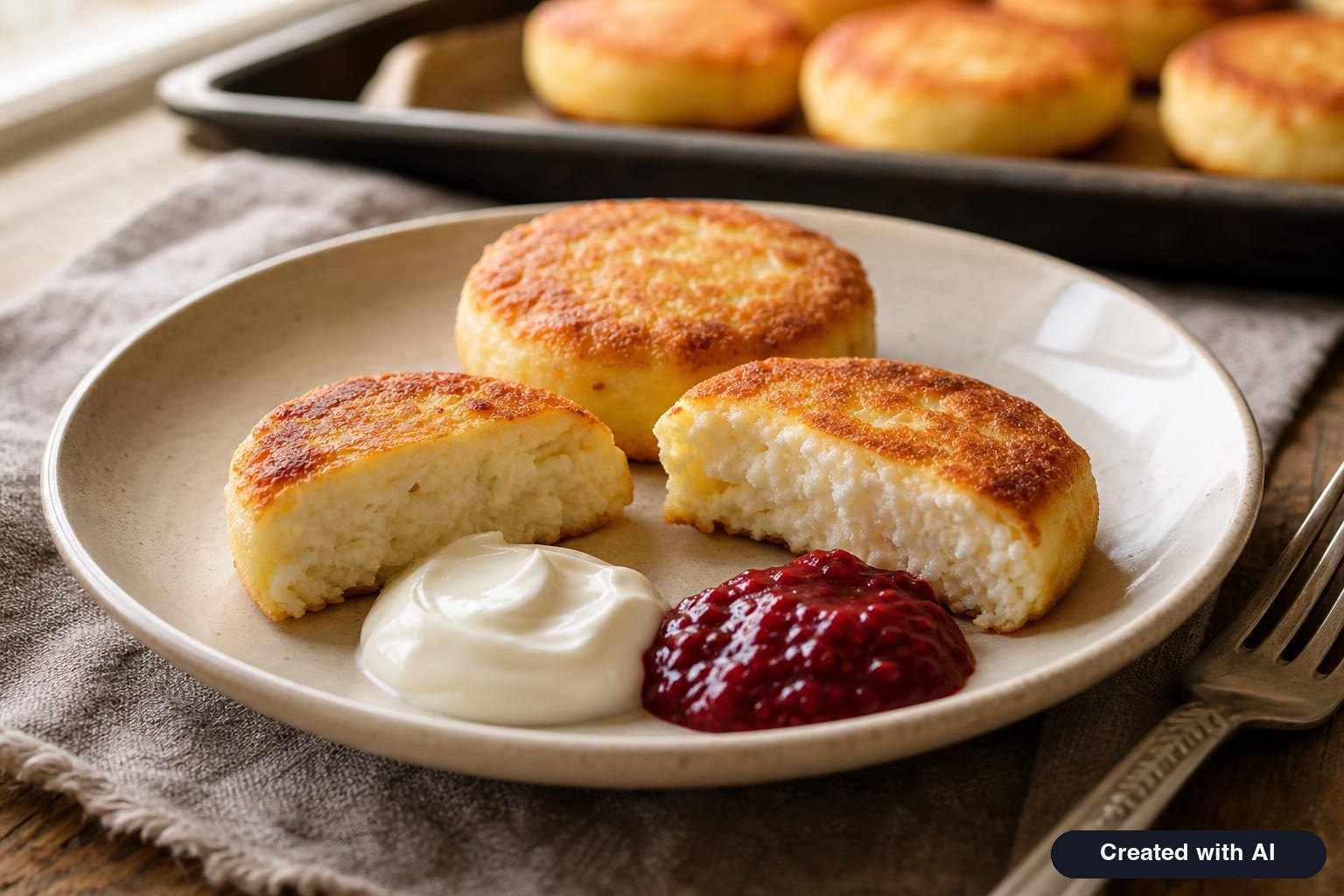
Baked syrniki are best served warm, about 5–10 minutes out of the oven. Classic toppings include sour cream, jam, honey, mashed berries with a little sugar, or plain yogurt. Because the crust is delicate, tart toppings work especially well: cranberry or lingonberry jam, fresh raspberries, or applesauce. For savory syrniki, try sour cream mixed with dill and garlic.
Store leftover cooled pancakes in an airtight container in the fridge for up to 3 days. The best way to reheat them is in a 325°F (160°C) oven for 6–8 minutes, or in a skillet over low heat with a little butter. The microwave will heat them quickly but can make them rubbery.
It's best to freeze them raw. Arrange the shaped pancakes on a flour-dusted board, freeze until solid, and then transfer them to a freezer bag—they will keep for up to 2 months. Bake them straight from the freezer: place on a baking sheet, brush with butter, and bake at 375°F (190°C) for about 30 minutes, flipping halfway through. You can also freeze fully baked syrniki, though they tend to be drier once thawed.
If you prefer a crispier crust, try making pan-fried syrniki—the main recipe of this guide, with a ratio chart for different amounts of cheese. For a no-bake option, check out boiled cottage cheese dumplings, and for a quicker small batch, try air fryer syrniki. When you have a lot of cheese and don't feel like shaping individual pancakes, you can bake the entire dough in one dish to make a cottage cheese casserole.
Frequently asked questions
How long and at what temperature do you bake syrniki?
Bake medium, ¾-inch (2 cm) thick syrniki at 375°F (190°C) or 350°F (175°C) convection for 15 minutes, flip, and bake another 8–10 minutes. Small ones take 15–16 minutes, large ones about 30 minutes.
How do you make fluffy baked syrniki?
Use dry, well-mashed farmer cheese, add 2 tablespoons (30 g) of farina, and let the dough rest for 15 minutes. Add ½ teaspoon of baking powder, shape into ¾-inch (2 cm) thick patties, and bake for no more than 25 minutes so they don't dry out.
Do you need to flip baked syrniki?
Yes. The side touching the pan browns more in the oven, so flipping them after 15 minutes ensures they turn golden on both sides. Drop-style "lazy" syrniki don't need flipping.
What are lazy baked syrniki?
These are syrniki you don't have to shape by hand. A softer dough (3 tablespoons/30 g of flour instead of ⅓ cup/50 g) is dropped directly onto parchment paper with a spoon and baked at 375°F (190°C) for 20–22 minutes without flipping.
Can you make flourless baked syrniki?
Yes. Replace the flour with farina—about ½ cup (80 g) for 2¼ cups (500 g) of cheese—and let the dough rest for 25–30 minutes. Shape with wet hands. One flourless pancake has about 96 calories.
How many calories are in baked syrniki?
One 2 oz (59 g) pancake from this recipe has about 102 calories and 6 g of protein. A serving of three is about 305 calories without toppings. Using low-fat cheese, half the sugar, and no butter drops it to 73 calories each.
Are baked syrniki good for kids?
Yes, they are soft, have no hard crust, and aren't soaked in oil. You can make bite-sized 1 oz (30 g) mini syrniki that bake in 15–16 minutes, and you can easily cut the sugar in half.
Can you freeze syrniki and bake them later?
Yes. Freeze the shaped, raw dough on a board, then store in a bag for up to 2 months. Bake straight from the freezer at 375°F (190°C) for about 30 minutes, flipping halfway through.
Log in to comment
No comments yet. Be the first.