Lazy Vareniki: Soft Boiled Cottage Cheese Dumplings Recipe
- Just 1 cup plus 3 tablespoons (150 g) of flour for 1 lb (500 g) of farmer cheese keeps the dumplings soft, not rubbery.
- A test dumpling shows if the dough will hold together before you boil the whole batch.
- Variations include semolina, cornstarch, flourless, savory, and mini dumplings for kids.
- Ingredients and how to choose them
- How to make lazy vareniki: step by step
- How long to boil lazy vareniki
- Ingredient ratios for ½ lb (250 g), 1 lb (500 g), and 2 lbs (1 kg) of farmer cheese
- Common mistakes
- Variations: with semolina, cornstarch, flourless, and more
- Lazy vareniki for kids
- A lighter version
- How many calories are in lazy vareniki
- What to serve with, how to store and freeze
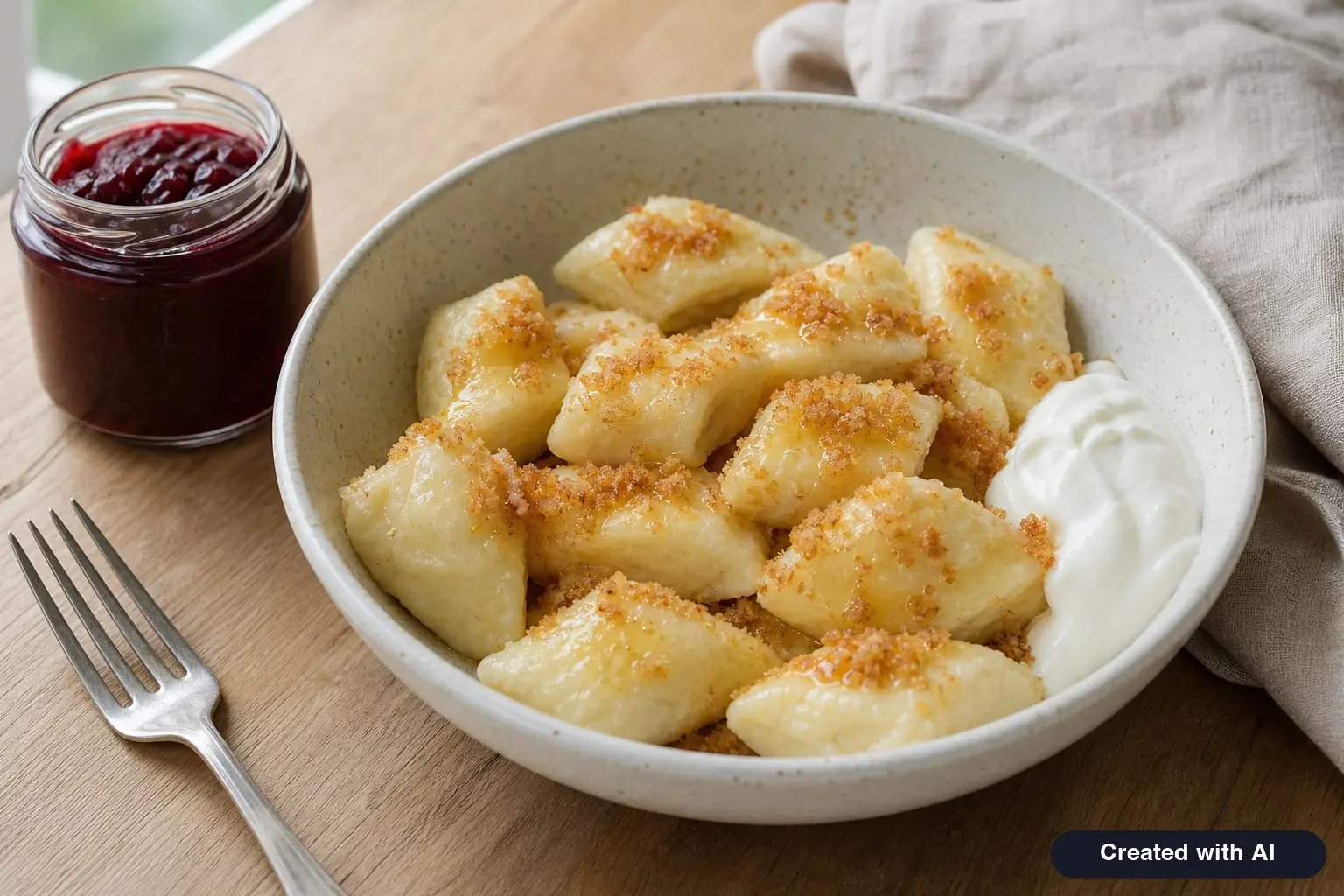
Lazy vareniki are dumplings made from a dough of farmer cheese (or dry-curd cottage cheese), eggs, and flour, cut into small pieces and boiled for a few minutes in salted water. In Eastern European kitchens, they are often called lazy vareniki or lazy pierogi because they offer the same comforting taste as traditional filled dumplings, but without the rolling, filling, and crimping. Unlike pan-fried cottage cheese pancakes (syrniki), the boiled ones have no crust: they are tender, moist, and slightly chewy, with all the richness coming from the sauce.
Good lazy vareniki should be soft but hold together in the pot. This depends on one thing: the amount of flour. Too much flour results in hard, rubbery pieces; too little turns into cheese mush in the water. This recipe uses just enough flour to bind the dough: 1 cup plus 3 tablespoons (150 g) for 1 lb (500 g) of farmer cheese, and the exact amount is verified by boiling one test dumpling. These dumplings come out fluffy, melt-in-your-mouth tender, and taste distinctly of cheese, not flour.
These are traditional homemade lazy vareniki with no gimmicks—a simple and fast dish: from opening the package of cheese to the plate takes about 25 minutes, with only 4–5 minutes of boiling. That makes lazy vareniki perfect for a weekday breakfast, a quick dinner for kids, or when you have leftover farmer cheese to use up. The stated amount makes 4 servings—about 40 small dumplings, 10 per person.
The full recipe is in the card below: you can adjust the quantities for a different number of servings, check off what you've added, and print it. Below the card, each step is explained in more detail, followed by variations with semolina, cornstarch, flourless, savory, and kid-friendly options.
Lazy Vareniki (Boiled Cottage Cheese Dumplings)
No ratings yet – be the firstIngredients
For the dough
For boiling
For serving
Directions
- Mashing the cheese. Press the farmer cheese through a fine-mesh sieve or mash it thoroughly with a fork until no large curds remain. If the cheese is wet, drain it in a sieve for 15–20 minutes beforehand.
- The dough. Crack the eggs into the cheese, add the sugar and a pinch of salt, and mix. Add 1 cup plus 3 tablespoons (150 g) of flour and mix just until absorbed—the dough should remain soft and slightly sticky.
- Rolling the logs. On a floured board, divide the dough into 4 parts and roll into logs about 1 inch (2.5 cm) thick. Flatten slightly and cut diagonally into ¾-inch (2 cm) pieces, placing them so they don't touch.
- The test dumpling. In a wide pot, bring 3 quarts (3 liters) of water to a boil with a teaspoon of salt and boil one piece. If it starts to fall apart, mix another 1–2 tablespoons of flour into the dough.
- Boiling. Reduce the heat so the water simmers gently. Boil the dumplings in batches of 12–15, stirring gently right away. Once they float to the surface, boil for another 2–3 minutes.
- Scooping out. Scoop them out with a slotted spoon into a bowl with a small piece of butter and shake gently so they don't stick together.
- The sauce. Melt the remaining butter in a skillet, add the breadcrumbs, and toast while stirring for 2–3 minutes until golden. Pour over the lazy vareniki and serve with cold sour cream.
- Calories
- 503 kcal
- Protein
- 23.2 g
- Fat
- 22.5 g
- of which saturated
- 11.2 g
- Carbohydrates
- 51.1 g
- of which sugars
- 12.5 g
- Fiber
- 1.5 g
Calculated with the Firmus Medicus calorie database (USDA, Fineli).
Ingredients and how to choose them
The cheese determines almost everything. Lazy vareniki are made from dry curd cheese (tvorog), so in the US buy farmer cheese or dry-curd cottage cheese, ideally whole-milk; Eastern European delis also sell it as tvorog. It's much drier and more crumbly than the regular cottage cheese sold in tubs. The wetter the cheese, the more flour it will demand, and more flour means tougher dumplings. Regular cottage cheese works only if you drain and press it: set it in a cheesecloth-lined sieve for 15–20 minutes, squeeze out the whey, then press it through the sieve. Do the same with farmer cheese if you see whey in the package. Low-fat farmer cheese also works, though the pieces will be slightly drier and tangier, while extra-rich, creamy cheese yields the softest but stickiest dough.
Eggs bind the dough: the egg white sets during boiling and keeps the pieces from falling apart. Two medium eggs are enough for 1 lb (500 g) of farmer cheese. A third egg would only thin the dough and force you to add more flour.
Flour. Regular all-purpose flour works perfectly. The dough takes 1 cup plus 3 tablespoons (150 g), and you'll need about 2½ tablespoons (20 g) more for dusting the board and your hands. This is a deliberately small amount—the dough remains soft and slightly sticky. If you're tempted to add more, boil a test piece first: usually, it turns out that extra flour isn't needed.
Sugar and salt. 2 tablespoons (30 g) of sugar give a barely noticeable sweetness—for a sweeter dish, jam or a sugar-dusted sauce will suffice. Don't add more sugar to the dough: as it dissolves, it thins the mixture. A pinch of salt in the dough and salt in the boiling water are essential even for the sweet version, otherwise the lazy vareniki will taste bland.
For the sauce, you need butter, breadcrumbs, and sour cream. Breadcrumbs toasted in butter are the traditional topping for lazy vareniki: they provide a crunch that the dumplings themselves lack. The sour cream is served cold, on the side or on top.
How to make lazy vareniki: step by step
1. Mashing the cheese. Press the farmer cheese through a fine-mesh sieve or mash it thoroughly with a fork until no large curds remain. This takes 3–4 minutes, but this step is what separates lumpy dumplings from smooth, silky ones. Skip the blender: it turns the cheese into a runny cream, and the dough will require much more flour.
2. The dough. Crack the eggs into the cheese, add the sugar and salt, and mix until smooth. Add 1 cup plus 3 tablespoons (150 g) of flour and mix with a spoon, finishing with your hands just until the flour is absorbed. Do not knead for long: the gluten in the flour strengthens with kneading, which will make the dumplings tough. The dough should be soft, slightly sticky to the fingers, but hold its shape.
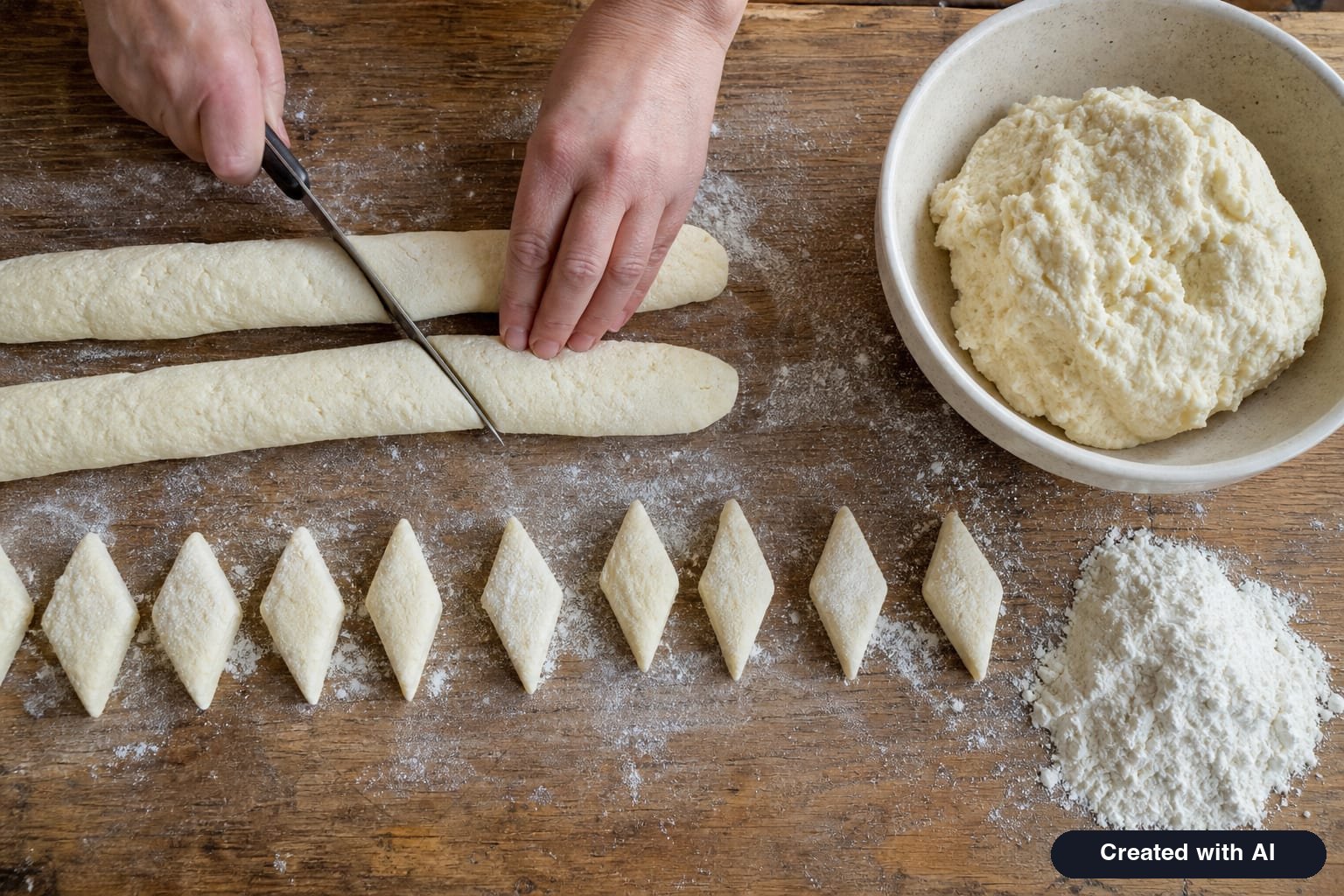
3. Rolling and cutting. Dust your table or cutting board with flour. Divide the dough into 4 parts, and with floured hands, roll each into a log about 1 inch (2.5 cm) thick. Flatten the log slightly with your palm and cut diagonally into ¾-inch (2 cm) wide pieces—you'll get diamond-shaped dumplings. Place the cut pieces on a floured board so they don't touch, as the soft dough sticks together quickly.
4. The test dumpling. In a wide pot, bring 3 quarts (3 liters) of water to a boil and add a teaspoon of salt. Drop in one piece. If it floats and stays intact, the dough is good. If the edges start to disintegrate, mix another 1–2 tablespoons of flour into the remaining dough. This test takes three minutes and prevents the only major failure—a whole batch falling apart.
5. Boiling. Reduce the heat so the water is just at a gentle simmer: vigorously boiling water will batter the soft pieces and tear their surface. Add the dumplings in batches, about 12–15 at a time, and immediately stir gently with a wooden spoon so they don't stick to the bottom. Once they float to the surface, boil for another 2–3 minutes.
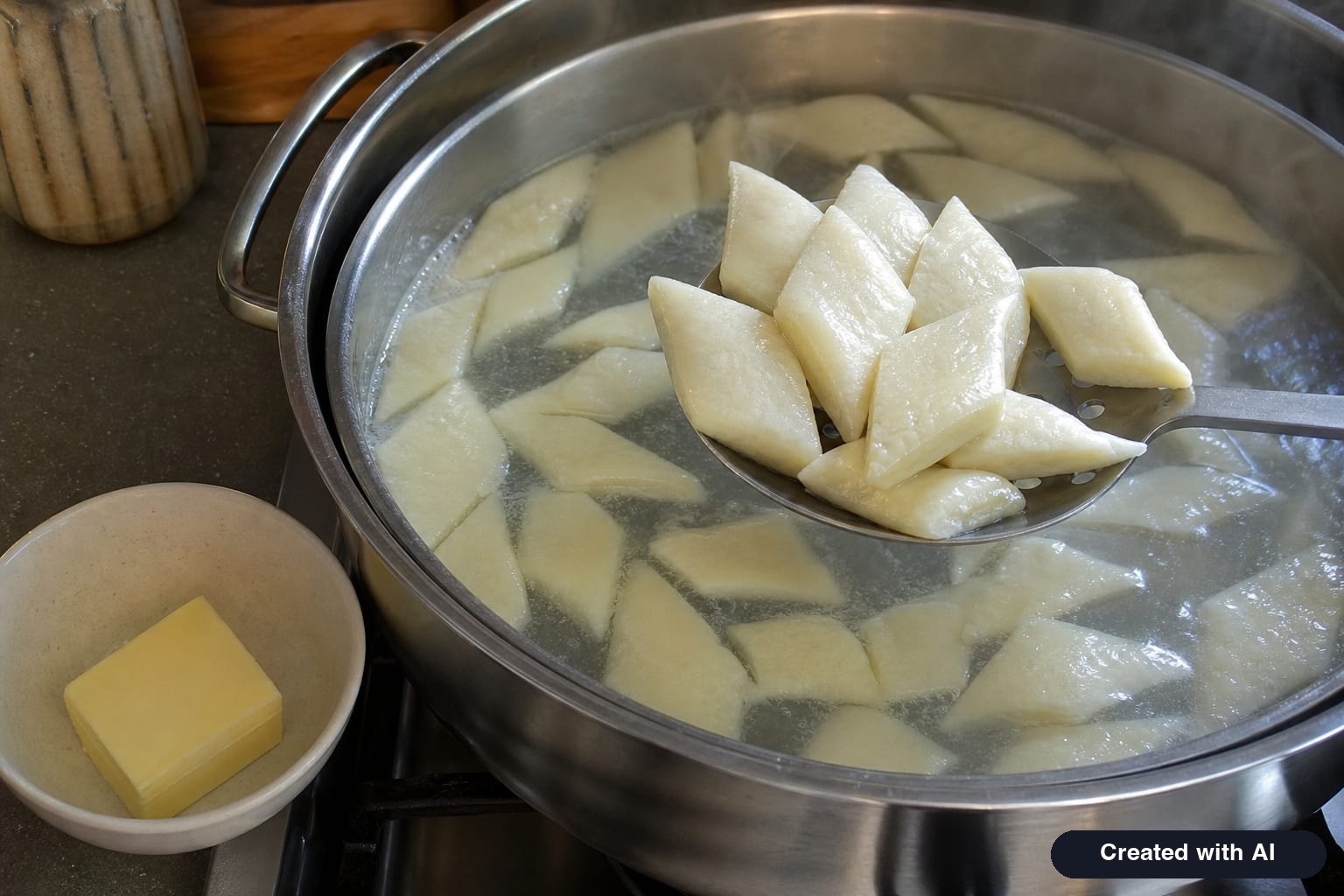
6. Scooping out. Scoop the boiled dumplings out with a slotted spoon and place them in a bowl with a small piece of butter. Gently shake the bowl—the butter will coat the surface and keep the dumplings from sticking together while the next batches cook. Do not pour the whole pot into a colander: the hot pieces are delicate and will crush under their own weight.
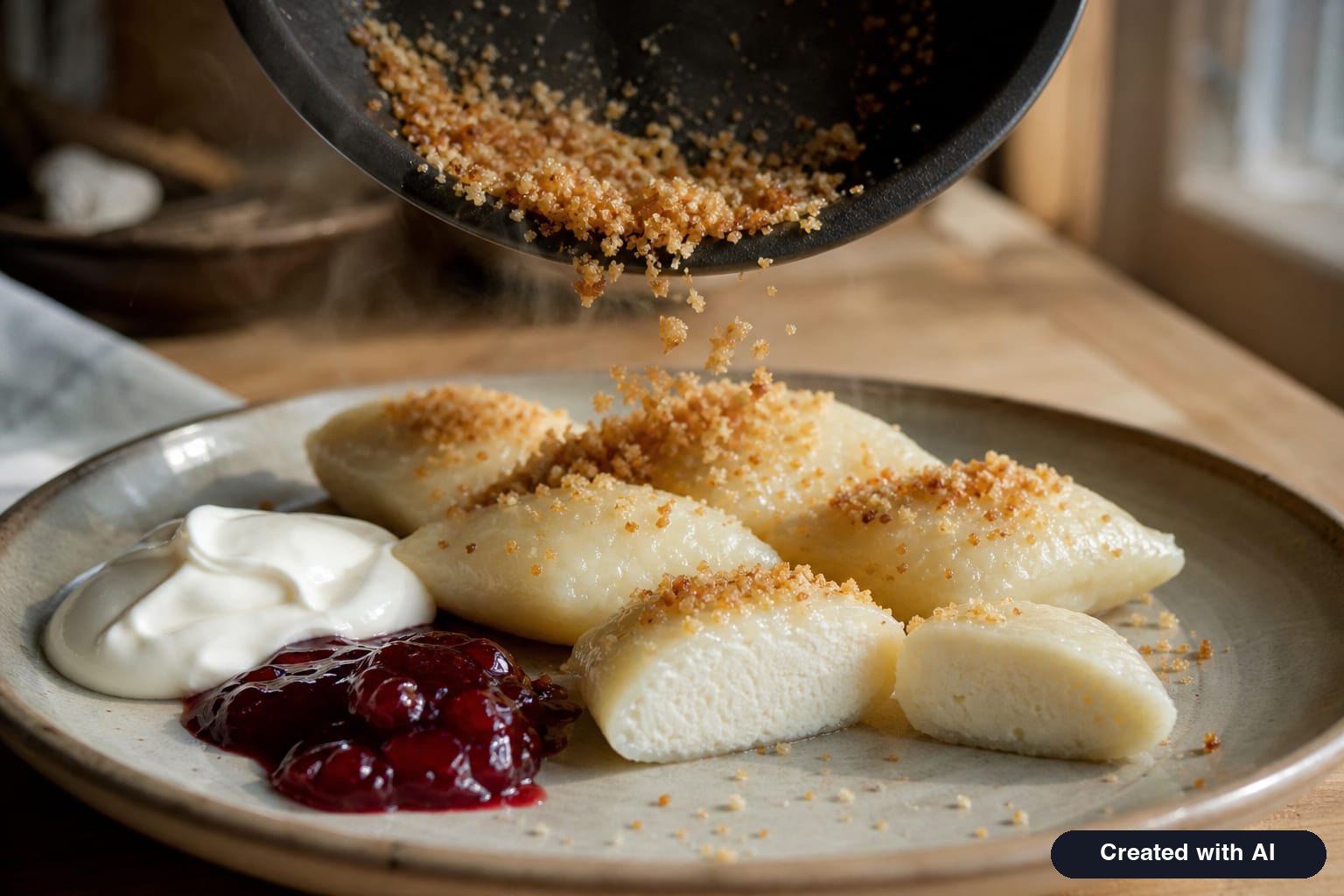
7. The sauce. Melt the butter in a skillet over medium heat, add the breadcrumbs, and toast while stirring for 2–3 minutes until golden and nutty-smelling. Remove from the heat immediately—breadcrumbs burn quickly. Pour over the lazy vareniki and serve with cold sour cream.
How long to boil lazy vareniki
The short answer: 2–3 minutes from the moment they float to the surface, about 4–5 minutes in total. The exact time depends on the size of the pieces and whether they are fresh or frozen. Overboiled dumplings absorb water, swell, and become slimy, so it's better to watch the clock rather than boiling them longer "just in case."
| Dumpling size | Until they float | Boil after floating | Total time |
|---|---|---|---|
| Mini dumplings (about ½ inch / 1.5 cm) | 1–2 min. | 1–2 min. | 3–4 min. |
| Standard (¾ inch / 2 cm pieces) | about 2 min. | 2–3 min. | 4–5 min. |
| Large balls (1¼–1½ inches / 3–4 cm) | 3–4 min. | 3–4 min. | 6–8 min. |
| Frozen, unthawed | 3–4 min. | 3–4 min. | 6–8 min. |
If in doubt, scoop one out and cut it in half: the inside should be uniform, with no raw, shiny dough in the center.
Ingredient ratios for ½ lb (250 g), 1 lb (500 g), and 2 lbs (1 kg) of farmer cheese
The ratio is simple: for every 3.5 oz (100 g) of farmer cheese, use 1 oz (30 g) of flour for the dough and about half an egg. Making lazy vareniki with 1 lb (500 g) of cheese is the most convenient amount for four people, while 2 lbs (1 kg) is worth making when you plan to freeze some.
| Farmer cheese | Eggs | Flour for dough + board | Sugar | Yield |
|---|---|---|---|---|
| ½ lb (250 g) | 1 | ½ cup + 1½ tbsp (75 g) + 1 tbsp (10 g) | 1 tbsp (15 g) | 2 servings, about 20 pcs. |
| 1 lb (500 g) | 2 | 1 cup + 3 tbsp (150 g) + 2½ tbsp (20 g) | 2 tbsp (30 g) | 4 servings, about 40 pcs. |
| 2 lbs (1 kg) | 4 | 2⅓ cups (300 g) + 5 tbsp (40 g) | ¼ cup (60 g) | 8 servings, about 80 pcs. |
When making a 2 lb (1 kg) batch, boil in at least 5–6 batches and don't reduce the amount of water: in an overcrowded pot, the water cools down, and the pieces sit on the bottom and stick together.
Common mistakes
Hard, rubbery dumplings. Too much flour or the dough was kneaded too long. Measure the flour carefully rather than adding it by eye, and mix only until it's absorbed.
Falling apart while boiling. The cheese was too wet, there wasn't enough flour, or the water was boiling too vigorously. A test dumpling and a gentle simmer will help.
Slimy, coated in a film. Overboiled or left sitting in hot water. Scoop them out immediately once 2–3 minutes have passed after they float.
Sticking together on the plate. The scooped-out dumplings were left without fat. Toss them immediately with a small piece of butter.
Bland taste. Unsalted water. Salt is just as necessary when boiling these as it is for pasta.
Grainy texture. The cheese wasn't mashed. Grainy farmer cheese must be pressed through a sieve.
Variations: with semolina, cornstarch, flourless, and more
Lazy vareniki with semolina. Replace half the flour with semolina: for 1 lb (500 g) of farmer cheese, use ½ cup (80 g) of semolina (farina or Cream of Wheat works) and ½ cup (70 g) of flour. You must let the dough rest for 20–30 minutes—the semolina swells, absorbs the moisture from the cheese, and the dough firms up without extra flour. Semolina dumplings turn out fluffier and lighter, which is why many consider this the softest version.
With cornstarch. You can replace the all-purpose flour with ¾ cup (90–100 g) of cornstarch or potato starch. These dumplings are incredibly smooth, slightly bouncy, and glossy. Starch has no gluten, so the pieces are more delicate: make them smaller and boil very gently.
Flourless lazy vareniki. All-purpose flour can be replaced not only with semolina or starch but also with other types of flour—approximate amounts for 1 lb (500 g) of farmer cheese are in the table. We write more about flourless, gluten-free, and egg-free dough in a separate section—flourless cottage cheese pancakes.
| Flour substitute | Amount per 1 lb (500 g) cheese | Result |
|---|---|---|
| Semolina (no flour) | ¾ cup (120 g), rest 30 min. | Fluffy, more delicate; shape with wet hands |
| Cornstarch | ¾ cup (90–100 g) | Smooth, bouncy, gluten-free |
| Oat flour | 1¾ cups (150–160 g) | Darker, more filling, mild nutty flavor |
| Fine cornmeal | ¾ cup (100 g) + ⅓ cup (40 g) cornstarch | Yellowish, slightly grainy, gluten-free |
| Almond flour | 1¼ cups (120 g) + ¼ cup (30 g) cornstarch | Very soft, delicate, lower carb |
Gluten-free lazy vareniki work well with cornstarch, cornmeal, or almond flour; if using oat flour, make sure it's certified gluten-free. For a keto version, omit the sugar entirely and replace the flour solely with almond flour—without starch, the dough is fragile, so a test dumpling is mandatory here.
Egg-free. Boiling lazy vareniki without an egg is possible if the cheese is dry: for 1 lb (500 g), use about 1⅓ cups (170–180 g) of flour and a tablespoon of cornstarch. They will be denser because the flour takes over the binding job of the egg.
From regular cottage cheese or ricotta. Drain and press regular cottage cheese, then push it through a sieve; you'll need 1–2 tablespoons more flour. Lazy vareniki made with ricotta turn out creamier, but ricotta is wet—drain it well and expect to use 1½ cups (180–200 g) of flour. You can't make these dumplings without farmer cheese or a similar fresh cheese—that would just be plain flour dumplings.
Savory lazy vareniki. Omit the sugar, add half a teaspoon of salt, and you can mix in some chopped dill. Savory dumplings are served with crispy bacon and sautéed onions, with sour cream, or a white sauce: warm ⅔ cup (150 g) of sour cream with a tablespoon of butter and a pinch of salt, but don't let it boil. For spinach vareniki, mix 3.5 oz (100 g) of blanched, well-squeezed, and finely chopped spinach into the dough along with an extra tablespoon of flour. You can find variations with boiled potatoes, cheese, and other add-ins in the cottage cheese pancakes with add-ins section.
With bananas and sugar-free. Instead of sugar, you can mash one ripe banana into the dough and add 3–4 tablespoons (20–30 g) more flour. More ideas like this can be found in the healthy banana cottage cheese pancakes section.
"Hedgehog" dumplings. There isn't just one recipe by this name; it usually refers to round dumplings with a rough surface. Don't cut the dough; instead, roll walnut-sized balls with wet hands. Once boiled, roll them in toasted breadcrumbs or shredded coconut—the surface becomes rough and "spiky." The balls are thicker, so they boil longer (see table).
Boiled and pan-fried. Boiled lazy vareniki can be pan-fried in butter for 1–2 minutes on each side to develop a thin golden crust. This is also a great way to revive leftovers. Deep-frying them in oil is a different dish entirely, covered in the section on air fryer syrniki.
Lazy vareniki for kids
Boiled lazy vareniki are even better for kids than fried ones: they have no frying fat and no hard crust, making them soft and easy to chew. For kids, make mini dumplings—roll thinner logs, about ½ inch (1.5 cm), and cut them into short pieces that are easy to pick up with fingers or a fork. You can halve the sugar in the dough or omit it entirely, providing sweetness with mashed berries or a banana. Instead of the breadcrumb sauce, a spoonful of yogurt or sour cream is plenty for younger children.
For babies and toddlers, lazy vareniki are made without salt and sugar, and the pieces are cut according to the child's chewing ability. When to introduce farmer cheese, eggs, and wheat flour into their diet is an individual decision—consult your pediatrician.
A lighter version
The dumplings themselves aren't heavy—almost a third of the calories in a serving come from the sauce. Therefore, healthy lazy vareniki start not with the dough, but with what you pour over them. Here are the real differences per serving:
| Change | How | kcal / serving | Difference |
|---|---|---|---|
| Main recipe | as written above | 503 | – |
| Low-fat farmer cheese | 1 lb (500 g) of low-fat farmer cheese instead of whole-milk | 470 | −33 |
| No sugar in the dough | omit sugar, get sweetness from berries or fruit on the plate | 474 | −29 |
| Half the sauce | 1.5 tbsp (20 g) butter, 2 tbsp (15 g) breadcrumbs, and ⅓ cup (80 g) sour cream | 432 | −71 |
| Sour cream only | no butter or breadcrumbs, ½ cup (120 g) sour cream | 401 | −102 |
| With Greek yogurt | ⅔ cup (150 g) Greek yogurt instead of butter, breadcrumbs, and sour cream | 378 | −125 |
| Lightest combination | low-fat cheese, no sugar, with ⅔ cup (150 g) Greek yogurt instead of sauce | 317 | −186 |
Calculated with the Firmus Medicus calorie database, with the recipe divided into 4 servings.
Skipping the butter and breadcrumbs and leaving only the sour cream drops a serving from about 503 to 401 kcal. Replacing the sauce with ⅔ cup (150 g) of Greek yogurt leaves about 378 kcal, and the protein even increases slightly. Low-fat farmer cheese on its own doesn't change much—about 470 kcal—and omitting sugar in the dough brings it to about 474 kcal. Combining everything (low-fat cheese, no sugar, with yogurt) yields a serving with about 317 kcal and 26 g of protein. Replacing some flour with semolina barely changes the calories—that's a matter of texture, not calories.
How many calories are in lazy vareniki
One serving according to this recipe (a quarter of the total amount with the butter, breadcrumb, and sour cream sauce, about 9 oz / 250 g of food) has about 503 kcal, 23 g of protein, 23 g of fat, and 51 g of carbohydrates. Plain dumplings without sauce have about 342 kcal per serving. During boiling, the pieces absorb some water, so the serving weighs more on the plate, but this doesn't add calories.
| Ingredient | Amount | kcal, whole recipe | Share |
|---|---|---|---|
| White wheat flour | 170 g | 619 | 31 % |
| Cottage cheese | 500 g | 490 | 24 % |
| Butter | 40 g | 287 | 14 % |
| Sour cream | 120 g | 238 | 12 % |
| Egg | 100 g | 143 | 7 % |
| Breadcrumbs, dry | 30 g | 119 | 6 % |
| Granulated sugar | 30 g | 116 | 6 % |
| Table salt | 2 g | 0 | 0 % |
| Total | 992 g | 2012 | 503 kcal / serving |
Ingredient values – Firmus Medicus calorie database.
What to serve with, how to store and freeze
The classic is butter-toasted breadcrumbs and sour cream. Sweet versions pair well with jam, mashed strawberries or blueberries, honey, or cinnamon sugar. For a quick sour cream "hat," whip cold sour cream with a little powdered sugar and vanilla and spoon it over the hot dumplings; the oven-baked sour cream "hat" is in the main cottage cheese pancakes recipe.
Boiled lazy vareniki are best eaten immediately. They keep in the fridge in an airtight container for 2 days; reheat them in a skillet with a little butter rather than in water—boiling them a second time makes them mushy.
It's best to freeze them raw. Arrange the cut dumplings in a single layer on a floured board or tray, place in the freezer for 1–2 hours, then transfer to a bag. This keeps them from sticking together, and they will last up to 3 months. Boil them unthawed, straight from the freezer—thawed dough becomes watery and sticky.
If you crave a crust, return to pan-fried cottage cheese pancakes or try baked syrniki, which don't require standing by the stove. The syrniki served in Soviet-era canteens and the way earlier generations made them are covered in old-fashioned syrniki, and if you prefer a looser batter, try cottage cheese kefir pancakes.
Frequently asked questions
How long do you boil lazy vareniki?
Standard ¾-inch (2 cm) pieces boil for 2–3 minutes after floating, about 4–5 minutes total. Mini dumplings take 3–4 minutes, while large or frozen ones need 6–8 minutes.
Why do lazy vareniki fall apart in the water?
The cheese was too wet, there wasn't enough flour, or the water was boiling too vigorously. Drain wet cheese (press regular cottage cheese well), boil a test piece, and if it falls apart, add 1–2 tablespoons of flour; boil in a gentle simmer.
How do you make soft and fluffy lazy vareniki?
Use no more than 1 cup plus 3 tablespoons (150 g) of flour per 1 lb (500 g) of dry farmer cheese, mix only until combined, and don't overboil. For even fluffier dumplings, use ½ cup (80 g) semolina and ½ cup (70 g) flour, letting the dough rest for 20–30 minutes.
Can you make lazy vareniki without flour?
Yes. For 1 lb (500 g) of farmer cheese, use ¾ cup (120 g) of semolina and let it rest for 30 minutes, or use ¾ cup (90–100 g) of cornstarch. These are more delicate, so make them smaller and boil very gently.
How many calories are in lazy vareniki?
One serving (a quarter of the recipe) with butter, breadcrumbs, and sour cream has about 503 kcal, 23 g protein, and 51 g carbs. Plain dumplings without sauce have about 342 kcal, and with Greek yogurt instead of sauce, about 378 kcal.
What sauce do you serve with lazy vareniki?
The traditional topping is 3 tablespoons (40 g) of butter toasted with ¼ cup (30 g) of breadcrumbs for 2–3 minutes, plus cold sour cream. Sweet versions pair well with jam or mashed berries, while savory ones go with crispy bacon and onions or a warm sour cream sauce.
Are lazy vareniki good for kids?
Yes, they are soft, crustless, and cooked without frying fat. For kids, roll thinner ½-inch (1.5 cm) logs to make mini dumplings, halve the sugar, and serve with yogurt or mashed berries instead of the breadcrumb sauce.
Can you freeze boiled lazy vareniki?
It's best to freeze them raw: arrange in a single layer on a floured board, and after 1–2 hours, transfer to a bag for up to 3 months. Boil without thawing for 6–8 minutes.
Log in to comment
No comments yet. Be the first.