How to Grow Mulberries: Varieties, Care, and Harvesting
- The Morus genus includes 10 to 16 species; the most commonly grown is the white mulberry (Morus alba), native to China.
- White mulberry leaves are the primary food source for silkworms, a practice dating back over 4,700 years in China.
- The sweet berries measure 0.4–0.6 inches (1–1.5 cm) and range in color from white and pink to dark purple.
- A 3.5 oz (100 g) serving of mulberries contains about 43 calories and 36.4 mg of vitamin C.
- Mulberry trees can be grown commercially or in home gardens, with mature trees yielding 22–33 lbs (10–15 kg) of fruit per season.
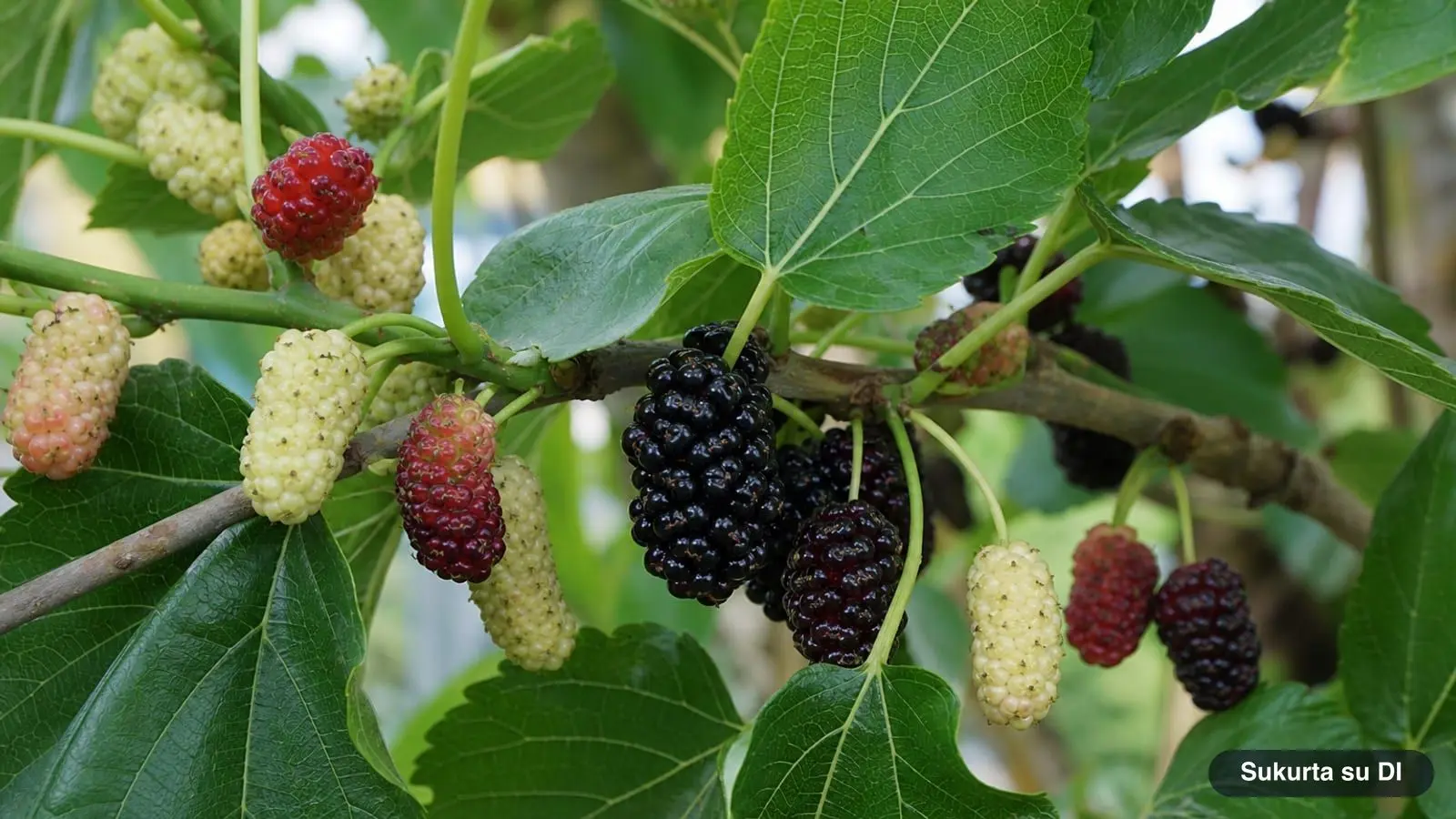
- The Morus genus includes 10 to 16 species, with the white mulberry being the most widely grown
- White mulberry leaves have been fed to silkworms in China for over 4,700 years
- Mulberries can grow up to the 55th parallel, thriving in sunny and sheltered spots
- Commercial mulberry orchards and home growing in cooler climates
- Mulberry fruits are sweet aggregate berries ranging from white to dark purple
- Mulberries can be eaten fresh, dried, or made into jams and juices
- Mulberries, blackberries, and raspberries: Similar fruits from very different plants
This article is part of the 77.today berries guide, prepared by the 77.today editors from the sources listed at the end.
For many, the mulberry tree is primarily associated with silk: its leaves have been fed to silkworms for thousands of years. However, the mulberry also produces sweet berries that look like white, pink, or dark purple blackberries. While sometimes uncommon in local nurseries, it is an increasingly popular tree planted by home gardeners in temperate climates. In this part of our berry growing guide, we cover the different types of mulberries, what the berries look like and when they ripen, how to grow the trees, and what to make with the fruit.
| Latin name | Morus alba (white mulberry), Morus nigra (black mulberry) |
|---|---|
| Family | Moraceae (mulberry family) |
| Origin | China and India (white mulberry) |
| Plant | fast-growing tree, 33–65 ft (10–20 m) |
| Blooms | in spring, with unisexual catkins |
| Berries ripen | in summer, gradually |
| Berries | 0.4–0.6 inches (1–1.5 cm), white, pink, or dark purple |
| Energy value | about 43 kcal / 3.5 oz (100 g) |
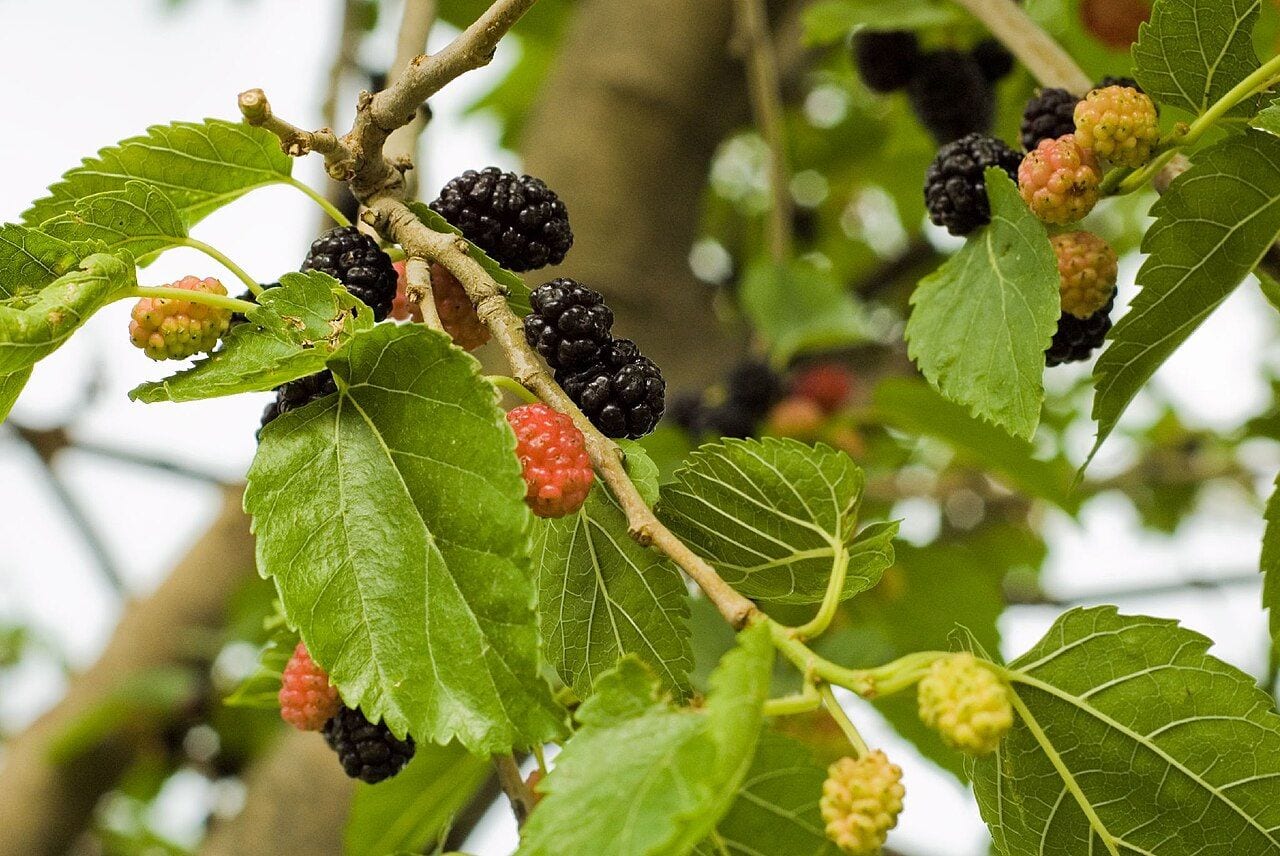
The Morus genus includes 10 to 16 species, with the white mulberry being the most widely grown
Mulberry trees are distributed across the temperate and subtropical regions of Asia, Africa, and North America, with the greatest diversity of species found in Asia. The genus comprises 10 to 16 species, including the white, black, red, and southern mulberries. The most widely cultivated worldwide is the white mulberry, native to China and India. It is a fast-growing, small to medium-sized tree that reaches 33–65 feet (10–20 m) in height. It typically has a lifespan similar to that of a human, though some specimens are known to be over 250 years old.
The leaves of the white mulberry are highly variable: on young, vigorous shoots, they can be up to 12 inches (30 cm) long and deeply, intricately lobed, while on mature trees, they are generally 2–5 inches (5–13 cm) long, unlobed, with a heart-shaped base and toothed edges. The Latin name alba means "white."
White mulberry leaves have been fed to silkworms in China for over 4,700 years
The white mulberry is primarily cultivated for silkworms, whose caterpillars feed exclusively on its leaves. This practice has been carried out in China for more than 4,700 years, and mulberry trees eventually spread throughout the warm temperate zones of the world. Mulberries are also grown for livestock fodder, timber, and fruit, which is why they are often shaped as hedges, grown as standard trees, or pollarded. Many of the fruit-bearing varieties grown globally originated from the white mulberry and its hybrids with the red mulberry and other species.
Mulberries can grow up to the 55th parallel, thriving in sunny and sheltered spots
Mulberry trees are generally cultivated between the 28th and 55th parallels north, and they thrive best in temperatures of 75–82°F (24–28°C). They require warm, fertile, loose, and well-draining loam or sandy loam soil with a pH of 6.2 to 6.8. They also need plenty of sunlight—in their native range, they receive at least 9 to 13 hours of sun per day. In cooler northern climates, which sit at the edge of their growing zone (USDA zones 4–8 depending on the variety), they are mostly planted in home gardens in sunny, sheltered locations. Mulberries can be propagated from seed, but cuttings or grafting are much more common.
The mulberry tree is vigorous and highly resistant to diseases, as its bark and leaves contain natural antimicrobial and antifungal compounds. Many cultivars are adapted to specific regional conditions and may perform poorly outside of them, so when planting, it is worth selecting cold-hardy varieties and purchasing from reliable local nurseries.
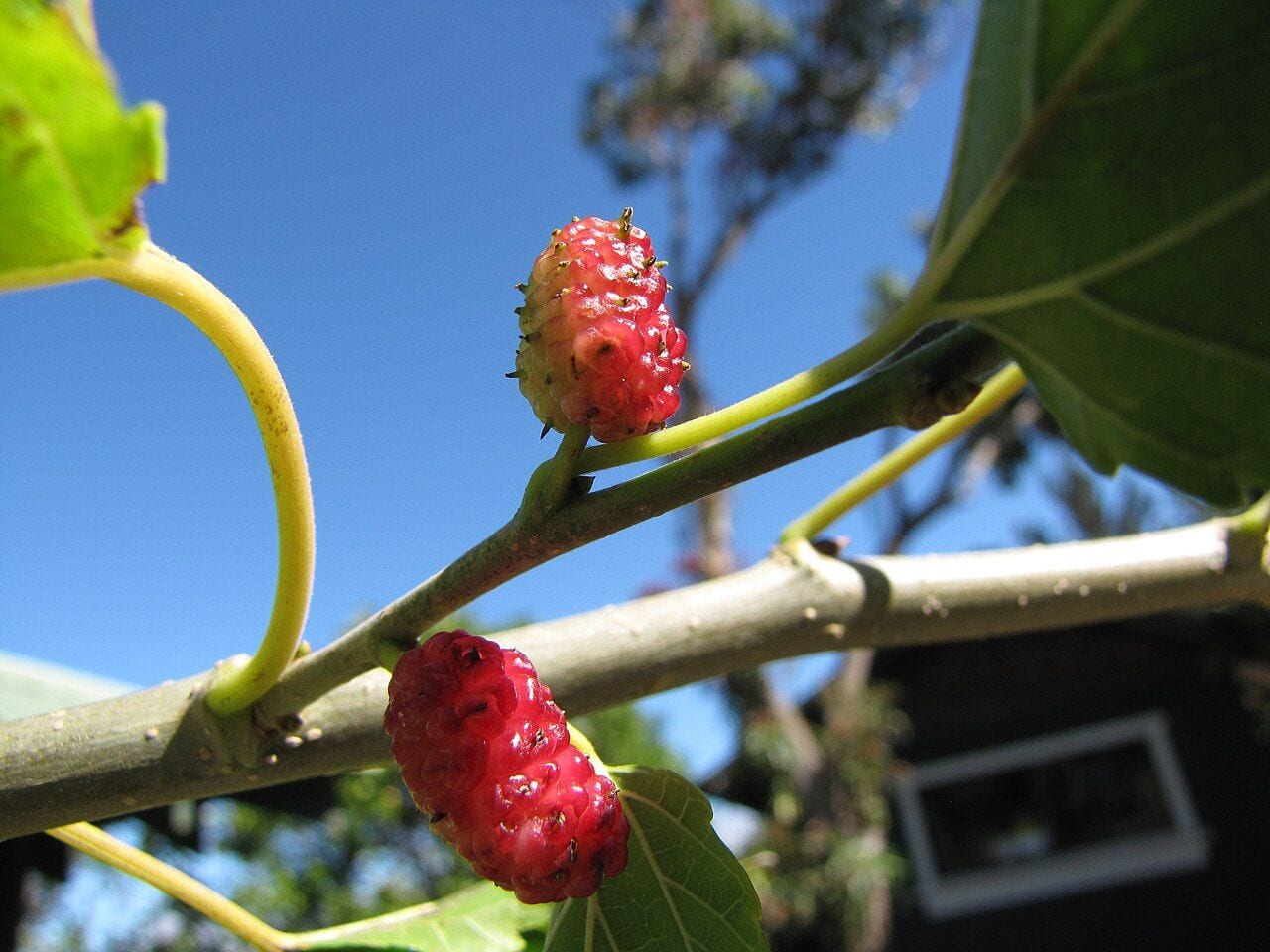
Commercial mulberry orchards and home growing in cooler climates
Growers in cooler temperate zones successfully cultivate mulberries by choosing cold-hardy, disease-resistant varieties of the white mulberry. While harsh, snowless winters can occasionally cause dieback on young branches, the trees typically recover quickly. You can expect the first harvest in three to four years, with trees reaching full production around seven to eight years of age. A mature tree can yield 22–33 lbs (10–15 kg) of fruit, which usually ripens in midsummer and continues for several weeks. The biggest threat to the harvest is birds: starlings and other species can consume up to 70% of the crop if the trees are not netted. Historically, attempts to establish silk-producing estates in colder parts of Northern Europe during the 18th and 19th centuries failed because silkworms could not survive the freezing winters.
Mulberry fruits are sweet aggregate berries ranging from white to dark purple
The mulberry is a 0.4–0.6 inch (1–1.5 cm) long aggregate fruit that outwardly resembles a blackberry or an elongated raspberry. The berries of the wild white mulberry are dark purple, while many cultivated varieties produce fruit ranging from white to pink. White mulberry fruits are sweet but often lack tartness, resulting in a somewhat mild flavor, whereas red and black mulberries have a much more intense, complex taste. The berries ripen gradually, so it is common to see fruits of various colors on the same branch. The berries are eagerly eaten by birds, which then disperse the seeds.
A 3.5 oz (100 g) serving of fresh mulberries contains about 43 calories and 36.4 mg of vitamin C—more than blueberries or grapes. Mulberry fruits are composed of about 88% water.
Mulberries can be eaten fresh, dried, or made into jams and juices
Ripe mulberries are very soft and highly perishable, so it is best to eat them fresh or process them as quickly as possible. Mulberries are used to make jams, jellies, syrups, juices, and wines; they are baked into pies, and when dried, they can be eaten like raisins or added to oatmeal. The dark berries stain heavily, so it is usually more convenient to wear gloves when harvesting them. Other less commonly grown garden berries include the serviceberry, jostaberry, and ground cherry.
Mulberries, blackberries, and raspberries: Similar fruits from very different plants
While mulberry fruits outwardly resemble blackberries or elongated raspberries, they come from a completely different type of plant—a tree rather than a shrub.
| Plant | Plant type | Fruit | Energy value, kcal / 3.5 oz (100 g) | Vitamin C, mg / 3.5 oz (100 g) |
|---|---|---|---|---|
| Mulberry | tree, 33–65 ft (10–20 m) | 0.4–0.6 inches (1–1.5 cm), white, pink, or purple | 43 | 36.4 |
| Blackberry | thorny semi-shrub | black, with a solid core | 43 | 21 |
| Raspberry | semi-shrub with biennial canes | red or yellow, hollow core | 53 | 26.2 |
Mulberries contain more vitamin C than blackberries or raspberries, while their energy value is similar. Furthermore, the mulberry is a long-lived tree, whereas blackberries and raspberries are semi-shrubs whose individual canes only live for two years.
Frequently asked questions
Are mulberries edible?
Yes. White mulberries are sweet but often have a mild flavor, while red and black mulberries offer a more intense, tart taste. Ripe berries can be eaten fresh, dried, or made into jams and juices.
What do mulberries look like?
The mulberry is a 0.4–0.6 inch (1–1.5 cm) aggregate fruit that resembles a blackberry or an elongated raspberry. Wild white mulberries are dark purple, while cultivated varieties range from white to pink.
Can mulberry trees grow in cold climates?
While mulberries thrive in warmer climates with ideal temperatures of 75–82°F (24–28°C), cold-hardy varieties can grow as far north as the 55th parallel (USDA zones 4–8). In cooler regions, they should be planted in sunny, sheltered locations.
How many calories are in mulberries?
A 3.5 oz (100 g) serving of fresh mulberries contains about 43 calories and 36.4 mg of vitamin C.
What is the difference between white and black mulberries?
The white mulberry is native to China, its leaves feed silkworms, and its berries are sweet but mild. The black mulberry produces dark fruit with a much richer, tart, and intense flavor.
When do mulberries ripen?
Mulberries ripen gradually over the summer. It is common to see green, white, pink, and dark purple berries all on the same branch at the same time.
Log in to comment
No comments yet. Be the first.