English Oak Guide: Leaves, Acorns, Flowers and Bark
- The English oak (Quercus robur) is a member of the beech family, typically growing 65–115 feet (20–35 m) tall, and occasionally reaching 130 feet (40 m).
- Its leaves feature 4–6 pairs of rounded lobes, a very short stalk, and two ear-like lobes at the base.
- It blooms in mid-spring as the leaves unfurl; the acorns grow on long stalks and ripen in early to mid-autumn.
- Native to Europe and parts of Asia, English oaks are a major component of broadleaf woodlands and are widely planted as solitary landscape trees.
- They can live for 500–1,000 years or more, with some of the oldest known specimens estimated to be over a millennium old.
This article is part of the 77.today trees guide, prepared by the 77.today editors from the sources listed at the end.
The English oak (also known as the pedunculate oak) is a tree almost everyone recognizes, but not everyone knows how to distinguish it from introduced relatives, when it blooms, or why acorn crops vary wildly from year to year. In this part of the tree identification guide, you will find a complete profile of the English oak: what its leaves, flowers, acorns, bark, and buds look like, where it grows, how long it lives, and what it is used for.
| Latin name | Quercus robur |
|---|---|
| Family | Beech family (Fagaceae) |
| Group | Broadleaf tree, native to Europe and western Asia |
| Height | 65–115 ft (20–35 m), rarely up to 130 ft (40 m) |
| Lifespan | 500–1,000 years or more |
| Blooms | Mid-spring, as leaves unfurl |
| Fruit | Acorns, ripening in early to mid-autumn |
| Habitat | A major component of European broadleaf woodlands |
How to Identify the Oak
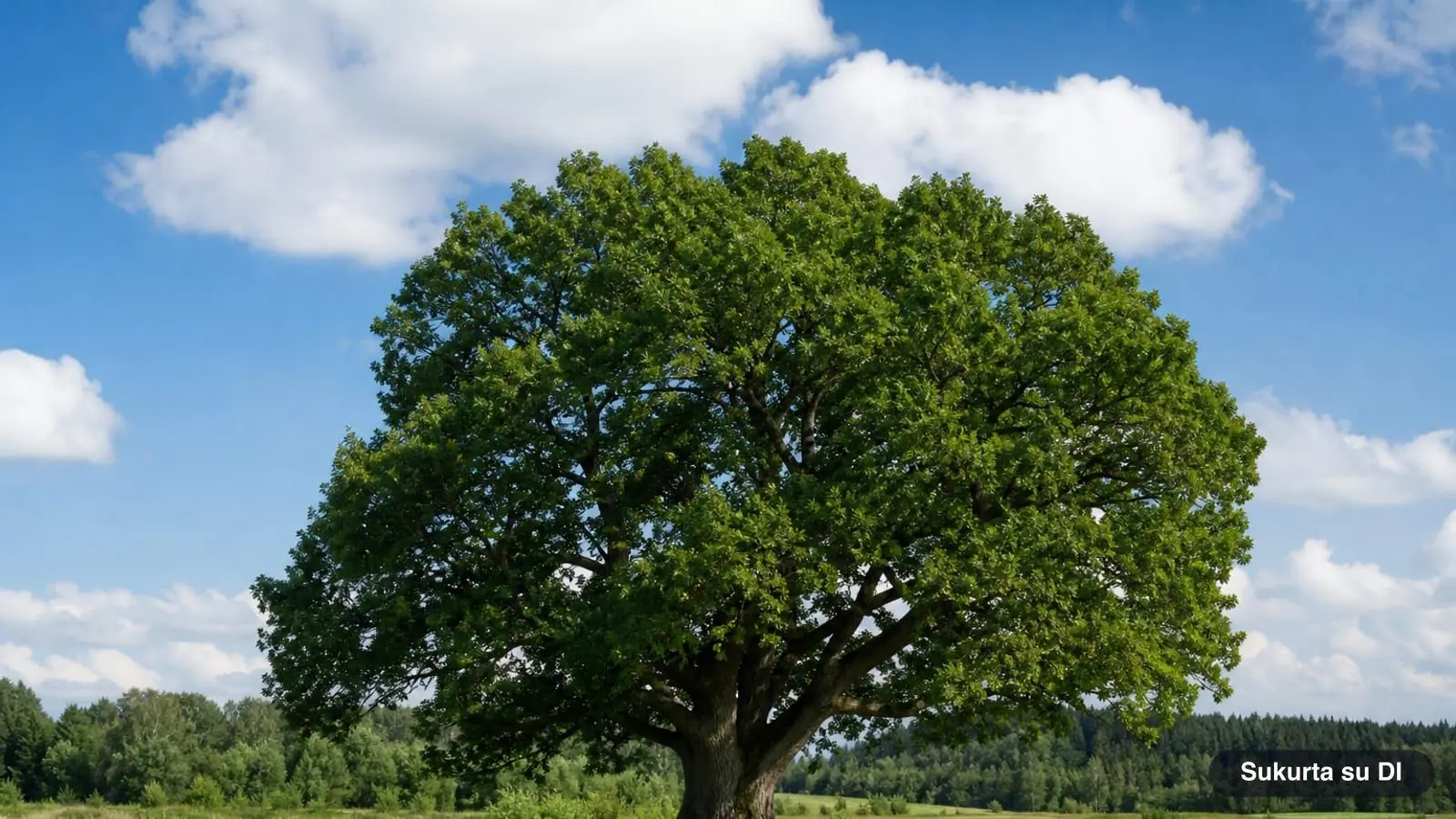
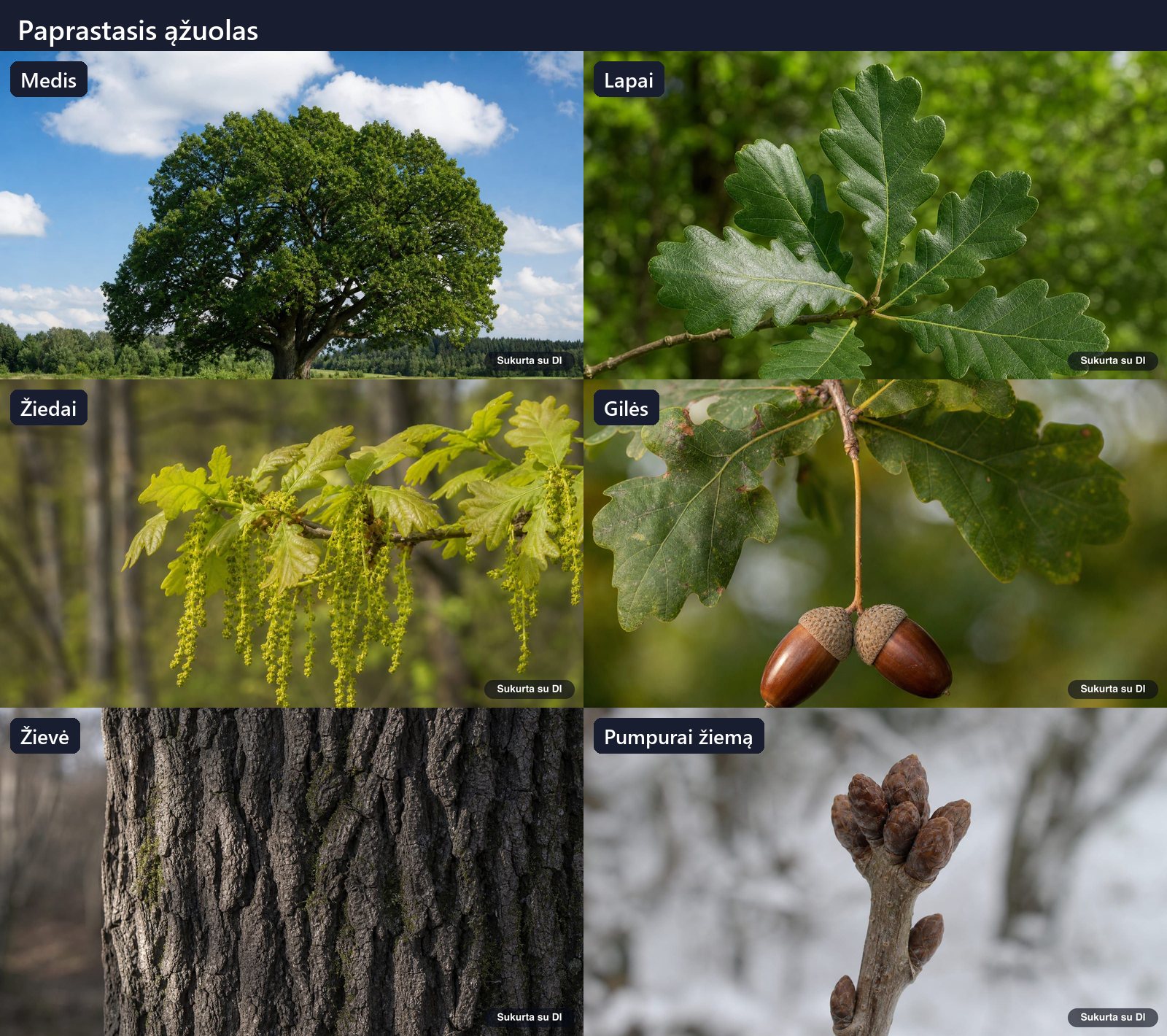
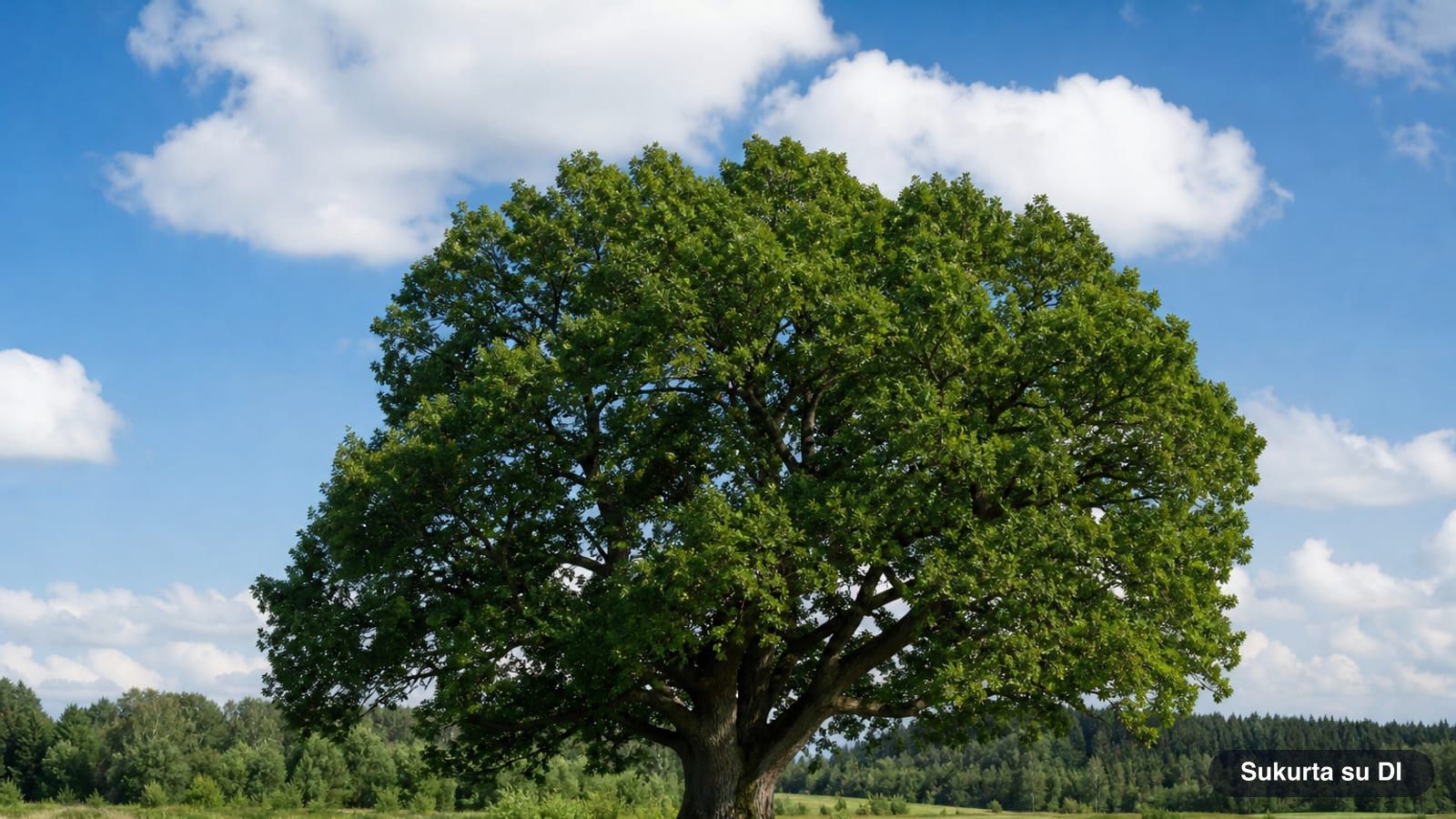
Grown in an open field, an oak is recognizable from afar: a short, thick trunk branches out near the ground into several stout, twisting limbs, forming a broad, rounded canopy. In a forest, the same tree looks different—the trunk is long and straight, with branches starting high up. In both cases, the oak needs plenty of light: in the shade beneath other trees, a young sapling will struggle, which is why foresters plant it where the crown will receive full sun.
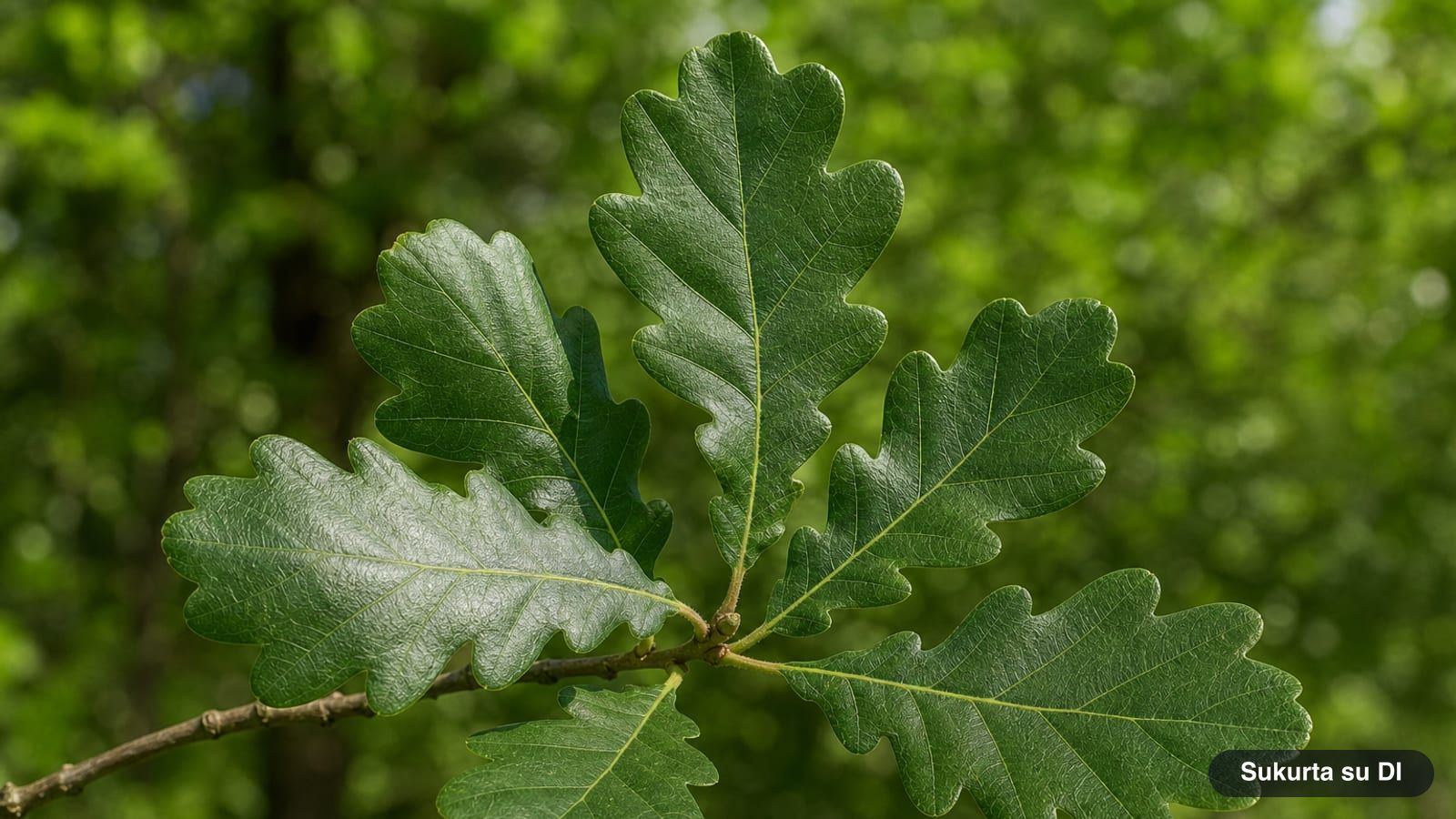
The most reliable identifying features are the leaves and acorns. If you are unsure whether you are looking at an English oak, check the leaf stalk (petiole): it is barely a fraction of an inch long, and the base of the leaf has two small "ear-like" lobes. The acorns, on the other hand, hang on a long stalk (peduncle). This specific combination—a short leaf stalk and long-stalked acorns—distinguishes it from its closest relative, the sessile oak.
Leaves
The leaf is 2.5–4.5 inches (7–12 cm) long, sometimes up to 6 inches (15 cm), and is widest above the middle. The margin is divided into 4–6 pairs of blunt, rounded lobes. The upper side is dark green and slightly glossy, while the leaf itself is stiff and leathery. Leaves are clustered at the ends of the twigs. In autumn, they turn yellow or brown, and the leaves of young oaks often cling to the branches until spring—one of the most noticeable signs of an oak in a winter forest.
Flowers
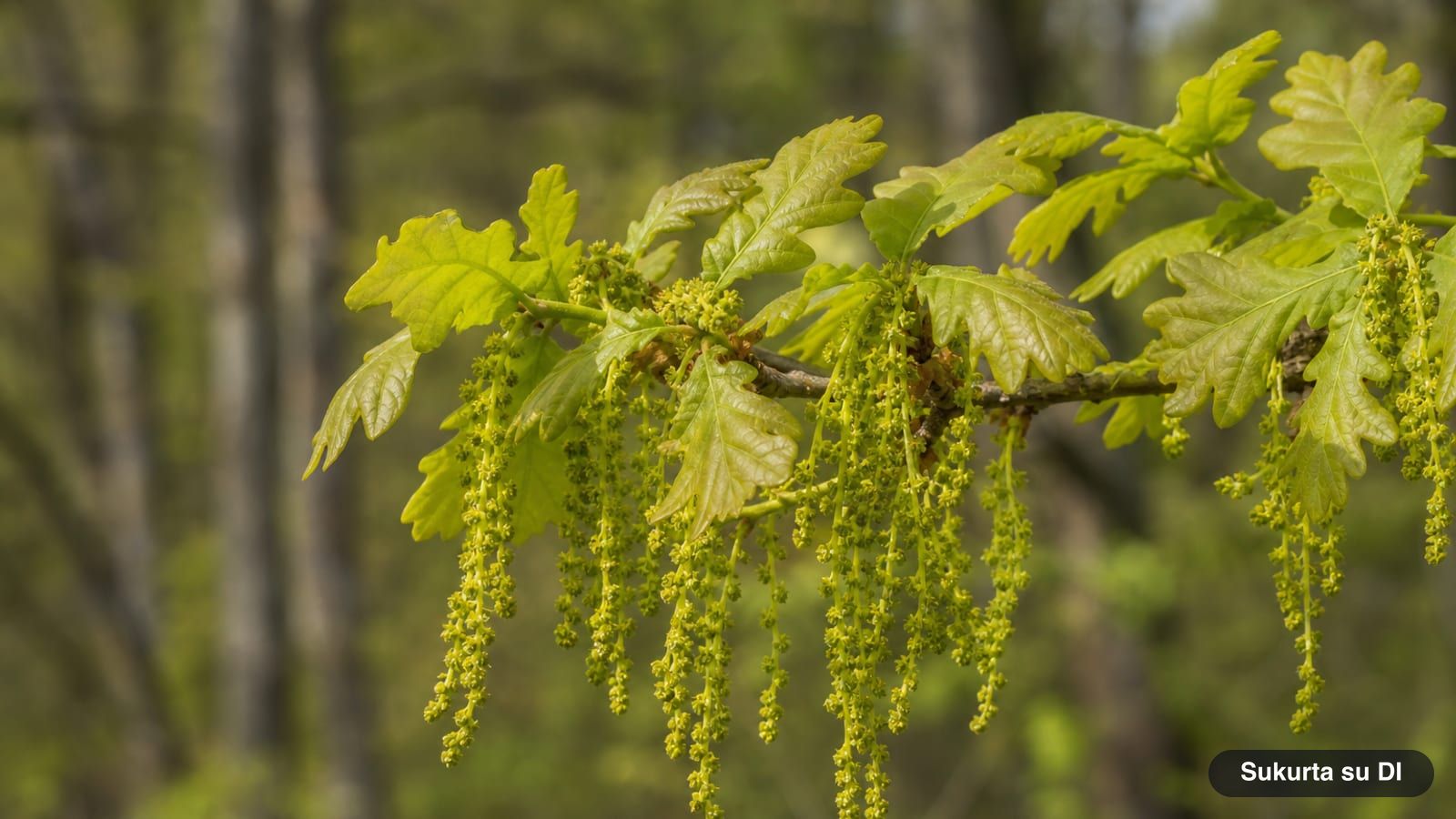
The oak is a monoecious tree: male and female flowers grow on the same plant. In mid-spring, as the young, brownish-green leaves unfurl, thin yellowish-green catkins droop from the twigs—these are the male flowers, whose pollen is carried by the wind. The female flowers are almost unnoticeable: growing singly or in small clusters on a long stalk, they look like tiny buds with a reddish perianth. Early-leafing oak varieties can leaf out and bloom two to three weeks before late-leafing ones, making them more susceptible to late spring frosts.
Acorns
The acorn is a single-seeded nut-like fruit, 0.6–1.4 inches (1.5–3.5 cm) long, elongated and egg-shaped, with a short spike at the tip. About a third of it is covered by a scaly cupule (cap). On a single stalk, which is 0.6–1.5 inches (1.5–4 cm) long, 1–4 acorns typically grow, though occasionally more. Unripe acorns are light green, later turning brown with dark longitudinal stripes. They ripen and fall in early to mid-autumn. An oak growing in an open area begins to bear fruit at 20–25 years of age, while a forest-grown tree may not produce acorns until it is 50–70 years old. Abundant seed years, known as mast years, occur roughly every 4–5 years.
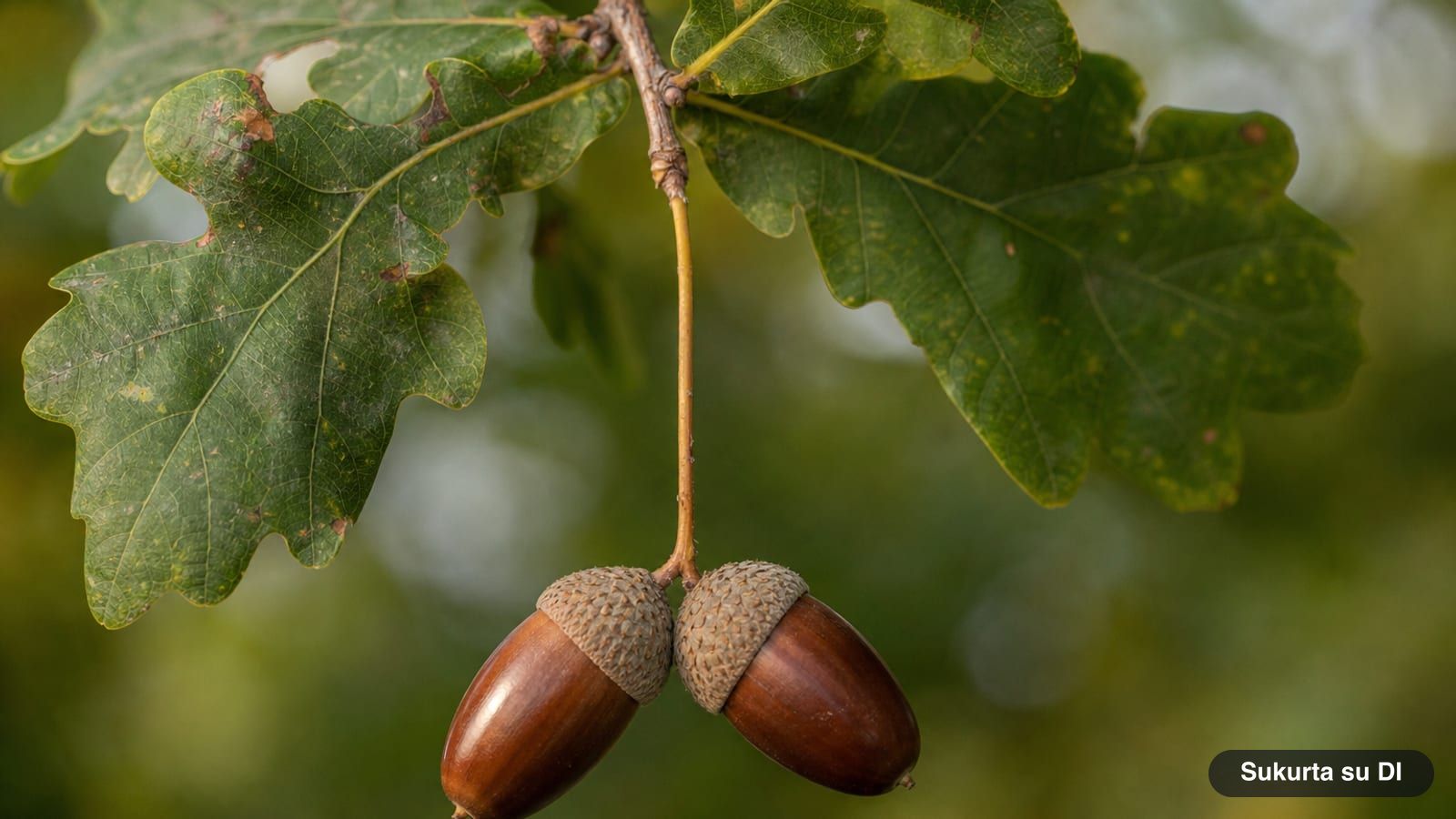
Acorns are a favorite food for wild boars, deer, squirrels, and mice, while jays carry them off and hide them in the ground as winter stores. Some of these hidden acorns remain unfound and sprout, making jays some of the most important "planters" of oak trees. You can learn more about the structure of acorns and other seeds in the tree seeds and fruits article.
Bark and Buds
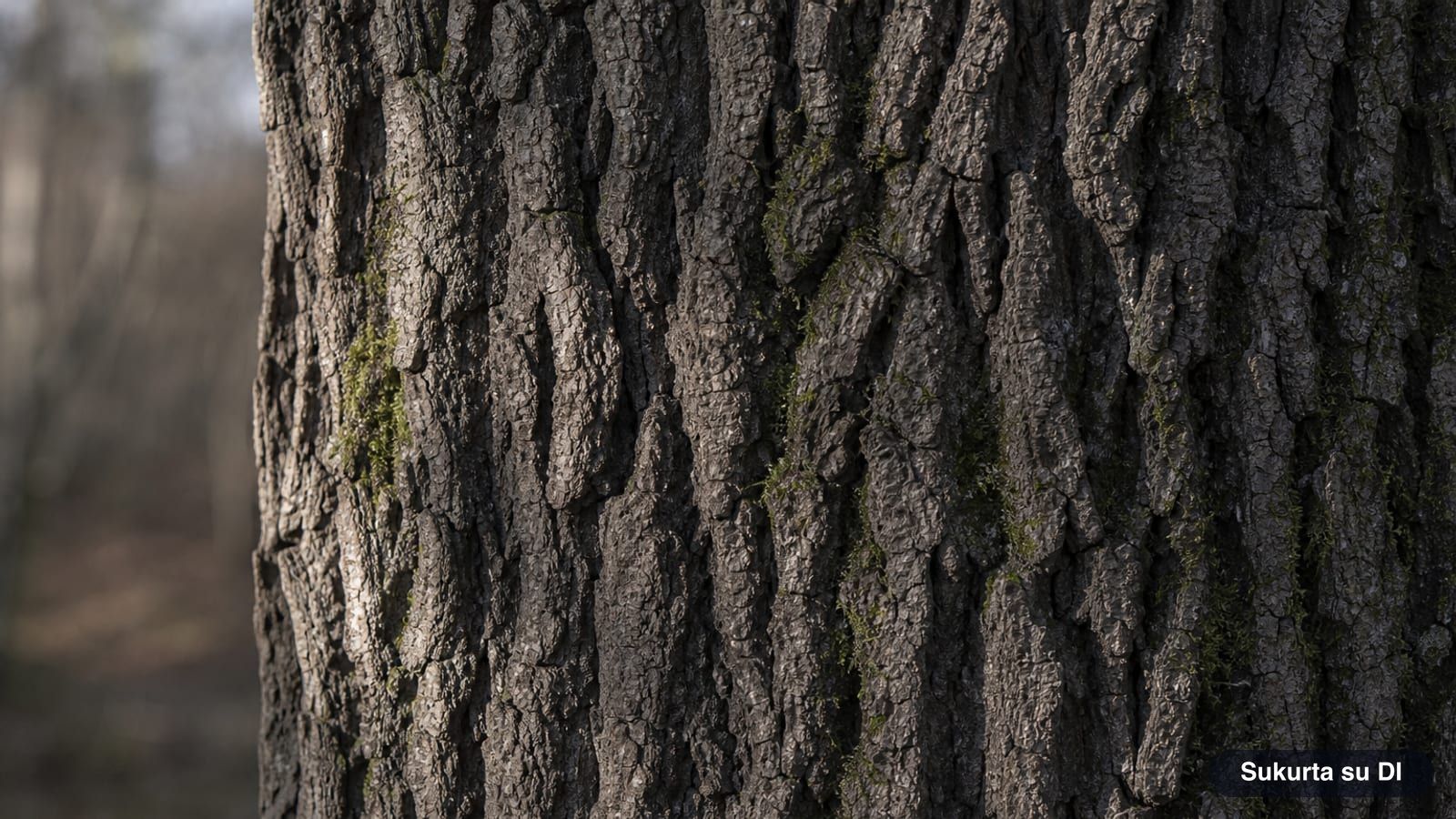
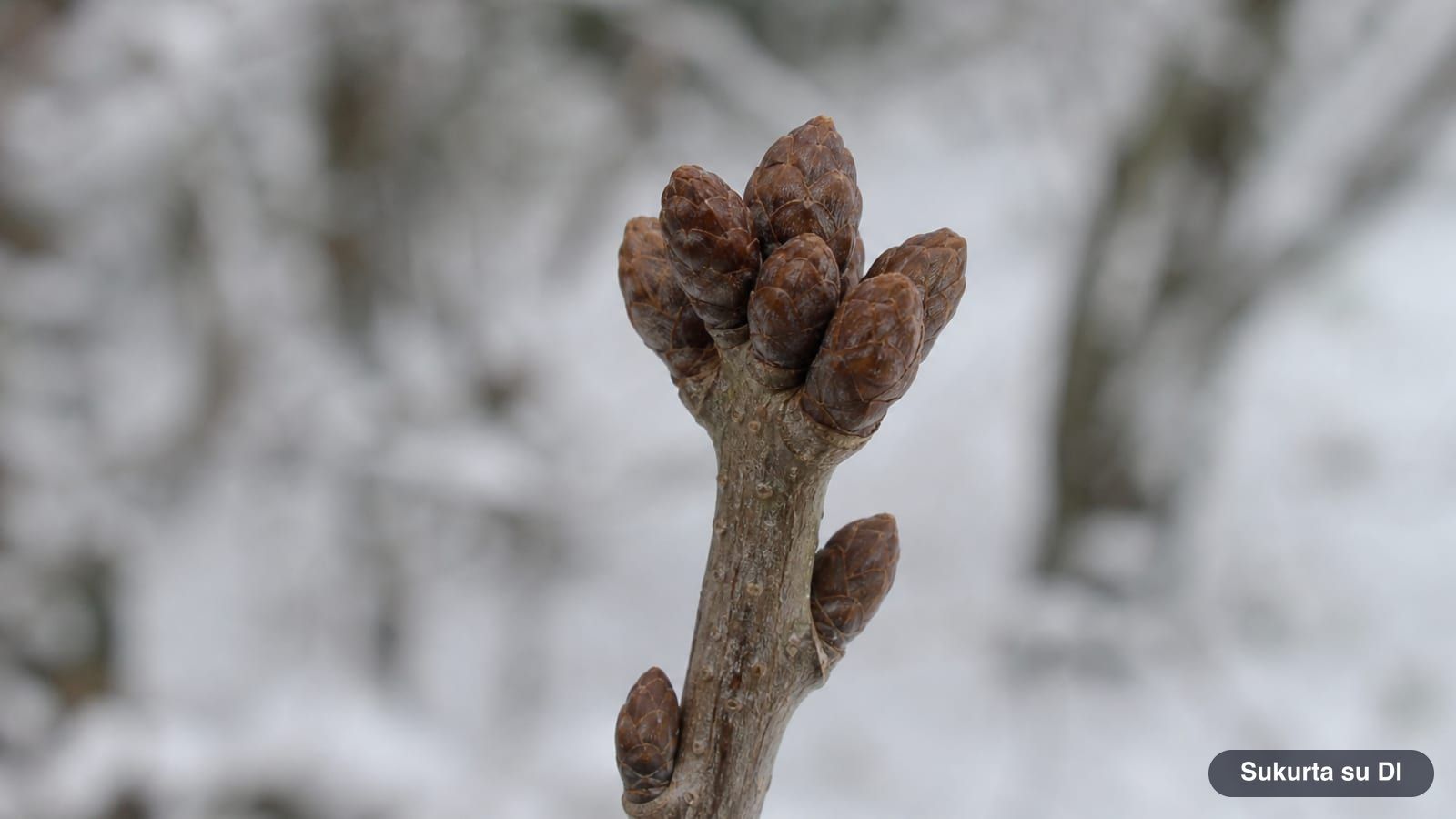
The bark of a young oak is smooth, grayish, and even slightly shiny. With age, it thickens, darkens to a blackish-gray, and develops deep longitudinal fissures with rough ridges—the trunks of old oaks are easy to identify even in the dark just by touching them. The buds are egg-shaped, blunt, 0.1–0.2 inches (3–5 mm) long, brown, and covered with numerous tiny scales. At the tip of the twig, they are clustered together, so in winter, an oak twig looks as if it has a small tuft of buds at the end.
English, Sessile, and Red Oaks: How to Tell Them Apart
In many parts of Europe, two very closely related oak species grow naturally—the widespread English oak and the sessile oak (Quercus petraea), which prefers slightly drier, hillier terrain. In parks, along roadsides, and sometimes in managed forests, you will also find the northern red oak (Quercus rubra), which was introduced from North America.
| Feature | English Oak | Sessile Oak | Northern Red Oak |
|---|---|---|---|
| Leaf stalk | Very short, 0.08–0.28 in (2–7 mm) | Long, 0.5–1 in (13–25 mm) | Long |
| Leaf lobes | Rounded, blunt | Rounded, more symmetrical | Pointed, with bristle tips |
| Acorns | On a long stalk | Stalkless, sitting directly on the twig | Rounder, in a shallow, flat cap |
| Autumn color | Yellowish-brown | Yellowish-brown | Bright red or reddish-brown |
| Origin | Native to Europe | Native to Europe | Introduced from North America |
In nature, hybrids of English and sessile oaks with intermediate characteristics also occur. The red oak grows faster—under good conditions, a ten-year-old sapling can reach 16–20 feet (5–6 m) in height—but it has a shorter lifespan, typically living around 200 years. In some countries, the red oak is considered an invasive species, so conservationists encourage planting native oaks to replace harvested trees.
Where Oaks Grow
The English oak is widely distributed across Europe, from the British Isles to the Caucasus, and is hardy in cool temperate climates (USDA zones 4–8). While pure oak forests exist, oaks more commonly grow in mixed broadleaf woodlands alongside ash, maple, spruce, linden, aspen, and alder. Countless solitary oaks also dot rural landscapes, parks, historic estates, and roadsides.
The oak requires deep, moist, but well-drained, fertile soil—typically loam or sandy loam. It is highly wind-resistant because it develops a massive, deep-reaching taproot, and it tolerates drought well. However, young saplings are sensitive to late spring frosts. The oak does not tolerate prolonged waterlogging or severely compacted soils.
How Long an Oak Lives and How Big It Gets
An oak grows slowly, especially in its first few decades, with its growth rate only accelerating after 30–40 years. It continues to grow in height for about 150–200 years, while its trunk continues to thicken throughout its entire life. A typical height is 65–115 feet (20–35 m), though solitary forest trees can reach up to 130 feet (40 m). Generally, English oaks live for 500–1,000 years, and exceptional specimens can survive even longer.
Some of the oldest known English oaks are found in Europe. For example, the Stelmužė Oak is estimated to be around 1,500 years old. We write more about these and other famous ancient trees in our section on the oldest and largest trees.
Oak Wood and Other Uses
Oak wood is hard, strong, and beautiful, with a density of about 45 lbs/ft³ (720 kg/m³). It is used to make high-quality furniture, parquet flooring, stairs, doors, and, historically, ships. It is highly durable in the open air, in the ground, and underwater. When submerged in water for centuries, it turns black and becomes even harder, forming highly prized "bog oak." All parts of the tree are rich in tannins: the bark contains about 12%, and the wood about 9%. Traditionally, oak leaves are added when pickling cucumbers to help keep them crisp.
Acorns are rich in starch but also contain tannins that make them very bitter. Raw acorns are inedible for humans. Historically, people made "acorn coffee" by leaching the tannins out of the acorns and then roasting them. Acorns are not harmless to all livestock: Wikipedia notes that northern red oak and English oak acorns are toxic to horses and cattle. In traditional folk medicine, oak bark decoctions were used as a rinse or gargle, though you should always consult a healthcare professional before trying herbal remedies.
The Oak in Culture and Mythology
In ancient European cultures, such as those of the Baltic region, the oak was a sacred tree, often associated with thunder gods like Perkūnas. Ancient oak trees growing in sacred groves were considered the dwellings of the gods, and offerings were made beneath their branches. The Latin species name robur means strength, and even today, the oak remains a universal symbol of endurance, power, and longevity. Tree-planting campaigns continue this legacy, with communities and forestry organizations planting oak groves to commemorate important historical anniversaries or to restore native woodlands.
How to Plant an Oak
It is easy to grow an oak from an acorn. Healthy acorns that fall in mid-autumn, just after the first frosts, germinate best. They can be sown immediately, planted shallowly in loose soil, or stored in a cool, moist place until spring. Choose a sunny spot with deep, fertile soil for your sapling, and leave plenty of room: a mature oak's canopy can span dozens of feet across, and its root system spreads wide and deep. It should not be planted right next to a house or over underground utilities. It is also wise to protect young trees from deer and rabbits, which love to nibble on the tender shoots and bark.
Frequently asked questions
How do you identify an English oak?
Look for lobed leaves with 4–6 pairs of rounded lobes, a very short stalk, and two ear-like bases. The acorns hang in small clusters on a long stalk, and the bark is thick, dark gray, and deeply fissured. In winter, it is identifiable by clusters of egg-shaped buds at the tips of its twigs.
When do oak acorns fall?
Acorns ripen and fall in early to mid-autumn. Oaks experience abundant seed-producing years, known as mast years, roughly every 4–5 years, meaning acorn crops can be massive one year and very sparse the next.
When does the oak tree bloom?
It blooms in mid-spring, at the same time the leaves are unfurling. The male flowers form long, drooping catkins, while the female flowers are tiny, bud-like structures on long stalks that eventually develop into acorns.
What is the lifespan of an oak tree?
English oaks typically live for 500–1,000 years, and exceptional solitary trees can survive even longer. Some ancient oaks in Europe are estimated to be well over 1,000 years old, though exact dating can be difficult.
Are oak acorns poisonous?
Acorns are very high in tannins, making them bitter and inedible raw. Wikipedia notes that acorns are toxic to horses and cattle. Humans historically ate them only after extensively leaching out the tannins and roasting them, such as for acorn coffee.
What is the difference between English and red oaks?
The northern red oak is native to North America. Its leaves are larger with pointed, bristle-tipped lobes, they turn bright red in autumn, and its rounder acorns sit in a flat, shallow cap. The English oak is native to Europe and has leaves with rounded lobes.
Log in to comment
No comments yet. Be the first.