Tree Leaf Identification Guide: How to Identify Trees
- The easiest way to identify a tree by its leaf is to answer three questions: is it simple or compound, how are they arranged, and what is the edge like.
- Opposite leaves are relatively rare among common temperate deciduous trees—look for them on maples, ashes, and horse chestnuts.
- Among conifers, pine needles grow in bundles, larch needles in clusters, and spruce needles attach individually.
- Autumn colors are caused by carotenoids (yellow, orange) and anthocyanins (red), which become visible when green chlorophyll breaks down.
- To make a leaf herbarium, press leaves between sheets of absorbent paper under a heavy weight for one to two weeks.
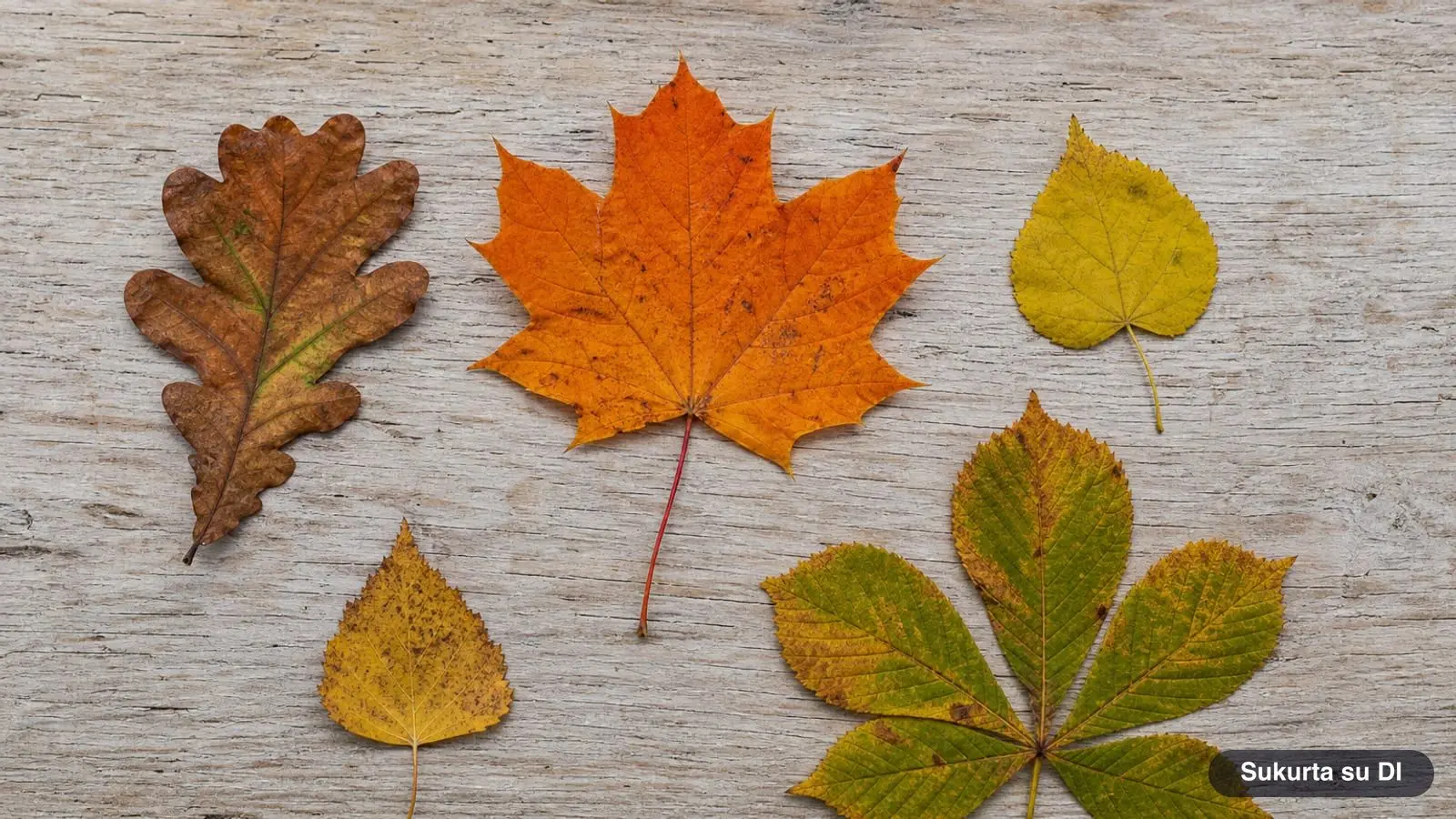
This article is part of the 77.today trees guide, prepared by the 77.today editors from the sources listed at the end.
Autumn is the best time to learn how to identify trees: leaves fall at your feet, making them easy to pick up, compare, and even bring home. In this part of our tree identification guide, you will find a comprehensive leaf atlas: what features to look for, how to distinguish common trees by their leaves, why leaves change color in the fall, and how to create a leaf herbarium. This guide is perfect for both adults and students who are often tasked with collecting leaves for school projects.
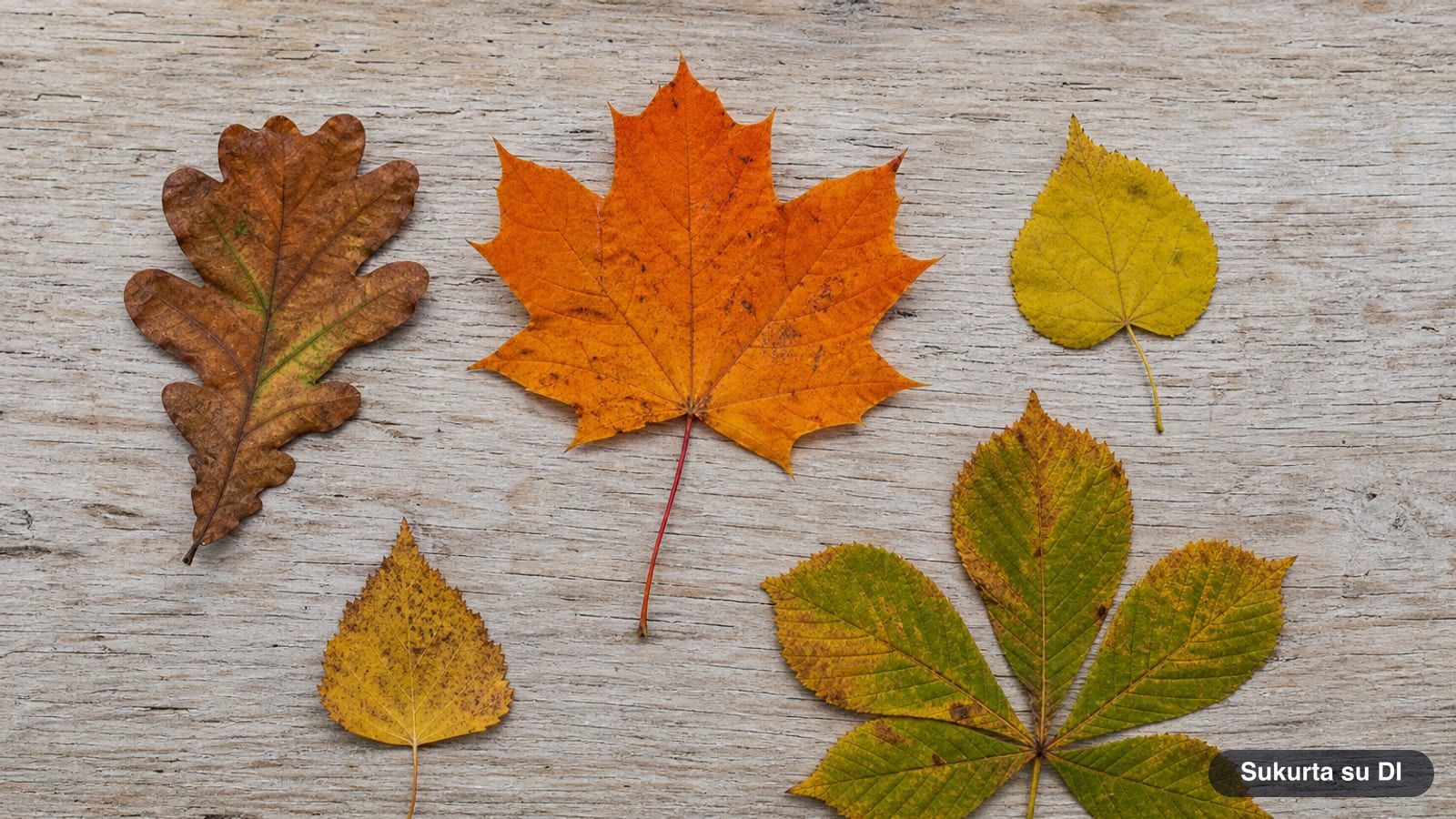
Parts of a Leaf
A typical tree leaf consists of a blade (lamina)—the flat, widest part—a petiole (leaf stalk) that attaches the leaf to the twig and allows it to turn toward the light, and a leaf base. The blade is crisscrossed by veins, which act as channels for water and nutrients while also serving as the leaf's skeleton. Veins can be pinnate (branching outward from a central midrib, as in an oak or birch leaf) or palmate (radiating from a single point in multiple directions, as in a maple leaf). The leaf is the tree's primary organ for nutrition: it is where photosynthesis takes place, and through it, the tree transpires water and exchanges gases.
Three Key Questions for Identification
1. Is the leaf simple or compound?
A simple leaf has a single, undivided blade, even if it is deeply lobed (like an oak or maple). A compound leaf is made up of several separate leaflets attached to a central stem. These can be pinnately compound—where leaflets are arranged in pairs along a central axis, often with a single terminal leaflet at the tip (like ash or rowan)—or palmately compound, where all leaflets radiate from a single central point (like horse chestnut). The best way to tell a leaflet of a compound leaf from a simple leaf is to look for the bud: a bud is always found at the base of the main leaf stalk (petiole) where it joins the twig, but never at the base of an individual leaflet.
2. How are the leaves arranged on the twig?
Most common deciduous trees in temperate climates have an alternate leaf arrangement—leaves grow one at a time, alternating along the twig. Opposite leaves, where two leaves grow directly across from each other at the same node, are much less common. Among widespread broadleaf trees, you will primarily see opposite leaves on maples, ashes, and horse chestnuts. This feature is also useful for winter identification, as the buds follow the exact same arrangement as the leaves.
3. What is the leaf shape and edge?
The outline of a leaf can be heart-shaped (linden/lime tree), triangular or diamond-shaped (silver birch), round (aspen), elliptical (beech), obovate—widest above the middle (oak, black alder), or lanceolate—narrow and long (willows). The edge (margin) can be smooth or entire (beech), serrated or toothed with forward-pointing teeth (linden, hornbeam, elm), double-toothed where the large teeth have smaller teeth on them (birch, hazel), wavy (aspen), or divided into lobes (oak, maple).
Leaf Identification Key
- Needles or scales? – These are conifers; see the table below. If the tree has broad leaves, go to step 2.
- Is the leaf compound? – If leaflets radiate from a single point: horse chestnut. If pinnately compound with opposite leaves: ash. If pinnately compound with alternate leaves and 9–15 toothed leaflets: rowan (mountain ash). If the leaf is simple, go to step 3.
- Are the leaves opposite and lobed? – Maple. If the leaves are alternate, go to step 4.
- Is the leaf lobed with rounded tips? – Oak. If it is unlobed, go to step 5.
- Is the leaf heart-shaped, finely toothed, with an asymmetrical base? – Linden (lime tree). If triangular or diamond-shaped, double-toothed, on a long stalk: birch. If round, with a wavy edge and a long flattened stalk that flutters in the wind: aspen. If obovate with a blunt or notched tip and slightly sticky when young: black alder. If narrow and long: willow. For other variations, see the table below.
Leaves of Common Deciduous Trees
| Tree | Leaf Type & Arrangement | Shape & Edge | Autumn Color |
|---|---|---|---|
| English Oak (Common Oak) | simple, alternate, clustered at twig ends | 4–6 pairs of rounded lobes, very short petiole with ear-like lobes at the base | yellowish-brown, some remain through winter |
| Norway Maple | simple, opposite | 5–7 lobes with long pointed teeth, milky sap in the petiole | yellow, orange, pinkish |
| Small-Leaved Linden (Lime Tree) | simple, alternate in two ranks | heart-shaped, finely serrated, 1.5–3 inches (4–8 cm) | yellow |
| Silver Birch | simple, alternate | triangular or diamond-shaped, double-toothed | pale yellow |
| Horse Chestnut | palmately compound, opposite | 5–7 large toothed leaflets | yellow, brown |
| Common Ash | pinnately compound, opposite | 7–15 pointed serrated leaflets | often fall while still green |
| Black Alder | simple, alternate | obovate, blunt or notched tip, sticky when young | fall while green |
| Eurasian Aspen | simple, alternate | round, wavy edge, long flattened petiole | yellow, orange, red |
| Common Hornbeam | simple, alternate | ovate, double-serrated, prominent parallel veins | yellow, dry leaves persist in winter |
| Elms | simple, alternate | asymmetrical base, double-serrated, rough texture | yellow |
| Common Hazel | simple, alternate | nearly round, heart-shaped base, double-toothed, hairy | yellow |
| Rowan (Mountain Ash) | pinnately compound, alternate | 9–15 oblong serrated leaflets | orange, red |
| Willows | simple, alternate | lanceolate, narrow, long | yellow |
| Bird Cherry | simple, alternate | elliptical, finely serrated, pointed tip | yellow, pinkish |
| European Beech | simple, alternate | elliptical, smooth or wavy ciliated edge | copper brown |
Conifer Needles
Needles are also leaves, but they are narrow, rigid, and covered with a thick layer of wax to reduce water loss during winter. The easiest way to identify conifers is by observing how their needles grow from the twig.
| Tree | How Needles Grow | Other Features |
|---|---|---|
| Scots Pine | in pairs from a common sheath, 1.5–3 inches (4–8 cm) long | bluish-green, slightly twisted, last 2–3 years |
| Norway Spruce | individually, all around the twig | short, four-sided, pointed |
| Larch | in clusters of 20–40 on short shoots | soft, light green, turn yellow and fall in autumn |
| Common Juniper | in whorls of 3 | very prickly, with a white band on the upper surface |
| European Yew | individually, arranged in two flat rows | flat, soft, dark green; all parts of the plant except the red aril are poisonous |
| Northern White-Cedar (Arborvitae) | scale-like leaves pressed tightly against flat twigs | fragrant when crushed; these are actually scales, not true needles |
Why Leaves Change Color in Autumn
In summer, leaves are green because they are full of chlorophyll, the pigment that absorbs sunlight for photosynthesis. Leaves also contain yellow and orange carotenoids year-round, but during the summer, these are masked by the dominant green color. In autumn, as days grow shorter and temperatures drop, the tree stops producing chlorophyll. It breaks down the remaining chlorophyll and reabsorbs valuable nutrients, especially nitrogen, back into its branches and roots for winter storage. As the green fades, the underlying yellow and orange pigments are revealed—this is why birches, lindens, and aspens turn golden yellow.
Red and purple colors have a different origin: anthocyanins are newly synthesized in the leaves from trapped sugars during the autumn. The highest production of anthocyanins occurs on bright, sunny days followed by cool, but not freezing, nights, which is why dry, clear autumns produce the most vibrant displays. Maples, rowans, aspens, and red oaks are famous for their brilliant red hues. Brown colors, on the other hand, are the result of dead cells and tannins, which is why oak and beech leaves eventually turn a rich, coppery brown.
Why Trees Lose Their Leaves
In winter, roots can hardly absorb any water from frozen ground. If broad leaves remained on the tree, they would continue to transpire moisture, causing the tree to dry out and die. Furthermore, heavy snow accumulating on a fully leafed canopy would break branches. To prevent this, an abscission layer forms at the base of the leaf stem in autumn. The cells in this layer weaken until the leaf detaches and falls, leaving behind a leaf scar sealed with protective corky tissue. Young oaks, beeches, and hornbeams often hold onto their dry leaves until spring—a phenomenon known as marcescence—because their abscission layer only fully forms just before new leaves emerge. Fallen leaves also benefit the forest ecosystem, decomposing to return vital nutrients to the soil.
How to Make a Leaf Herbarium
- Collect healthy, untorn leaves on a dry day, ideally with the petiole (leaf stalk) attached. Do not take apart compound leaves; press them whole.
- Arrange the leaves between sheets of absorbent paper—such as newspaper, drawing paper, or blotting paper—making sure the leaves do not touch or overlap.
- Press them under heavy books or a weighted board. Change the paper daily for the first few days to prevent mold from forming.
- After 1 to 2 weeks, once the leaves are completely dry, glue them or secure them with small strips of paper onto a thick sheet of cardstock.
- Label each specimen with the tree's common name, Latin name, collection location, and date—just as professional botanists do in real herbariums.
Leaves that are dried quickly tend to retain their vibrant autumn colors much better. If you want the leaves to remain flexible, you can briefly soak them in a solution of glycerin and water, though simple pressing is perfectly adequate for a standard school herbarium or personal collection.
Leaves Through the Seasons
In cool temperate climates, bird cherries, birches, willows, and hazels are among the first to leaf out in early spring, while oaks and ashes are some of the last. Summer is the best time to compare leaves, particularly in June, when they are fully unfurled but not yet damaged by pests. In autumn, leaves do not change color all at once: birches and lindens are usually the first to turn yellow in early fall, followed by maples and aspens mid-season, while oaks are typically the last to turn brown. In winter, you can identify trees by their buds, bark, and overall silhouette—which we cover in detail on each species' dedicated page, such as our guides to the oak, birch, or linden tree.
Frequently asked questions
How do you identify a tree by its leaf?
First, determine if the leaf is simple or compound (multiple leaflets on a single stem). Next, check if the leaves are arranged in opposite pairs or alternately along the twig. Finally, look at the leaf shape and edge: lobed, heart-shaped, triangular, smooth, or toothed. These three features are usually enough to identify most common trees.
Which trees have compound leaves?
Among common trees, ashes and rowans (mountain ashes) have pinnately compound leaves, while horse chestnuts have palmately compound leaves (with 5 to 7 leaflets). Black locusts, box elders, and walnut trees also feature compound leaves.
Why do leaves change color in autumn?
As days shorten, the tree stops producing green chlorophyll and breaks it down. This reveals the yellow and orange carotenoids that were in the leaf all summer. Red shades come from anthocyanins, which are newly produced in autumn, especially during sunny days and cool nights.
Why do trees lose their leaves?
In winter, roots cannot absorb water from frozen ground, and broad leaves would continue to lose moisture, causing the tree to dry out. Therefore, in autumn, an abscission layer forms at the base of the leaf stem, the leaf detaches, and a corky scar seals the wound.
How do you dry leaves for a herbarium?
Collect dry, healthy leaves, place them between absorbent paper (like newspaper or blotting paper), and press them with books or another heavy weight. Change the paper daily for the first few days. After 1 to 2 weeks, the leaves will dry flat and retain their shape.
Which conifers lose their needles?
The larch is a deciduous conifer that drops all its needles every autumn. Pines and spruces shed their oldest needles gradually—pine needles typically last 2 to 3 years, so only the inner, oldest needles turn yellow and fall in autumn.
Log in to comment
No comments yet. Be the first.