Oldest and Largest Trees: Notable European Records
- The Stelmužė Oak in the Baltic region is considered one of the oldest and thickest trees in Northern Europe, with an estimated age of about 1,500 years.
- The Laukiai Oak won the 2026 European Tree of the Year award, marking a historic victory for Baltic heritage trees.
- Among the tallest trees in the region is a 161-foot (49 m) European larch located in the Degsnė forest, planted in 1849.
- Other notable records include a 144-foot (44 m) double-topped pine and a towering oak reaching approximately 125 feet (38 m).
- A tree's exact age can only be determined by counting its annual rings, though estimates for ancient hollow trees rely on girth and historical records.
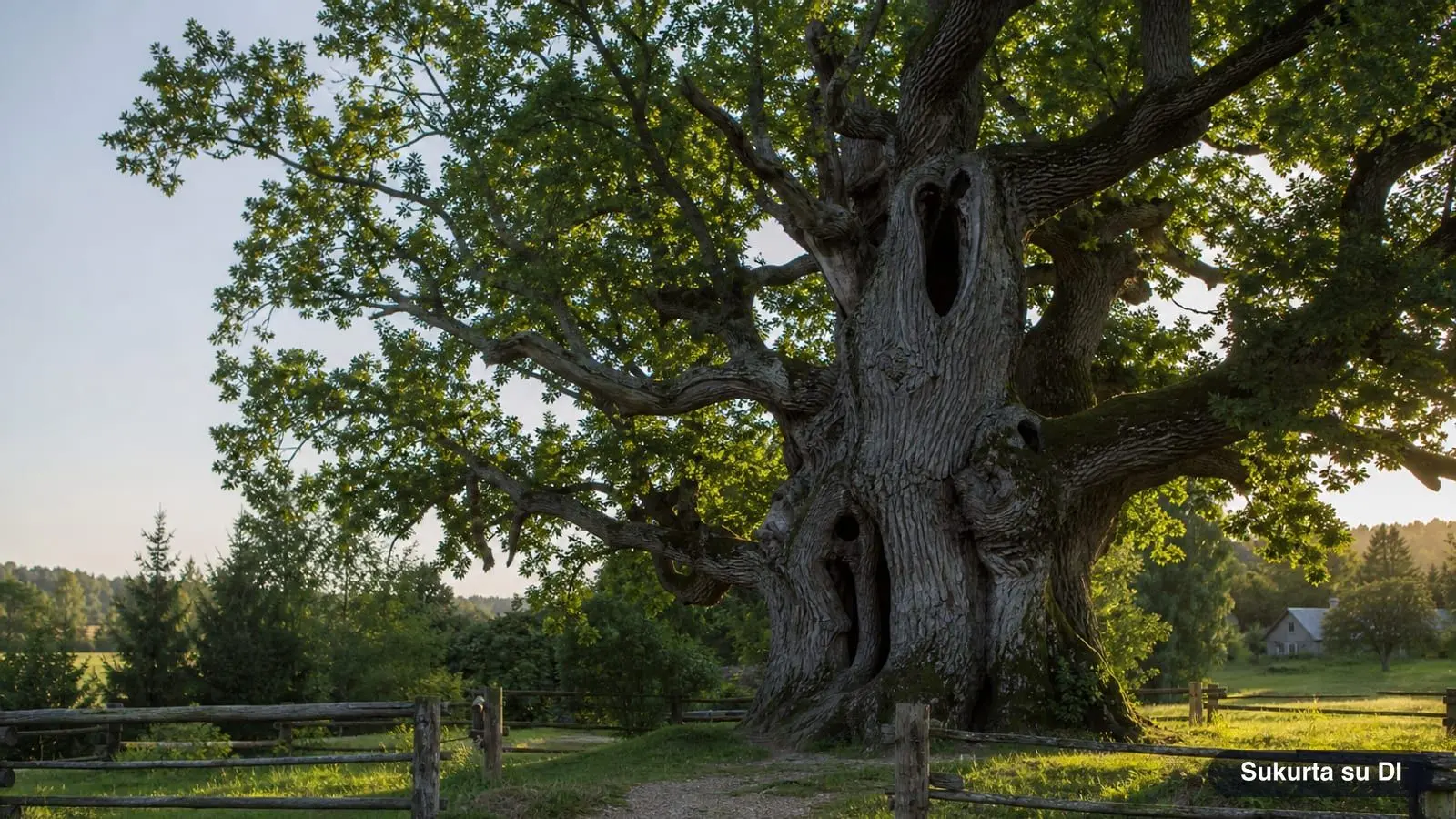
This article is part of the 77.today trees guide, prepared by the 77.today editors from the sources listed at the end.
The Baltic region and Northern Europe are home to ancient trees – the examples below are from Lithuania – that have witnessed centuries of history, from medieval battles to the shifting of borders. Most of these venerable giants are oaks, as they are the longest-living broadleaf trees in the area, but the record-holders also include towering larches, pines, and lindens. In this section of our tree guide, we have gathered some of the oldest, thickest, and tallest trees in the region: where they grow, their size and age, what makes them famous, and how to visit them.
The Stelmužė Oak – An Ancient Giant
In the Zarasai district of northeastern Lithuania lies the village of Stelmužė, home to a famous natural monument: the Stelmužė Oak. It is considered the oldest and thickest English oak in the region and one of the oldest in Europe. Its age is most frequently cited as around 1,500 years, though this is only an estimate. Guesses range from 1,000 to 2,000 years, and because the trunk is completely hollow, counting the annual rings is impossible.
The measured trunk girth at 4.3 feet (1.3 m) above the ground is 31.4 feet (9.58 m). The tree reaches a height of 62 feet (19 m), with a crown diameter of about 66 feet (20 m). Declared a natural monument and voted a National Tree of the Year in 2016, it first received conservation care in 1916 when its hollow was boarded up and a fence was built. Today, the ancient tree is in fragile condition: fungi and infections have damaged the trunk, so visitors are prohibited from walking in the root zone, and arborists recommend mulching the surrounding area and pruning branches that are at risk of breaking.
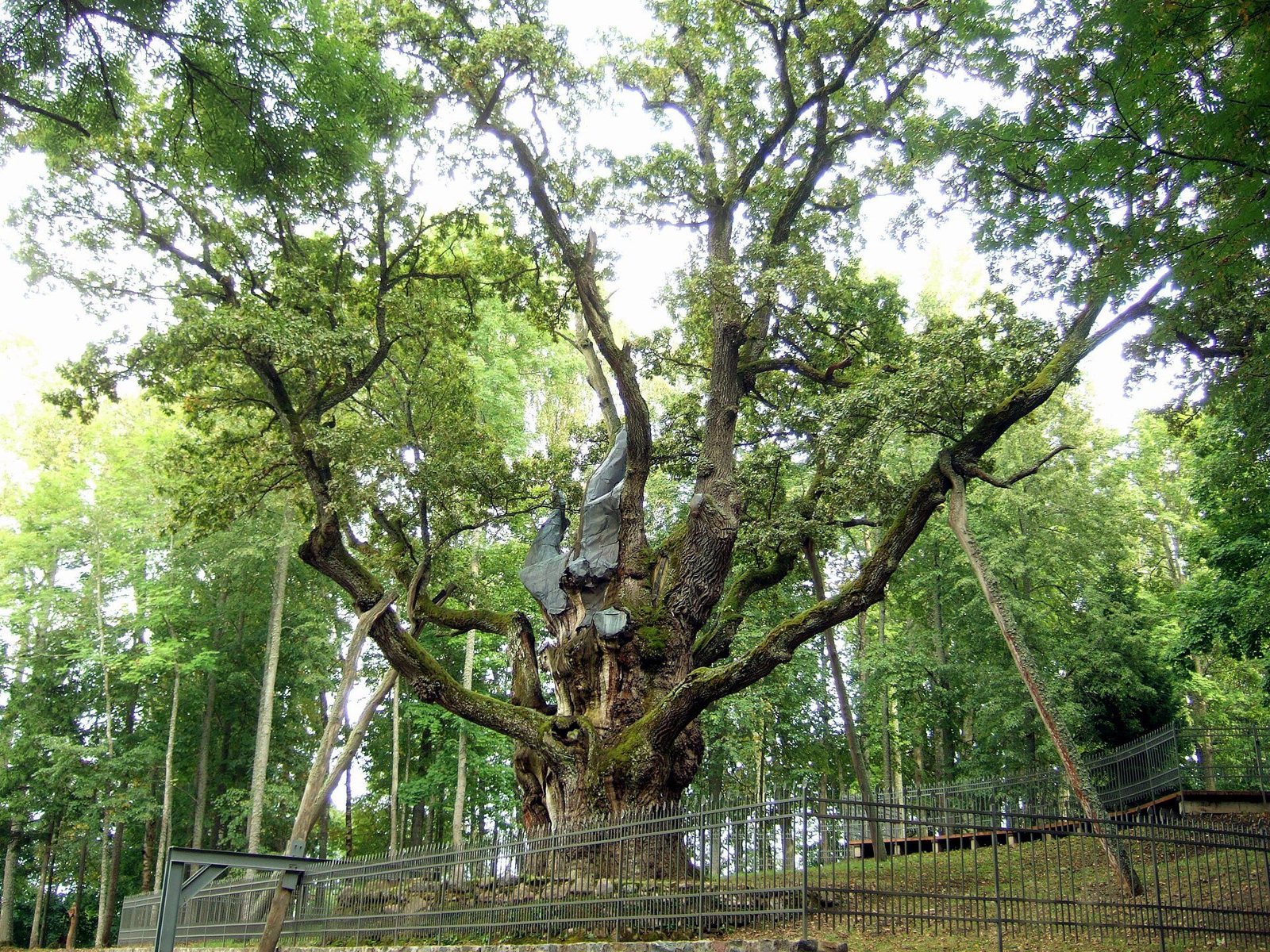
Many legends surround the Stelmužė Oak: tales say that its hollow leads to the underworld, that a treasure is buried beneath its roots, and that sacred fires once burned under its branches. The area is famous not only for the oak but also for a historic wooden church nearby, making it a worthwhile destination for a half-day trip.
The Laukiai Oak – 2026 European Tree of the Year
The Laukiai Oak grows in the Skuodas district, in the village of Rukai, on the former Laukiai family homestead. According to legend, the oak was planted over 350 years ago by the Laukiai family to grow alongside their five sons and protect the land. The tree has been nurtured by six generations of the family and the local community, who improved its surroundings in 2025: they laid a path, encircled the oak with a low stone wall, and installed a bench and an information board.
The oak's trunk girth at 4.3 feet (1.3 m) high is about 16.7 feet (5.1 m), its height is around 89 feet (27 m), and its crown spread is roughly 92 feet (28 m). Its age is estimated at 350–400 years. In 2025, it was named a National Tree of the Year, and on March 24, 2026, it was announced in Brussels that the Laukiai Oak had won the European Tree of the Year contest. It scored 6,153 points, defeating a Slovakian apple tree (4,766 points) and a Polish elm (4,720 points). This marked a historic first victory for a Baltic tree in the contest's 15-year history.
Other Old and Famous Oaks
The Stakai Oak grows in a historical regional park forest in the southeastern Baltic region. Its age is estimated at around 1,000 years. In 2017, forestry officials recorded the oak at 79 feet (24 m) tall, with a trunk girth of about 16.4 feet (5 m), noting that both the trunk and crown were completely healthy. It has been state-protected since 2003.
The oldest oak in Vilnius grows in the Bernardinai Garden. Estimated to be nearly 500 years old, it is about half as thick and perhaps a third the age of the Stelmužė Oak. During the construction of a nearby transformer substation, the tree lost a significant portion of its root system. To prevent it from toppling onto park visitors, arborists pruned the large branches and shaped it into a snag during park renovations.
Other notably thick oaks in the region include the Lenkaičiai Oak (girth up to 29.5 ft / 8.98 m), the Kybarčiai Oak (27.6 ft / 8.40 m), and the Mingėla Oak (26.6 ft / 8.10 m). The tallest known oak in the area grows in the Jūrava forest, reaching about 125 feet (38 m). There are over 145 oaks designated as natural monuments in the region. Read more about this species in our English oak guide.
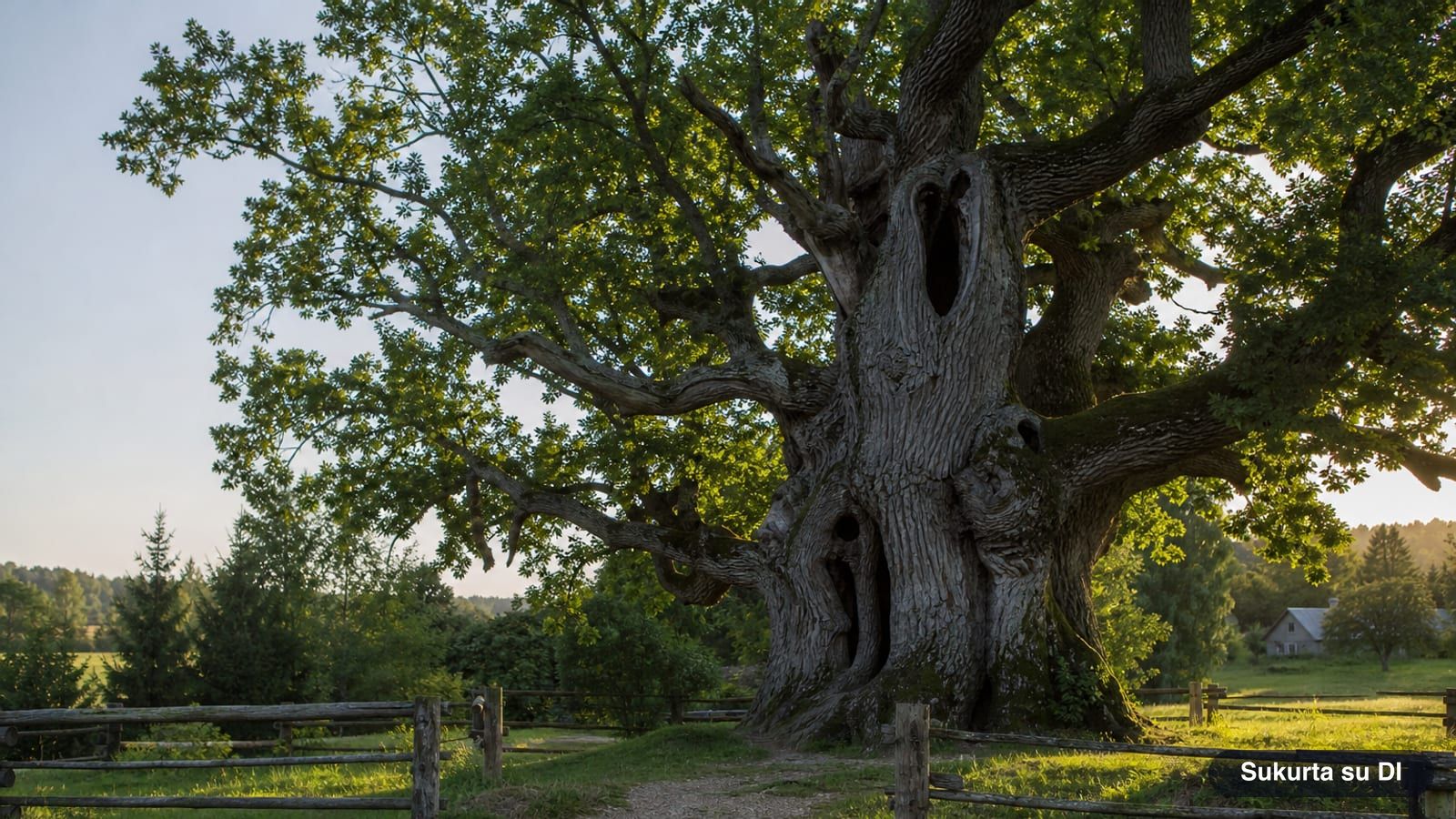
The Tallest Trees in the Region
The tallest tree in the region is neither a pine nor a spruce, but a European larch. On the edge of the Degsnė forest, the first larches were planted in 1849, and today the larch grove covers 6.7 acres (2.7 ha). According to protected areas data, the average tree height in the Degsnė grove is about 138 feet (42 m), with the tallest trees exceeding 148 feet (45 m), and the absolute record-holder reaching 161 feet (49 m). The grove has been protected since 1960.
The tallest known pine in the region is the 144-foot (44 m) Kiauneliškis double-topped pine in a local nature reserve, which forks into two crowns at a height of about 98 feet (30 m). Until 2014, the 139-foot (42.5 m) Punia pine was considered the tallest. Both species are described in our pine tree guide. The tallest recorded introduced eastern white pine in the area reaches 138 feet (42 m).
| Record | Tree | Location | Data |
|---|---|---|---|
| Oldest, thickest | Stelmužė Oak | Zarasai district | ~1,500 years, girth 31.4 ft (9.58 m) |
| Tallest tree | Degsnė Larch | Prienai district | 161 ft (49 m) |
| Tallest pine | Kiauneliškis double-topped pine | Kiauneliškis Nature Reserve | 144 ft (44 m), ~200 years |
| Tallest oak | Jūrava forest oak | Jūrava forest | ~125 ft (38 m) |
| European Tree of the Year 2026 | Laukiai Oak | Skuodas district, Rukai | ~350–400 years, ~89 ft (27 m) |
| ~1,000-year-old oak | Stakai Oak | Šalčininkai district | 79 ft (24 m), girth ~16.4 ft (5 m) |
| Most trunks | Spraudė forest linden | Rietavas municipality | 30 trunks |
Famous Linden Trees
Lindens are second only to oaks in their number of old and famous specimens in Northern Europe. For a long time, the Papilė linden, with its 13 trunks, was considered the multi-trunk record holder, until a linden with an astonishing 30 trunks was discovered in the Spraudė forest in 2010. The "Motinėlė" (Mother) linden in the village of Braziūkai is one of the oldest and thickest lindens in the region. In 2018, the Raudonė linden was voted a National Tree of the Year. In a regional park near Kaunas, the 82-foot (25 m) tall Žiegždriai linden grows among conglomerate outcrops, boasting a trunk girth of 14.1 feet (4.3 m). Learn more about these trees in our linden tree guide.
European Tree of the Year Contest
The European Tree of the Year contest has been organized by the Environmental Partnership Association since 2011. It focuses not on the size or age of the tree, but on its history and its connection to people. Winners of national contests advance to the European stage, where anyone can vote online. National Tree of the Year elections are organized by local arboricultural centers. Notable regional winners that have advanced to the European stage include the Stelmužė Oak (2016), the Witches' Spruce (2017), the Raudonė linden (2018), and the Laukiai Oak (2025).
How Trees Become Protected Heritage Sites
Exceptional individual trees—whether they are ancient, unusually thick, exceptionally tall, or historically significant—can be declared botanical natural heritage objects. Around the world, such trees are entered into state or national registries and are managed by protected area directorates or local municipalities, which can also designate locally significant heritage trees. A protected tree cannot be felled, damaged, or pruned without a special permit. Therefore, before carrying out major work on an old tree on your property, it is always advisable to check with local environmental or arboricultural authorities to see if it is listed as a protected specimen.
How Tree Age is Determined
The most accurate method is counting the annual rings: every year, a tree grows one lighter spring layer and one darker summer layer of wood. For a living tree, rings are counted on a tiny core sample extracted with a specialized increment borer. However, ancient oaks and lindens are usually hollow, so their age must be estimated based on trunk girth, the typical growth rate for that species in the local climate, and historical documents. Because of this reliance on estimation, different sources can often provide vastly different age figures for the exact same tree.
How to Visit Old Trees Responsibly
The greatest threat to ancient trees is often not the wind, but human activity: compacted soil around the trunk, torn bark, and trash stuffed into hollows. When visiting famous heritage trees, stay on designated paths, avoid climbing on the roots or trunk, and never light fires under the canopy. A tree's root zone extends at least as far as its canopy spread (the drip line), so even regular foot traffic around the trunk can severely weaken a centuries-old tree over just a few years.
Frequently asked questions
What is the oldest tree in the Baltic region?
The Stelmužė Oak is widely considered the oldest in the region. Its age is estimated at around 1,500 years, though experts suggest anywhere from 1,000 to 2,000 years, as old hollow trees cannot be precisely dated.
What is the tallest tree in the region?
A European larch in the Degsnė forest holds the record, reaching 161 feet (49 m). The average tree height in this larch grove, planted in 1849, is about 138 feet (42 m).
Where is the Laukiai Oak located?
It grows in the village of Rukai in the Skuodas district of the Baltic region, on a former family homestead. The site is adapted for visitors with a path, an information board, and a bench.
When did the Laukiai Oak become European Tree of the Year?
On March 24, 2026, it was announced in Brussels that the Laukiai Oak won the European Tree of the Year contest with 6,153 points. A Slovakian apple tree took second place, and a Polish elm took third.
Where is the oldest oak in Vilnius?
It grows in the Bernardinai Garden. Estimated to be nearly 500 years old, it was pruned and shaped into a snag during park renovations because it had lost most of its root system.
How is a tree's age determined?
The most accurate method is counting the annual rings on a cross-section or a core sample taken with an increment borer. Since ancient trees are often hollow, their age is usually estimated based on trunk girth, growth rate, and historical sources.
Log in to comment
No comments yet. Be the first.