Bernese Mountain Dog: Size, Temperament, Care & Health
- The Bernese Mountain Dog is one of four Swiss mountain dogs and the only one with a long coat.
- Farmers used them to drive cattle and pull milk and cheese carts, earning them the local nickname of "cheese dog."
- In 1907, breeders from the Burgdorf region, led by Professor Albert Heim, founded the first breed club and wrote the standard.
- Males stand 25–27.5 inches and weigh 80–115 lbs, while females are 23–26 inches and 70–95 lbs; they live only 7–10 years.
- They have a high risk of cancer, elbow dysplasia, and degenerative myelopathy, making parental health testing essential.
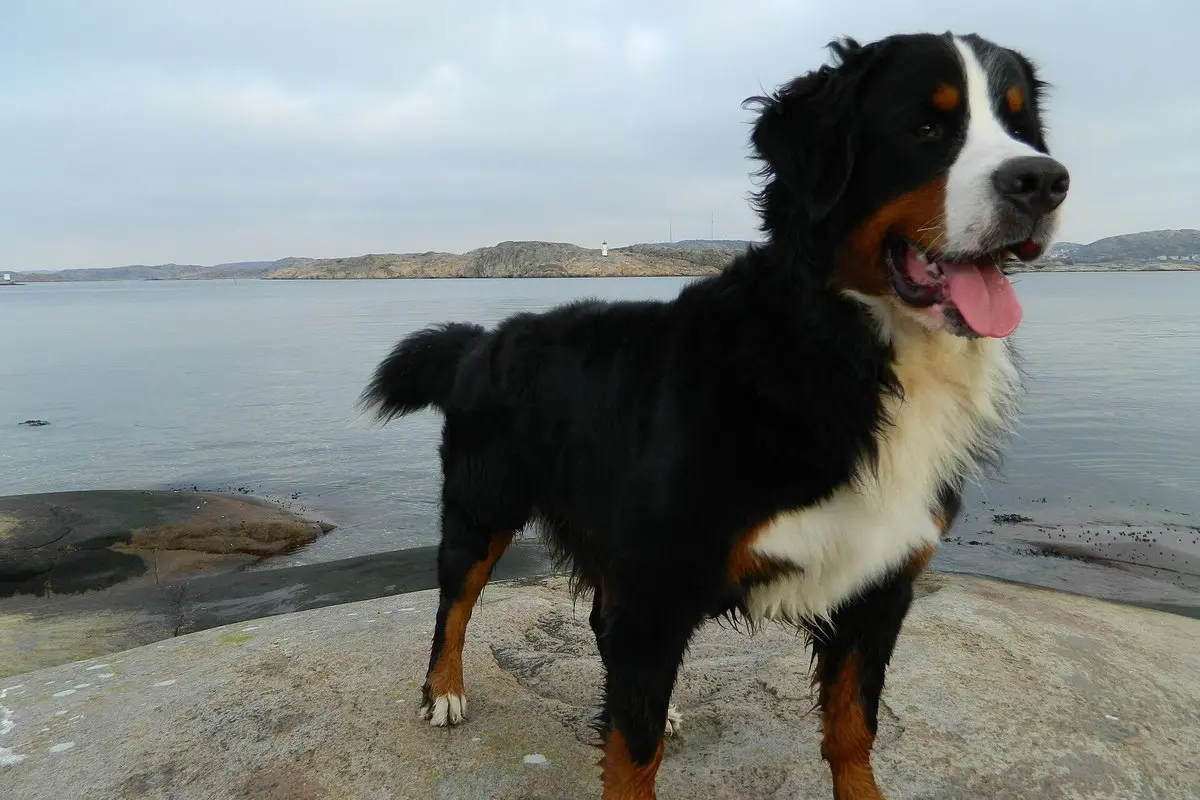
- The Bernese Mountain Dog – Switzerland's "Cheese Dog"
- Appearance: A Tricolor Mountain Giant
- Temperament: A Gentle Giant
- Health: A Short Lifespan and Important Screenings
- Care
- The Four Swiss Mountain Dogs
- The Bernese Mountain Dog is perfect for families with space in cooler climates
- How to Choose a Bernese Mountain Dog Puppy
This article is part of the 77.today dog breeds guide, prepared by the 77.today editors from the sources listed at the end.
The Bernese Mountain Dog is a large, powerful working dog that is also one of the gentlest family companions. Its glossy black coat with a white "Swiss cross" on the chest and rust markings over the eyes and on the legs make it one of the most recognizable dogs in the world. The AKC describes them as calm dogs who are always ready to play with their owner, for whom they live. In this dog breed directory profile, you will find the history, appearance, temperament, and health risks of the Bernese Mountain Dog (German: Berner Sennenhund).
| Origin | Switzerland (Canton of Bern) |
|---|---|
| FCI Group | Group 2 – Swiss Mountain and Cattle Dogs (No. 45) |
| Height | males 25–27.5 inches, females 23–26 inches |
| Weight | males 80–115 lbs, females 70–95 lbs |
| Coat | long, dense, silky, with undercoat |
| Colors | black with white and rust markings |
| Lifespan | 7–10 years |
| Temperament | gentle, calm, affectionate, aloof with strangers |
| Suitable for | families with children, cooler climates |
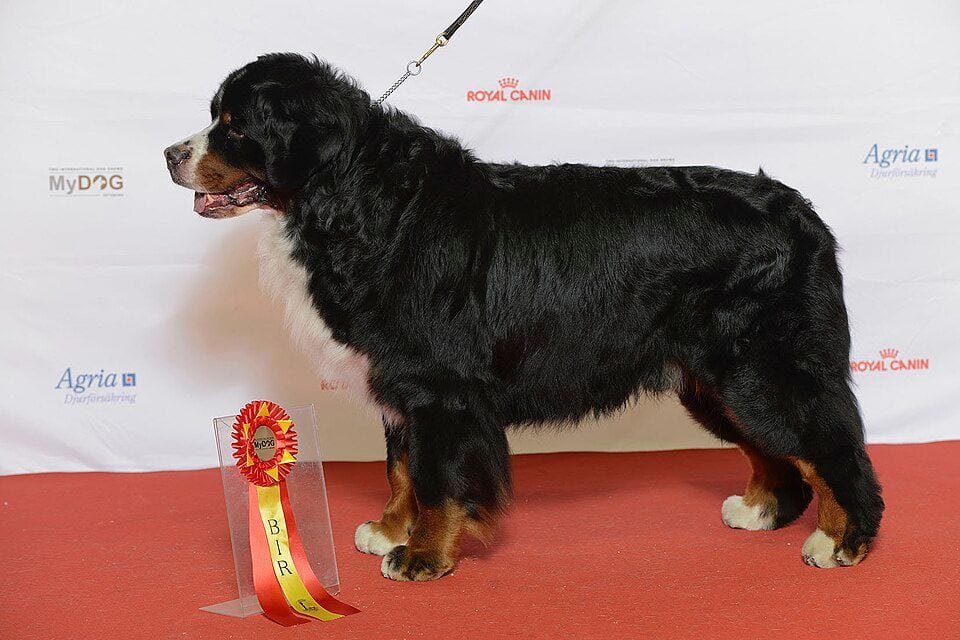
The Bernese Mountain Dog – Switzerland's "Cheese Dog"
The Bernese Mountain Dog is one of four Swiss mountain dogs whose ancestors are linked to Roman mastiffs. The name comes from the Canton of Bern and the German words Senne (Alpine pasture, and the dairymen and herders who worked there) and Hund (dog). In some areas, they were called Dürrbachhund, after the small town of Dürrbach where these dogs were especially numerous. Farmers used them to guard homesteads, drive cattle from farms to Alpine pastures, and pull carts loaded with milk and cheese, which is why locals called them "cheese dogs." The AKC notes that Bernese Mountain Dogs can pull loads several times their own weight.
By the late 19th century, the number of these dogs was declining, and the quality of the remaining ones was poor. In the early 20th century, enthusiasts began showing the remaining dogs at exhibitions in Bern, and in 1907, a few breeders from the Burgdorf area, led by the respected canine expert Professor Albert Heim, founded the first breed club and wrote the standard. By 1910, 107 dogs were registered, and the breed was officially recognized in 1912. In 1926, a Kansas farmer brought the first pair to the US. The AKC recognized the breed in 1937, and the FCI in 1954. In German-speaking countries, it remains one of the most popular family dogs.
Appearance: A Tricolor Mountain Giant
The Bernese Mountain Dog is a large, heavy, highly muscular dog with a broad, strong back, slightly longer than it is tall. The head is flat on top, the ears are medium-sized, triangular, set high, and rounded at the tips, and the eyes are dark and intelligent. The tail is bushy and carried low. This is a "dry-mouthed" breed that drools very little.
Of the four Swiss mountain dogs, only the Bernese has a long coat—dense, silky, medium-length, with a wooly undercoat. The color is black with a white chest and rust markings over the eyes, on the cheeks, the fronts of the legs, and around the white chest. An ideally marked dog has a white "horseshoe" around a nose that is always black, and a white "Swiss cross" on the chest. The AKC standard disqualifies blue eyes and any ground color other than black.
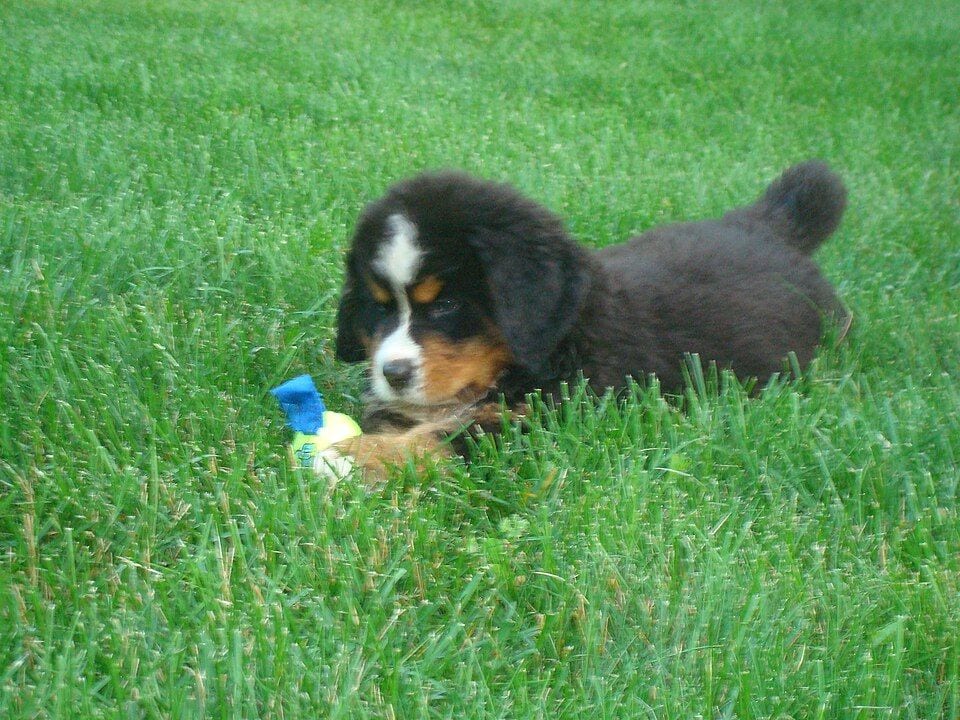
Temperament: A Gentle Giant
The AKC describes Bernese Mountain Dogs as calm, affectionate, and eager to please their owners. They get along with the entire family and are particularly gentle with children, though they often become most attached to one "lucky" person. With strangers, Berners maintain a dignified and aloof demeanor—they look impressive but are not threatening. They are intelligent and easy to train but sensitive: harsh corrections and heavy-handed methods do not work for them.
The Bernese Mountain Dog wants to live with its family—if regularly left alone for long periods, they can develop undesirable behaviors. They enjoy long walks, hiking, camping, pulling children in carts, and even drafting competitions. As a large breed, early socialization and obedience training are especially important.
Health: A Short Lifespan and Important Screenings
- Cancer – very common in the breed; one study found it accounted for 55% of deaths.
- Elbow and hip dysplasia – studies show the prevalence of elbow dysplasia ranges from 14–26%.
- Degenerative myelopathy – there are two DNA-testable mutations, one of which is unique to Bernese Mountain Dogs.
- Kidney disease – a Swiss study found the incidence of kidney disease was higher than in any other breed.
- Gastric dilatation-volvulus (bloat), blood disorders, and progressive retinal atrophy.
Care
- Coat. Brush once a week, and daily during shedding seasons; detangle mats with a slicker brush or metal comb.
- Exercise. At least half an hour of moderate exercise a day; avoid overloading puppies' joints.
- Heat. They love the cold, so in summer they need shade, plenty of water, and walks only during the coolest parts of the day.
- Ears, nails, teeth. Regular inspection and maintenance.
The Four Swiss Mountain Dogs
| Breed | Size | Coat |
|---|---|---|
| Bernese Mountain Dog | large | long, tricolor |
| Greater Swiss Mountain Dog | largest | short, tricolor |
| Appenzeller Sennenhund | medium | short, tricolor |
| Entlebucher Mountain Dog | smallest | short, tricolor |
The Bernese Mountain Dog is perfect for families with space in cooler climates
The Bernese Mountain Dog is one of the gentlest large dogs, but their size, thick coat, and shorter lifespan require careful consideration.
- Good for: families with children, homes with a yard, people who enjoy hiking and camping, and living in cooler climates.
- Not for: small walk-up apartments, people who frequently leave their dog alone, and families who may struggle with higher veterinary costs.
The US climate varies widely, but Bernese Mountain Dogs thrive in cooler regions. In the winter, they love rolling in the snow, while on hot summer days, they require air conditioning, shade, fresh water, and walks only during the coolest hours of the early morning or late evening.
How to Choose a Bernese Mountain Dog Puppy
Because the breed has a short lifespan, it is especially important to choose a reputable breeder who tests the parents' hips, elbows, hearts, and eyes, performs DNA tests for degenerative myelopathy, and knows the longevity of their lines. Ask how long the puppy's grandparents and great-grandparents lived. Meet the mother to observe her temperament—she should be calm and friendly. In the US, puppies should be registered with the AKC, and veterinarians highly recommend microchipping your new dog. We discussed other general rules for finding a responsible breeder in our guide introduction.
You can find other large family dogs in the profiles for the Saint Bernard, Newfoundland, and Golden Retriever.
Frequently asked questions
How much does a Bernese Mountain Dog weigh?
According to the AKC, males weigh 80–115 lbs and females weigh 70–95 lbs. Male height at the withers is 25–27.5 inches, and females are 23–26 inches. Under the FCI standard, the ideal height is 26–27 inches for males and 23.5–25 inches for females.
Why do Bernese Mountain Dogs have a short lifespan?
The AKC notes a lifespan of 7–10 years. Cancer is very common in the breed—one study found it caused 55% of deaths. Elbow dysplasia, kidney disease, and degenerative myelopathy are also prevalent.
Is the Bernese Mountain Dog good for families with children?
Yes. The AKC notes that Bernese Mountain Dogs get along with the whole family and are especially gentle with children, though they often attach most closely to one person. Because of their large size, playtime between small children and puppies should be supervised.
Do Bernese Mountain Dogs shed a lot?
Yes. Their double coat sheds year-round and blows out heavily twice a year. The AKC recommends brushing them once a week, and daily during shedding seasons.
Is a Bernese Mountain Dog suitable for an apartment?
This is a large breed that loves cool weather, so they do best in a home with a yard. They only need about half an hour of moderate exercise a day, but they must live indoors with their family, not left alone outside.
Sources
- Wikipedia: Bernese Mountain Dog
- AKC: Bernese Mountain Dog breed profile
- FCI: Bernese Mountain Dog breed standard (No. 45)
- Cover photo: Bernese Mountain Dog standing on a rock by the sea (Photo: Zebbanvettu, CC BY-SA 3.0)
- Wikimedia Commons photo: Bernese Mountain Dog at a dog show (Photo: Svenska Mässan from Sweden, CC BY 2.0)
- Wikimedia Commons photo: Bernese Mountain Dog puppy in the grass (Photo: Scovetta, CC BY 3.0)
Log in to comment
No comments yet. Be the first.