Weimaraner: Temperament, Size, Care & Health
- The Weimaraner originated around Weimar in Thuringia and was recognized as a distinct breed in 1891.
- Initially considered a blue variety of the German Shorthaired Pointer, 14 dogs were exhibited in Berlin in 1880.
- Males stand 23–27.5 inches and weigh 65–90 lbs; females are 22.5–25.5 inches and 55–75 lbs. They come in short- and long-haired varieties.
- Coat colors include mouse-gray, roe-gray, or silver-gray; eyes are amber, ranging from light to dark.
- Highly energetic and intelligent—a tired Weimaraner is a good Weimaraner; the most serious health risk is gastric torsion (bloat).

This article is part of the 77.today dog breeds guide, prepared by the 77.today editors from the sources listed at the end.
The Weimaraner is a lean, elegant, and swift hunting dog with a distinctive silver-gray coat, amber eyes, and long, velvety ears. The AKC calls them Germany's "Gray Ghost," beloved by hunters and families alike for their friendliness, obedience, and beauty. However, this is a working dog with immense energy needs—in Germany, they are not even considered suitable merely as companion pets. In this dog breed guide profile, you will find the history, appearance, temperament, and health of the Weimaraner.
| Origin | Germany (Weimar, Thuringia) |
|---|---|
| FCI Group | Group 7: Pointing Dogs (No. 99) |
| Height | Males 23–27.5 inches, females 22.5–25.5 inches |
| Weight | Males 65–90 lbs, females 55–75 lbs |
| Coat | Short or long |
| Colors | Mouse-gray, roe-gray, silver-gray |
| Eyes | Amber, from light to dark |
| Lifespan | 10–13 years |
| Working Trial | Yes—FCI requires a working trial |
The Weimaraner: The Hunting Dog of the Weimar Court
There are many theories about the Weimaraner's origins, but few documented facts. Silver-gray dogs are depicted in 17th-century paintings by Anthony van Dyck and 18th-century works by Jean-Baptiste Oudry. The breed originated around the city of Weimar, which gave it its name. The AKC notes that the key figure in its early history was Karl August, Grand Duke of Saxe-Weimar-Eisenach, a passionate hunter who dreamed of creating the perfect hunting dog. He reportedly crossed Bloodhounds with various German and French hunting dogs. Initially, Weimaraners hunted big game like bears, mountain lions, and wolves. As these predators declined in Europe, the breed transitioned into versatile bird-hunting dogs that point and retrieve.
From 1879, Weimaraners were considered a blue variety of the German Shorthaired Pointer and were registered in the Kurzhaar club's studbook. In 1880, 14 dogs from three kennels were presented at a Berlin dog show. The Weimaraner was recognized as a distinct breed in 1891, the standard was drafted in 1896, and a breed club was founded in Erfurt in 1897. The breed nearly went extinct during World War I and was rebuilt from a few surviving dogs. The FCI recognized the breed in 1954. Long kept as a closely guarded secret by the German aristocracy, Weimaraners arrived in the US in the late 1920s and surged in popularity during the 1950s—even President Dwight D. Eisenhower owned one.
Appearance: Silver and Amber
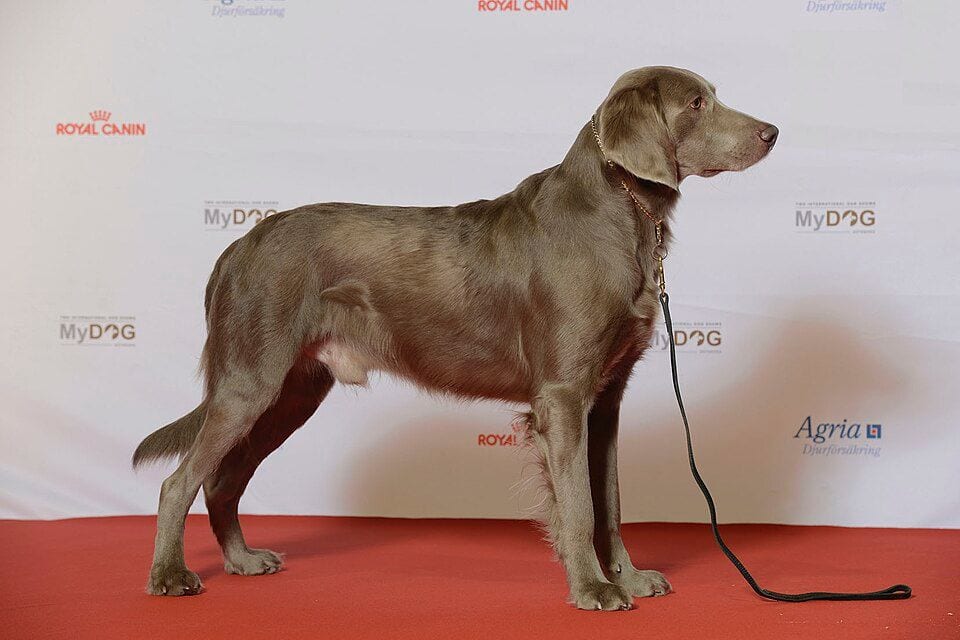
The Weimaraner is a medium-to-large, athletically built, graceful, and well-balanced dog. Under the FCI standard, males stand 23–27.5 inches tall and weigh 65–90 lbs, while females are 22.5–25.5 inches tall and weigh 55–75 lbs. Their ears are dropped with rounded tips, and their eyes are amber, ranging from light to dark. The AKC notes that a well-bred Weimaraner is solid-colored, perhaps with a small white spot on the chest, and presents a breathtaking sight when standing on point.
The coat can be short or long; occasionally, an intermediate-length double coat also occurs. The FCI recognizes both short-haired and long-haired varieties. Colors include mouse-gray, roe-gray, or silver-gray in various shades, or intermediate hues. Small white markings on the toes and chest are tolerated.

Temperament: Intelligent, Energetic, and Highly Family-Oriented
The AKC describes Weimaraners as excellent with children and eager to be fully integrated family members. Their easy grooming, trainability, affectionate nature, and eagerness to work make them wonderful pets—provided their owners are committed to keeping them physically and mentally stimulated. As one breeder puts it: "The good news is that Weimaraners are smart; the bad news is that Weimaraners are smart." They quickly pick up both good and bad habits and often operate on a "what's in it for me?" basis, so training must be creative and consistent.
Weimaraners require a lot of exercise: walking is fine, but running flat out is much better. The AKC says that a tired Weimaraner is a good Weimaraner. Because they are so active, they often get injured—suffering cuts, scrapes, or sprains. Their love for chewing can also lead to mouth injuries or the ingestion of inappropriate objects.
Health
- Gastric torsion (bloat) – The most serious health issue for the breed; owners must know the symptoms and seek immediate veterinary care.
- Neurological conditions – Cerebellar hypoplasia, hypomyelination, and spinal dysraphism; DNA tests are available for the latter two.
- Eye disorders – Corneal dystrophy, extra eyelashes (distichiasis), and entropion.
- Other issues – Demodectic mange, hyperuricosuria (DNA test available), thyroid issues, and heart disease.
In a 2024 UK study, the median lifespan for Weimaraners was 12.8 years.
Care
- Exercise. Daily running, hiking, scent games, hunting, or dog sports.
- Grooming. An occasional wipe-down for short-haired dogs; weekly brushing for the long-haired variety.
- Safety. Remove dangerous chewable objects; enforce rest periods after meals to prevent bloat.
- Training. Puppy kindergarten classes and consistent obedience practice from an early age.
| Trait | Weimaraner | German Shorthaired Pointer | Vizsla |
|---|---|---|---|
| Color | Gray | Liver, liver and white | Golden rust |
| Origin | Germany | Germany | Hungary |
| Purpose | Versatile pointing dog | Versatile pointing dog | Pointing dog, retriever |
| Energy Level | Very high | Very high | Very high |
The Weimaraner is for the Athlete, Not the Couch Potato
The Weimaraner is elegant, but their energy levels rival those of working herding breeds. They are best suited for people who run, cycle, or hunt daily.
- Good fit for: Hunters, runners, people involved in dog sports, and families with older children and a securely fenced yard.
- Not a good fit for: Sedentary individuals, people who work long hours away from home, and households with small pets (unless heavily socialized).
Weimaraners struggle with being left alone and can suffer from severe separation anxiety, so it is crucial to train puppies to tolerate short periods of solitude from the start. Their short coat provides little warmth, so they will likely need a dog jacket in winter.
How to Choose a Weimaraner Puppy
Ask the breeder for the parent dogs' health clearances, including heart, eye, and thyroid exams, as well as DNA test results for spinal dysraphism, hypomyelination, and hyperuricosuria. Inquire if the parents are active hunting dogs, as working lines tend to be even more energetic. Honestly evaluate whether you can dedicate several hours a day to vigorous activity. When buying a Weimaraner puppy in the US, ensure you are working with a reputable breeder who registers their litters with the AKC or UKC, rather than a puppy mill or pet store. A good breeder will provide a clear contract and have the puppy microchipped and vaccinated before sending them home; you can learn more about finding a responsible breeder in our dog breed guide introduction.
You can find other active hunting dogs in our profiles for the Whippet, Labrador Retriever, and English Cocker Spaniel.
Frequently asked questions
How much does a Weimaraner weigh?
Under the FCI standard, males typically weigh 65–90 lbs and stand 23–27.5 inches tall, while females weigh 55–75 lbs and are 22.5–25.5 inches tall. The AKC breed standard specifies 70–90 lbs and 25–27 inches for males.
Why is the Weimaraner called the "Gray Ghost"?
They earned this nickname due to their distinctive silver-gray coat and quick, stealthy movements. The moniker became widely popular in the US, where the breed gained fame in the 1950s.
Is a Weimaraner a good family dog for households with children?
The AKC notes that Weimaraners are great with children and yearn to be full-fledged family members. However, they are highly energetic, so the family must be active and committed to keeping them physically and mentally engaged.
What colors do Weimaraners come in?
Permitted colors include mouse-gray, roe-gray, silver-gray, and intermediate shades. Small white markings on the chest and toes are tolerated. Their eyes are amber, ranging from light to dark; the AKC also notes blue-gray eyes.
What are common health issues in Weimaraners?
The AKC considers gastric torsion (bloat) to be the most serious risk. The breed is also prone to neurological conditions (cerebellar hypoplasia, hypomyelination, and spinal dysraphism—for which DNA tests are available), eye disorders, demodectic mange, and hyperuricosuria.
Sources
- Wikipedia: Weimaraner
- AKC: Weimaraner breed profile
- FCI: Weimaraner breed standard (No. 99)
- Cover photo: A silver-gray Weimaraner standing in a park among autumn leaves (Photo: Trougnouf, CC BY 4.0)
- Wikimedia Commons photo: A long-haired Weimaraner standing at a dog show (Photo: Svenska Mässan from Sweden, CC BY 2.0)
- Wikimedia Commons photo: Weimaraner head with amber eyes (Photo: Pooter 16, CC BY-SA 4.0)
Log in to comment
No comments yet. Be the first.