Labrador Retriever: Temperament, Size, Care & Health
- The Labrador Retriever's ancestors are the St. John's water dogs of Newfoundland, brought to England in the 1830s.
- The UK Kennel Club recognized the breed in 1903, and the FCI in 1954; it belongs to FCI Group 8 (Retrievers).
- Males weigh about 65–80 lbs, and females 55–70 lbs; there are only three recognized colors: black, yellow, and chocolate.
- Common health risks include hip and elbow dysplasia, eye conditions, exercise-induced collapse (EIC), and a tendency toward obesity.
- The Lab is one of the most successful guide and assistance dogs, but requires plenty of daily exercise and mental stimulation.

- The Labrador Retriever Originated from Newfoundland Fishing Dogs
- Appearance: A Sturdy Athlete with an "Otter" Tail
- Temperament: Friendly to Everyone, But Not Lazy
- Health: Joints, Eyes, and Weight
- Care: Plenty of Exercise and Moderate Feeding
- Labrador Retriever, Golden Retriever, and German Shepherd
- How to Choose a Labrador Puppy
This article is part of the 77.today dog breeds guide, prepared by the 77.today editors from the sources listed at the end.
The Labrador Retriever is a dog that many recognize at first glance: a broad head, kind brown eyes, a dense short coat, and a thick, constantly wagging "otter" tail. By nature, they are hunting retrievers, but today they are most highly valued as family dogs, guide dogs, search-and-rescue dogs, or therapy dogs. In this dog breed guide profile, you will find the Labrador Retriever's origins, appearance, temperament, health risks, and practical tips on how to choose a puppy.
| Origin | Great Britain; ancestors – St. John's water dogs of Newfoundland (Canada) |
|---|---|
| FCI Group | Group 8 – Retrievers, Flushing Dogs, Water Dogs (No. 122) |
| Height | males 22–22.5 inches, females 21.5–22 inches (FCI) |
| Weight | males 65–80 lbs, females 55–70 lbs |
| Coat | short, dense, slightly harsh, with a water-resistant undercoat |
| Colors | black, yellow, chocolate |
| Lifespan | 11–13 years |
| Temperament | friendly, obedient, energetic, non-aggressive |
| Suitable for | families with children, active people, working roles |
The Labrador Retriever Originated from Newfoundland Fishing Dogs
Although the breed is named after Labrador, its ancestors lived on the neighboring island of Newfoundland. There, the St. John's water dogs bred by European settlers helped fishermen: they retrieved fish that had slipped from nets in the icy waters of the North Atlantic and hauled in ropes. Their short, dense coat was a major advantage—long-haired dogs would freeze with ice after getting out of the water in winter. Exactly how these dogs got the name Labrador is unclear, but the name stuck.
In the 1830s, the 10th Earl of Home and his nephews, the Duke of Buccleuch and Lord John Scott, brought some of these dogs to England to use as hunting retrievers. In the 1880s, the Earl of Malmesbury, the Duke of Buccleuch, and the Earl of Home collaborated to develop and refine the breed: the dogs Buccleuch Avon and Buccleuch Ned are considered the ancestors of all modern Labs. By 1870, the name "Labrador Retriever" had become common in England. The first chocolate puppies were recorded in 1892, and the first yellow one in 1899. The UK Kennel Club recognized the breed in 1903, the AKC registered its first Labrador in 1917, and the FCI fully recognized the breed in 1954.
Appearance: A Sturdy Athlete with an "Otter" Tail
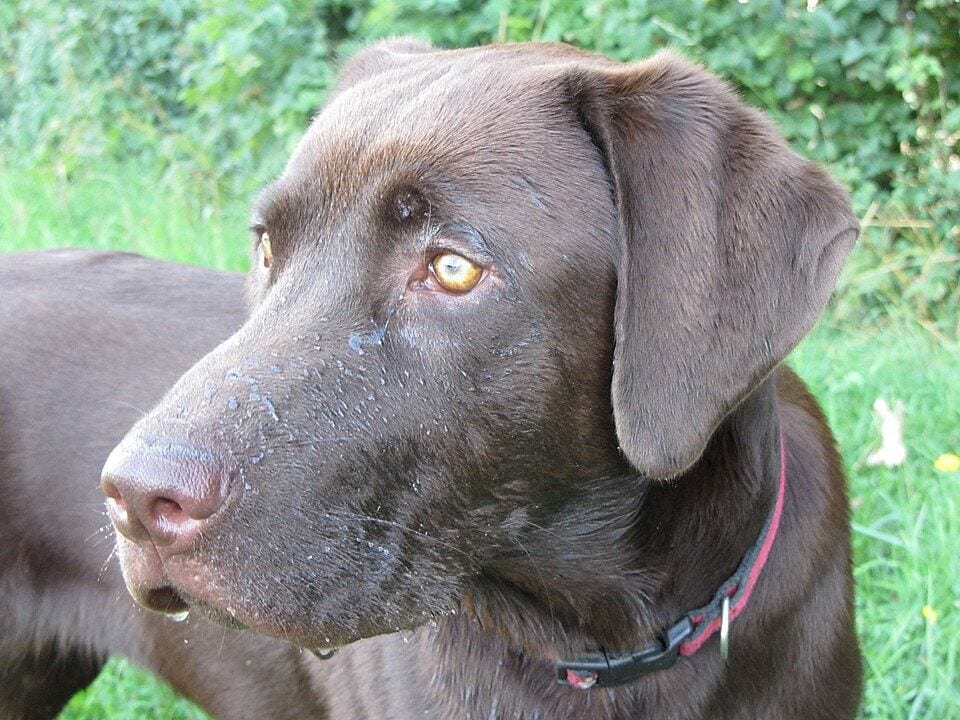
The Labrador is a medium-to-large, sturdily built dog whose body length from the withers to the base of the tail is roughly equal to its height. The head is broad with a distinct stop between the forehead and muzzle, the eyes are brown or hazel, and the ears hang down close to the head. The chest is deep and wide, and the loin is short and strong. A defining feature is the tail: thick at the base, gradually tapering, and densely covered with short hair, it acts as a rudder when swimming.
The coat is short, straight, dense, and slightly harsh, with a soft undercoat that protects against cold and water. Only three colors are registered—black, yellow (ranging from light cream to fox red), and chocolate—and puppies of all three colors can be born in the same litter. Coat color is determined by three genes, so it is not always possible to predict the puppies' colors just by looking at the parents. Due to selective breeding for different purposes, two distinct lines have emerged: the lighter, more energetic working (field) lines and the stockier, calmer show (conformation) lines.

Temperament: Friendly to Everyone, But Not Lazy
The breed standard describes the Labrador's temperament as good-natured, outgoing, and tractable, eager to please, and non-aggressive toward humans or other animals. The AKC emphasizes that true breed temperament is just as important a hallmark as the "otter" tail. Labs bond closely with the entire family and get along well with children and other dogs. Because of this, they make poor guard dogs—they are much more likely to greet a stranger happily than to bark at them.
Their calm demeanor should not be confused with a low need for energy. This is a very active breed that requires long daily walks, games of fetch, and, whenever possible, swimming. If a Lab does not burn off its excess energy, it may start chewing on things or jumping on people. Thanks to their stable nervous system and strong desire to work, they make excellent guide dogs: in a 2006 study, Labradors and their crosses with Golden Retrievers had the highest success rate among guide dog candidates.
Health: Joints, Eyes, and Weight
Labradors are generally sturdy dogs, but there are a few known health risks within the breed that responsible breeders screen for:
- Hip and elbow dysplasia – especially in larger dogs; parents should have their joints evaluated via X-rays.
- Eye conditions – progressive retinal atrophy (PRA-prcd, for which a DNA test is available), cataracts, and retinal dysplasia.
- Exercise-induced collapse (EIC) – young dogs may experience weakness and disorientation after brief, intense exercise; a DNA test helps prevent this disease in litters.
- Gastric dilatation-volvulus (bloat) – a dangerous, life-threatening condition common in large, deep-chested dogs.
- Obesity – some Labs have a mutation in the POMC gene that makes them feel constantly hungry.
Studies also show a predisposition to chronic liver inflammation. The average lifespan is 11–13 years, though chocolate Labs tend to have a slightly shorter life expectancy.
Care: Plenty of Exercise and Moderate Feeding
- Exercise. At least two long outings per day, games of fetch, swimming, or dog sports (like agility and tracking).
- Diet. High-quality, age-appropriate food. Portions should be measured, and treats must be factored into their daily caloric intake.
- Grooming. Their double coat sheds, so they should be brushed at least once a week, and more frequently during heavy shedding seasons.
- Training. Early socialization from 7 weeks to 4 months and puppy training classes are essential due to their size, strength, and energy levels.
Labrador Retriever, Golden Retriever, and German Shepherd
| Trait | Labrador Retriever | Golden Retriever | German Shepherd |
|---|---|---|---|
| Coat | short, dense | longer, wavy | medium, double coat |
| Weight (males) | 65–80 lbs | 65–75 lbs | 65–90 lbs |
| Guard instinct | weak | weak | strong |
| AKC popularity | 2nd place | 3rd place | 4th place |
How to Choose a Labrador Puppy
Look for a reputable breeder whose dogs are registered with the AKC or another recognized club, and who provides written health clearances for the parents (hips, elbows, eyes, and DNA tests). Ask whether the parents come from working or show lines, as this will heavily influence the puppy's energy levels. Always ask to meet the mother to observe her temperament and living conditions. A responsible breeder will never sell through pet stores or puppy mills. In the US, it is highly recommended by veterinarians to have your puppy microchipped, and many states have laws prohibiting the separation of puppies from their mother before 8 weeks of age. For more general rules on finding a good dog, check out our guide introduction.
You can find similar breeds in our Golden Retriever and German Shepherd profiles, or read about a giant water dog in the Newfoundland description.
Frequently asked questions
How much does a Labrador Retriever weigh and how big do they get?
Under the FCI standard, males stand 22–22.5 inches at the withers, and females 21.5–22 inches. Males typically weigh 65–80 lbs, and females 55–70 lbs. The AKC specifies slightly broader limits: 21.5–24.5 inches and 55–80 lbs.
How long does a Labrador Retriever live?
The AKC lists a lifespan of 11–13 years. A UK study estimated an average of 13.1 years, while research by the Royal Veterinary College and the University of Sydney showed that chocolate Labs live about 10% shorter lives on average than other colors.
Is a Labrador Retriever good for apartment living?
They can live in an apartment if they get plenty of daily exercise: long walks, games of fetch, and swimming if possible. Without enough physical activity, a Lab will get bored and can become destructive.
What colors do Labrador Retrievers come in?
Only three colors are registered: solid black, yellow (ranging from light cream to fox red), and chocolate. Puppies of all three colors can be born in the same litter.
What health tests should a Labrador's parents have?
The AKC recommends hip and elbow evaluations, an eye exam by a veterinary ophthalmologist, and DNA tests for progressive retinal atrophy (PRA-prcd), exercise-induced collapse (EIC), and other hereditary conditions.
Sources
- Wikipedia: Labrador Retriever
- AKC (American Kennel Club): Labrador Retriever breed profile
- FCI (Fédération Cynologique Internationale): Labrador Retriever breed standard (No. 122)
- Cover photo: Yellow Labrador Retriever looking at the camera (Author unknown, Public Domain)
- Wikimedia Commons: Head of a chocolate Labrador Retriever with brown eyes (Photo: Bene16, CC BY-SA 3.0)
- Wikimedia Commons: Black Labrador with a stick in the grass (Photo: Flobbadob, CC BY-SA 4.0)
Log in to comment
No comments yet. Be the first.