Lithuanian Hound: Temperament, Size, Care & History
- The Lithuanian Hound is a historic hunting breed, mentioned in written sources as early as the 16th century.
- After World War II, only 78 hound-like dogs remained; the breed was carefully restored by dedicated enthusiasts.
- The first official Lithuanian Hound exhibition was held in 1981, featuring 62 dogs.
- Height at the withers: males 20.5–23.5 inches, females 19–21.5 inches; coat color is black with tan markings.
- The breed is not yet recognized by the AKC or fully by the FCI; due to a small population, managing inbreeding is crucial.
This article is part of the 77.today dog breeds guide, prepared by the 77.today editors from the sources listed at the end.
The Lithuanian Hound is the only dog breed originating from Lithuania. This black and tan, sturdy, and fast hunting dog accompanied Lithuanian nobles and hunters for centuries, tracking hares, foxes, and wild boars. After World War II, the breed was on the brink of extinction, but thanks to dedicated enthusiasts, it was restored and has become a national symbol in its homeland—honored with sculptures and even a commemorative coin. In this dog breed directory profile, you will find the history, appearance, temperament, and current status of the Lithuanian Hound.
| Origin | Lithuania (Grand Duchy of Lithuania) |
|---|---|
| Recognition | Not recognized by AKC/FCI; standard approved in its home country (temporary in 1966, revised in 1983) |
| Height | males 20.5–23.5 inches (52–60 cm), females 19–21.5 inches (48–55 cm) |
| Coat | dense, short, glossy; 1.2–2 inches (3–5 cm) on the back |
| Color | black with tan markings; a small white spot on the chest is permitted |
| Tail | sword-shaped, carried low |
| Purpose | hunting hares, foxes, and wild boars with baying |
| Temperament | energetic, determined, easily trained |
| Population | small; around 300 registered dogs in 2007 |
Lithuanian Hound – Heritage of the Grand Duchy of Lithuania
The first known written mention dates back to 1541, when a forester in Grodno filed a lawsuit over a stolen hound. Hounds are also mentioned in the Statutes of Lithuania, with the Second Statute distinguishing 11 groups of dogs, including several hound breeds. During the Middle Ages, nobles considered it an honor to keep a pack of hounds on their estates. They adopted the passion for hunting with hounds from France, importing St. Hubert Hounds; hounds were also brought in from Germany. Russian zoologist Leonid Sabaneyev claimed that Lithuanian Hounds are most closely related to the St. Hubert Hounds imported from France in the 15th century.
19th-century authors described up to five types of local hounds, which varied in size and the game they hunted—smaller ones were used for hares, while large ones, known as ogars, hunted deer. All of them were black and tan. In the pre-war era, these hounds were widespread in their native region, but after the war, the breed's numbers plummeted. They were mixed with various dogs and simply referred to as local hounds. Historical records indicate that these local hounds were also crossbred with Beagles, as well as Polish and Russian hounds.
How the Breed Was Saved
In 1974, when efforts to organize hunting dog breeding began, only 78 dogs resembling the Lithuanian Hound remained, most without pedigrees. Dedicated cynologists and enthusiasts spearheaded the restoration, and the first breed standard was drafted. A temporary standard was approved in 1966 and revised in 1983. Because there were too few dogs to recreate all the old variations, breeders focused on a single, versatile type. In 1981, the first Lithuanian Hound exhibition was held, featuring 62 dogs.
By 1986, there were about 500 pedigreed hounds in their native country, but numbers dwindled again after the collapse of the Soviet Union: down to 137 in 1998, and around 300 registered in 2007. This decline in popularity is attributed to changing hunting habits—the Lithuanian Hound is best suited for hunting large game in vast, open spaces, whereas modern hunting grounds are shrinking. Due to the small population, managing inbreeding remains a significant challenge for breeders: a 2008 study found an inbreeding coefficient of 2.09%.
Appearance: A Black and Tan Hound
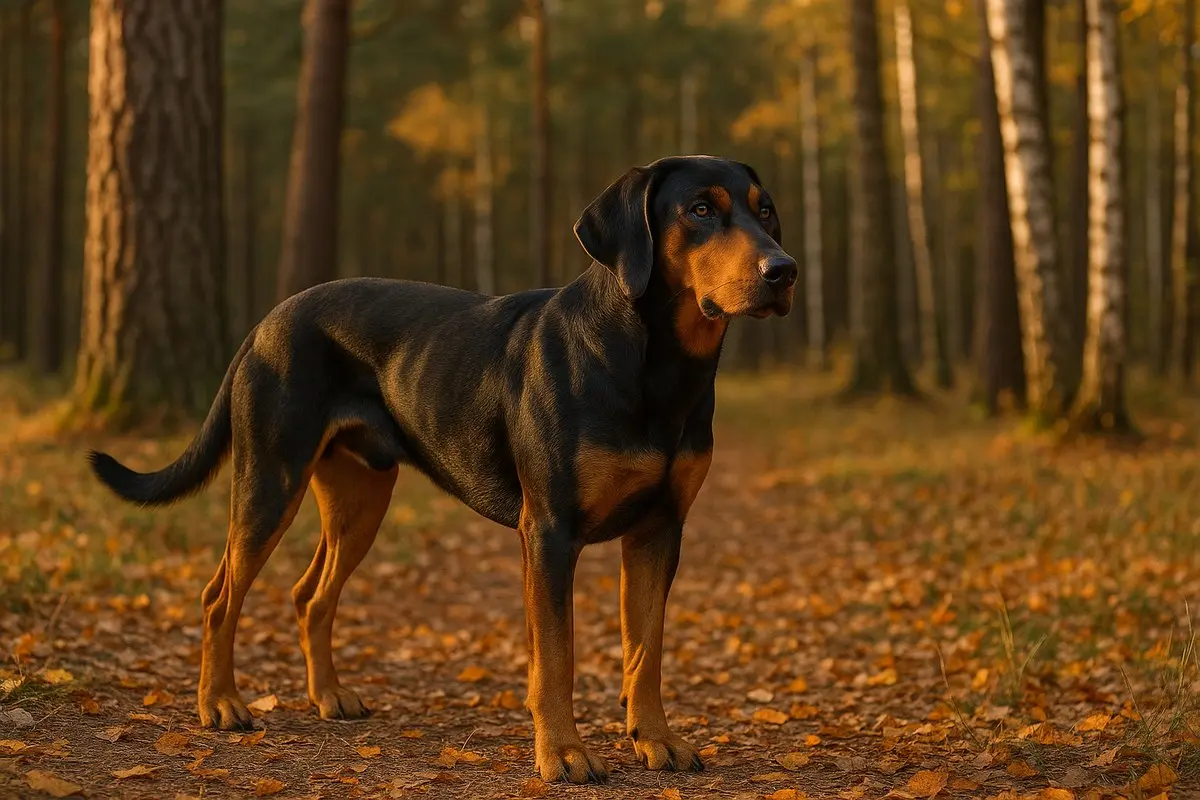
The Lithuanian Hound is a sturdy, heavy-boned, yet lean and muscular dog. The head is large and wedge-shaped with a broad forehead, a wide black nose, and dark brown, oval eyes that have a lively expression. The ears are of medium length with rounded tips, hanging close to the cheeks. The neck is muscular without skin folds, the chest is broad and deep, the back is straight and wide, and the loin is short. The legs are straight, and the paws are round and compact—traits that help the hound be a fast, agile, and relentless pursuer.
The coat is dense and glossy, about 1.2 to 2 inches (3–5 cm) long on the back, and shorter on the legs and ears. The color is black with dark tan markings on the muzzle, chest, belly, inside of the legs, and eyebrows; the boundary between the colors is distinct. A small white spot on the chest is permitted, but not on the toes. The tail is sword-shaped, thick at the base, carried below the backline, and reaches the hock joint.
Temperament: A Determined Hunter
A hound's purpose is to find fresh animal tracks or the game itself, flush it from its resting place, and track it while baying until the hunter is ready for a shot. Therefore, Lithuanian Hounds are energetic, resilient, and persistent, requiring plenty of vigorous exercise. At the same time, they respond well to training. Like other hounds, they have a booming voice and an exceptional sense of smell, so it is highly recommended to keep them on a leash when outside of hunting environments.
The Lithuanian Hound as a National Symbol
- Telšiai, 2011 – A sculpture of a Lithuanian Hound was unveiled during a city festival in the hometown of one of the breed's key restorers.
- Vilnius, 2015 – A sculpture featuring three hounds was unveiled near the historic Vilnius Castle Complex.
- Commemorative Coins, 2017 – The national bank issued special collector coins featuring two Lithuanian Hounds alongside a native horse breed.
- Exhibitions – Specialized Lithuanian Hound shows are organized biennially by local hunting and fishing associations in its native country.
| Trait | Lithuanian Hound | Beagle | Dachshund |
|---|---|---|---|
| Height | 19–23.5 inches | 13–15 inches | short |
| Origin | Lithuania | Great Britain | Germany |
| Recognition | Not AKC/FCI recognized | AKC/FCI recognized | AKC/FCI recognized |
| Purpose | hares, foxes, wild boars | hares, rabbits | burrowing game |
A Hunter's Dog, But Also for Active Families
Most Lithuanian Hounds live with hunting families, but they are also kept by outdoor enthusiasts who spend a lot of time in nature. The most important thing is to understand that this is a true scenthound, bred to track game while baying.
- Good for: Hunters, runners, hikers, and rural or suburban homes with a securely fenced yard.
- Not ideal for: Apartment living, households where the dog is left alone for long periods, and anyone expecting to let their dog roam off-leash in the woods.
A hound needs long daily walks and scent work—tracking exercises or search games can partially substitute for actual hunting. By acquiring a puppy, you are contributing to the preservation of a small population, so it is highly beneficial to collaborate with breeders and the national breed club.
How to Get a Lithuanian Hound Puppy
Because the Lithuanian Hound is exceptionally rare in the US and not recognized by the AKC, finding a puppy requires significant research. Breeding is primarily carried out by hunters and breed enthusiasts in its native country. If you are looking to import one, your best starting point is to contact the national breed club or hunting associations in its homeland. When speaking with overseas breeders, always ask about the parents' pedigrees, hunting traits, and the inbreeding coefficient, as this is crucial for a small population. Ensure you understand international import rules, and once your puppy arrives in the US, it is highly recommended to have them microchipped and registered with your local vet. We cover general tips for finding reputable breeders in our guide introduction.
You can find other hounds and hunting dogs in the profiles for the Beagle, Dachshund, and West Siberian Laika.
Frequently asked questions
Is the Lithuanian Hound the only dog breed from Lithuania?
Yes. The Lithuanian Hound is considered the only dog breed developed in Lithuania, with roots tracing back to the Grand Duchy of Lithuania.
Is the Lithuanian Hound recognized by the AKC or FCI?
No. The American Kennel Club (AKC) and the Fédération Cynologique Internationale (FCI) do not currently recognize the Lithuanian Hound. It is a rare breed, primarily exhibited in specialized shows in its home country.
How big is a Lithuanian Hound?
According to the breed standard, males stand 20.5–23.5 inches at the withers, and females are 19–21.5 inches. They have a sturdy, heavy-boned, yet lean and muscular build.
How many Lithuanian Hounds are there?
The population is quite small. In 1974, only 78 dogs resembling the breed remained. By 2007, there were about 300 registered dogs. Exact current global numbers are not widely published, making it a very rare breed.
Is the Lithuanian Hound a good family dog?
The Lithuanian Hound is an energetic and fast hunting dog that requires plenty of exercise. They are highly trainable but do best with hunters or very active families who can meet their need to run and track scents.
Log in to comment
No comments yet. Be the first.