Balinese Cat: Temperament, Colors, Care & Health
- The Balinese is a natural long-haired variety of the Siamese; long-haired kittens appeared in Siamese litters as early as the early 20th century.
- Breeder Helen Smith named them for their graceful movements, which reminded her of Balinese dancers; the cats have no actual connection to Bali.
- The CFA granted the breed championship status in 1970, and FIFe recognized it in 1983.
- Their semi-long, silky coat lacks an undercoat, making it mat-resistant, and they feature a distinctive plumed tail.
- They share the Siamese personality—social, talkative, intelligent, and playful—but typically have a softer voice.
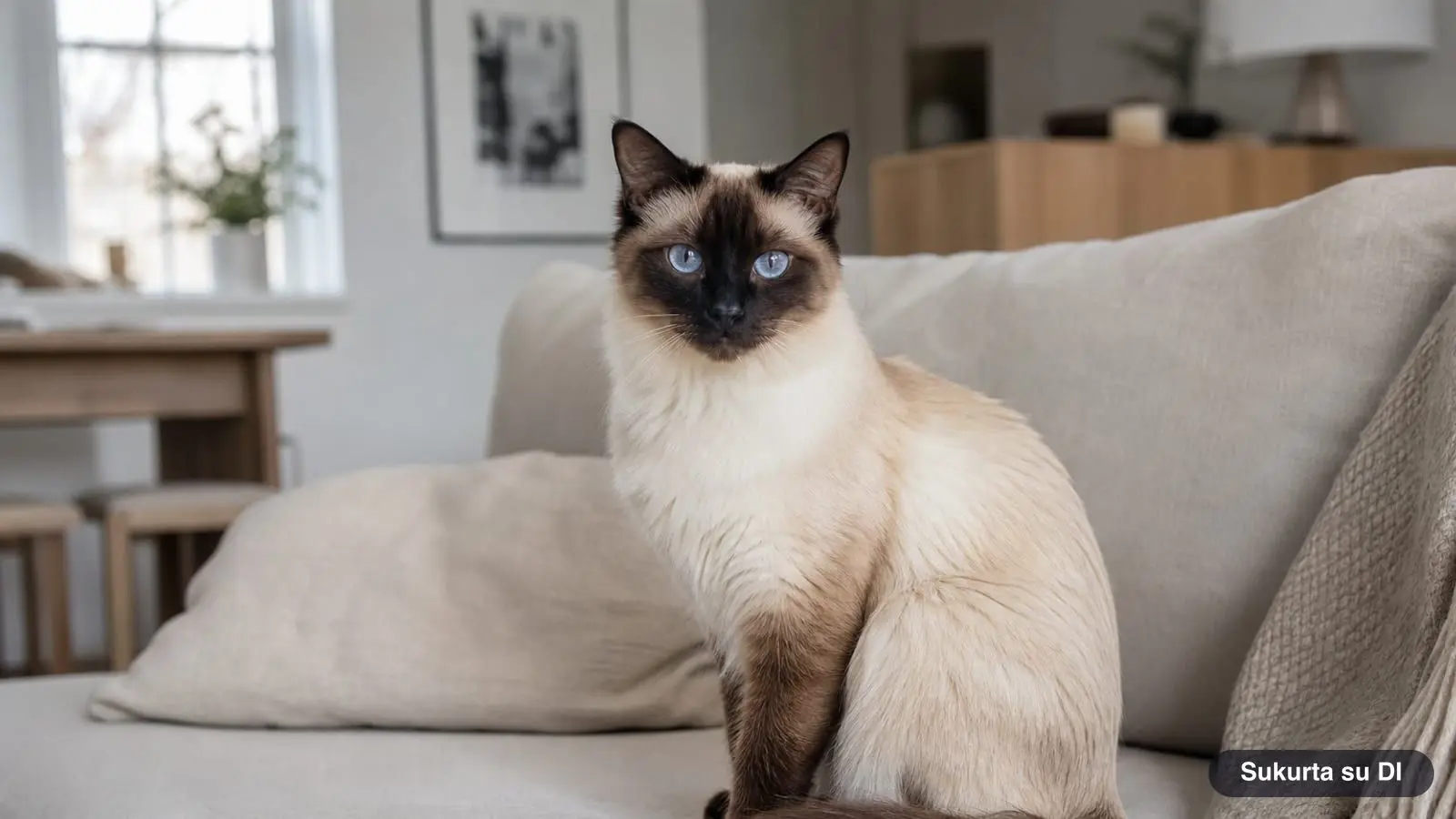
- The Balinese: A Siamese With a Silky Coat
- An Undercoat-Free Coat and a Plumed Tail
- Traditional and Modern Balinese Cats
- Personality: Intelligent, Talkative, and Affectionate
- Health: The Siamese Heritage
- Care: One of the Easiest Long-Haired Breeds to Groom
- Balinese, Siamese, and Oriental Longhair
- How to Choose a Balinese Kitten
This article is part of the 77.today cat breeds guide, prepared by the 77.today editors from the sources listed at the end.
If you love the Siamese but prefer a softer coat and a slightly quieter voice, you should meet the Balinese. This is essentially a long-haired Siamese: it shares the same svelte body, dark points on the face, ears, legs, and tail, and sapphire blue eyes, but features a semi-long, silky coat and a proudly carried plumed tail. In this cat breed guide profile, you will find the history, types, colors, personality, and care requirements of the Balinese cat.
| Origin | US, from long-haired Siamese kittens |
|---|---|
| Recognition | CFA championship status in 1970; FIFe in 1983 |
| Body | Svelte, fine-boned, long legs and tail |
| Coat | Semi-long, silky, no undercoat; plumed tail |
| Pattern | Colorpoint |
| Colors | Seal, blue, chocolate, lilac, red, cream; tabby and tortoiseshell points |
| Eyes | Blue, ranging from pale to sapphire |
| Personality | Social, talkative, intelligent, playful |
| Grooming | A few times a month |
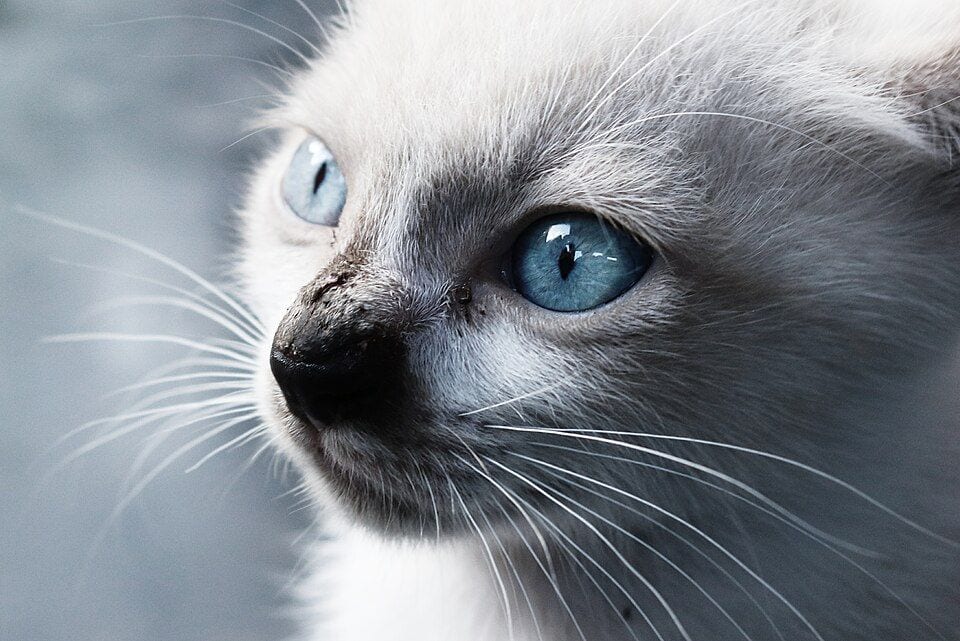
The Balinese: A Siamese With a Silky Coat
Some of the first Siamese cats brought from Thailand to the US and Great Britain carried a recessive long-hair gene, meaning long-haired kittens would occasionally appear in Siamese litters. Initially, they were considered a flaw in the bloodline and sold strictly as pets. However, "long-haired Siamese" were registered for US shows as early as 1928, and in the 1940s and 1950s, breeders Helen Smith and Sylvia Holland began intentionally developing them as a distinct breed. Smith chose the name "Balinese" because the cats' graceful movements reminded her of Balinese dancers. According to FIFe, early breeding programs also occasionally crossed Siamese cats with other long-haired breeds, such as Persians.
Sylvia Holland, who also worked as an illustrator for Walt Disney Studios, believed that only cats with the classic Siamese point colors—seal, chocolate, blue, and lilac—were true Balinese. Long-haired cats of other colors were registered in the US as Javanese cats until 2008, when the CFA merged the two into a single breed with separate divisions. The CFA granted the Balinese championship status in 1970, and FIFe recognized the breed in 1983.
An Undercoat-Free Coat and a Plumed Tail
The most defining feature of the Balinese is its fine, silky coat that lies close to the body. The CFA emphasizes that the coat should lightly drape over the svelte, muscular body without hiding its elegant structure, and it should never appear thick. The fur is longer on the ruff and shoulders, forming a beautiful plume on the tail. Because there is no undercoat, the fur resists matting. Their eyes range from pale blue to deep sapphire or violet, and their large, wide-based ears continue the triangular wedge shape of the head.
Like all colorpoint cats, Balinese kittens are born cream or white, with their points developing on the cooler areas of their bodies over a few weeks. By four weeks of age, a kitten's color can usually be determined. You can also guess their color by looking at their paw pads: pink pads indicate chocolate and lilac points, while dark pads belong to seal and blue points. As they age, and especially in cooler climates, their body color generally darkens.
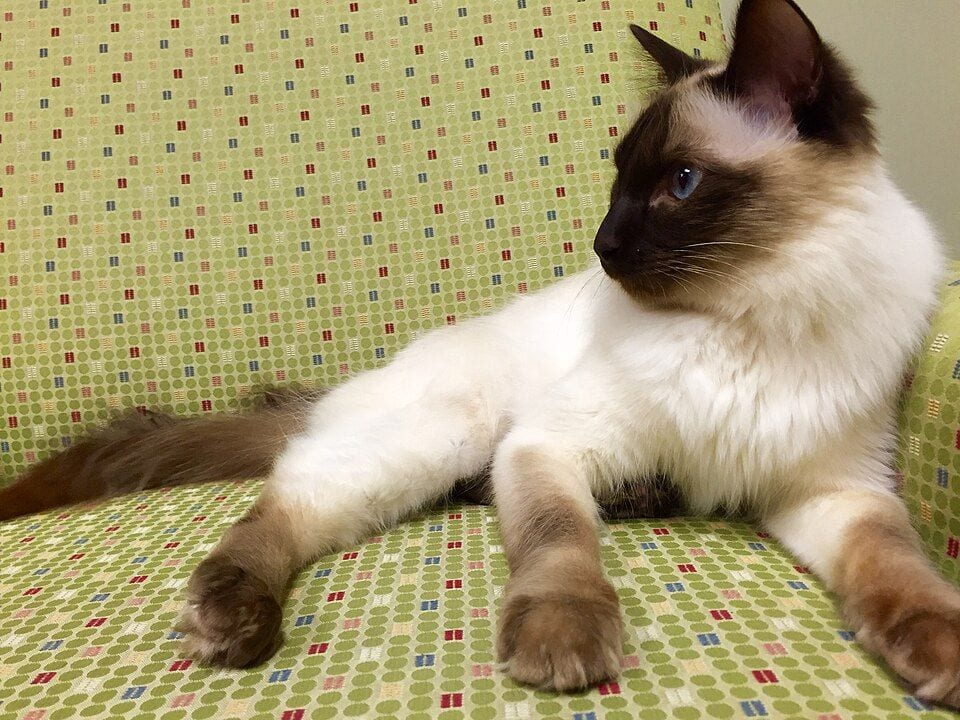
Traditional and Modern Balinese Cats
Much like the Siamese, the Balinese eventually diverged into two distinct types. The traditional, old-style Balinese is stockier, with a broader head and a more robust body, resembling the cats from the earliest breeding programs. The modern Balinese features a sharply wedge-shaped head, a long tapering muzzle, larger ears, and a leaner, more elongated body, bred to match the ideal of the contemporary Siamese. By the mid-1980s, the old-style Balinese had largely disappeared from most show rings, but a dedicated group of breeders has worked to preserve them.
Personality: Intelligent, Talkative, and Affectionate
The Balinese inherited the classic Siamese temperament: they are highly social, playful, curious, and intelligent, often described as having a "dog-like" personality. They are widely considered the most intelligent of all long-haired breeds. The CFA jokes that Balinese cats are convinced they are human: they want to help you with all your daily chores, sleep under the covers with you, and, if you let them, eat right off your plate. They will play fetch until you are too tired to throw the toy, and then they will figure out how to open the drawer where you hid it.
The CFA notes that Balinese cats are generally slightly less vocal than the Siamese and possess a softer voice, but conversations are still a constant occurrence—ranging from gentle purrs to loud protests when they feel ignored. FIFe points out that they prefer living in pairs or groups rather than being the only pet. They usually get along very well with dogs, and older children are a great match for their boundless energy.
Health: The Siamese Heritage
Balinese cats are generally healthy, but due to their Siamese ancestry, they can inherit some of the same predispositions. Some of these are harmless quirks, such as crossed eyes or a kinked tail, while others require genetic or veterinary screening. One confirmed condition found in the Balinese is progressive retinal atrophy (PRA), which can lead to vision loss. The CFA states that most reputable breeders now use genetic testing to identify and remove carriers from their breeding programs. Because the breed originated from a relatively small gene pool, it is important to ask breeders about the overall health history of their lines.
Care: One of the Easiest Long-Haired Breeds to Groom
- Coat. The single-layer coat resists matting; the CFA recommends combing or brushing it a few times a month.
- Bathing. If natural oils cause the coat to look stringy, bathe the cat with a mild feline shampoo and let them air dry in a warm spot—no blow dryer is needed.
- Activity. Fetch games, puzzle toys, and high shelving are essential to keep this acrobatic cat physically and mentally stimulated.
- Companionship. If you are away from home for long hours, getting a second cat is highly recommended.
Balinese, Siamese, and Oriental Longhair
| Trait | Balinese | Siamese | Oriental Longhair |
|---|---|---|---|
| Coat | semi-long, silky | very short | semi-long, silky |
| Color | colorpoint | colorpoint | all colors, no points |
| Eyes | blue | blue | mostly green |
| FIFe kittens in 2025 | 73 | 861 | 155 |
How to Choose a Balinese Kitten
The CFA notes that the Balinese is a rare breed, so you may have to search a bit longer to find a kitten; networking with Siamese or Oriental Shorthair breeders can often help. When speaking with a reputable breeder, ask whether the parents are of the traditional or modern type, and always request to see the results of PRA health tests. Because kittens are born light-colored, the best way to predict their final color is by reviewing the parents' pedigrees. Ethical breeders registered with organizations like the CFA or TICA typically will not let kittens go to their new homes until they are at least 14 weeks old. For more general advice on finding a responsible breeder or adopting through a breed rescue, check out the introduction to our cat breed guide.
You can find its short-haired relative in the Siamese profile, and the non-pointed cat from the same breed group in the Oriental Shorthair description.
Frequently asked questions
How is a Balinese different from a Siamese?
Primarily in the coat: the Balinese has a semi-long, silky coat without an undercoat and a plumed tail, while the Siamese has a very short coat. The CFA notes that Balinese cats are usually slightly less vocal and have a softer voice, though they are certainly not quiet.
What is a Javanese cat?
In the CFA, Balinese cats with non-traditional point colors (red, cream, tabby, tortoiseshell) were long registered as a separate breed called the Javanese. In 2008, the CFA merged them into a single breed with separate divisions. In other organizations, these colors simply fall under the Balinese breed.
Do Balinese cats shed a lot?
Because they have a single-layer coat without a downy undercoat, they do not mat easily and are simple to groom. The CFA recommends combing them a few times a month; if the coat becomes greasy, the cat can be bathed with a mild cat shampoo.
Is the Balinese cat connected to the island of Bali?
No. The name was chosen because their gracefulness resembles Balinese dancers, but the cats actually originated from Siamese cats bred in the US and Great Britain. Similarly, the Javanese cat was named simply to keep with the Indonesian island theme.
What colors do Balinese cats come in?
Many organizations recognize seal, blue, chocolate, lilac, red, and cream points, as well as their tabby and tortoiseshell variations. The CFA only considers the four classic colors as Balinese, registering the others in the Javanese division. Their eyes are always blue, ranging from pale blue to deep sapphire or violet.
Log in to comment
No comments yet. Be the first.