Thai Cat: Temperament, Size, Care & History
- The Thai cat is the old, "traditional" type of Siamese, whose ancestor in Thailand is called Wichien Maat ("moon diamond").
- After World War II, Siamese cats in the West became increasingly slender, but since the 1980s, the old style has been preserved as a distinct breed.
- The WCF recognized the Thai cat in 1990, TICA granted championship status in 2010, and FIFe gave preliminary recognition in 2015 and full recognition in 2017.
- It differs from the modern Siamese only in type: a more moderate body, a modified wedge head, and a long, flat forehead.
- Their personality is just like the Siamese: social, vocal, intelligent, and deeply attached to their family.
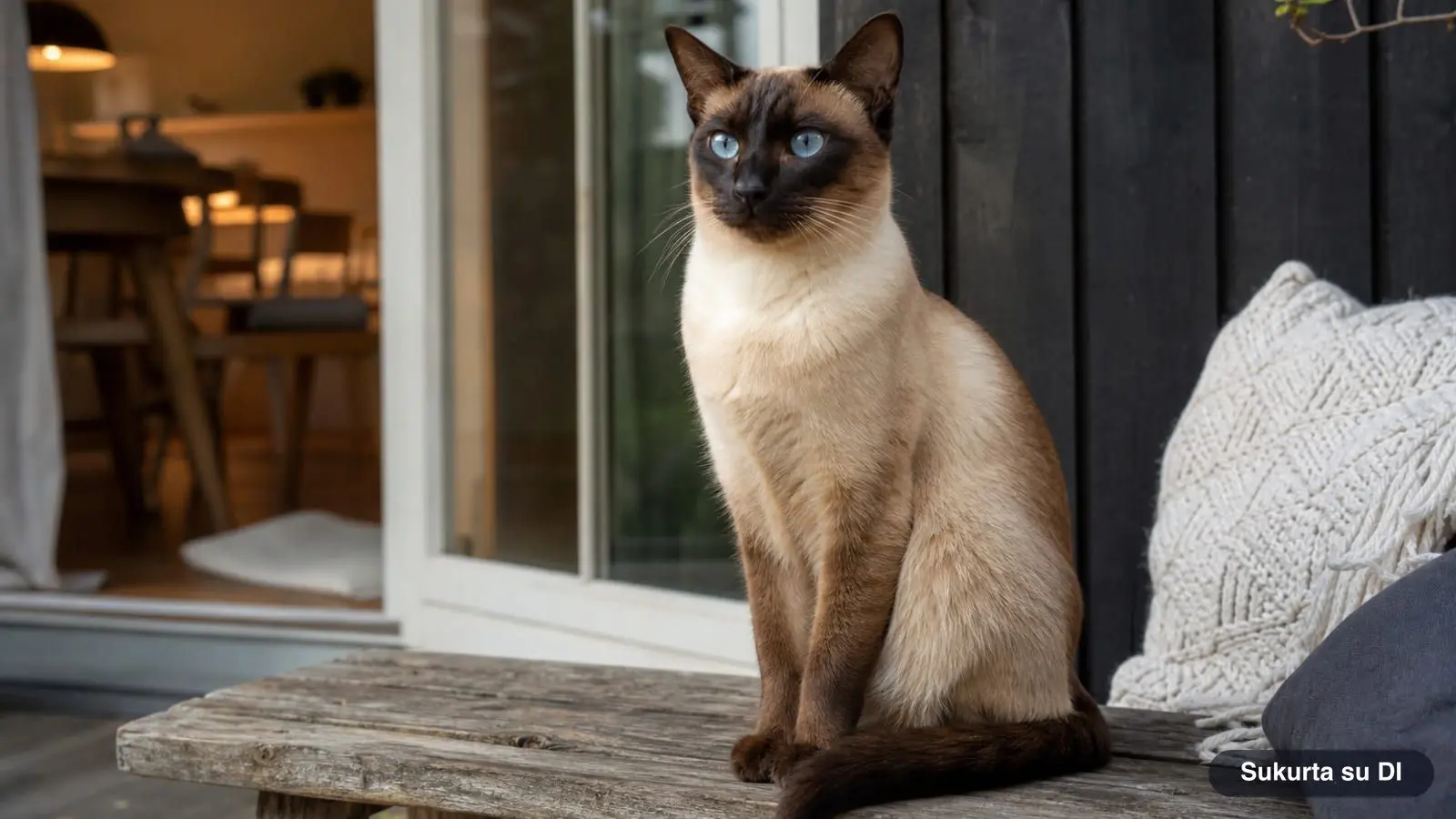
- The Thai Cat: The Old-Style Siamese That Remained Unchanged
- Appearance: The Moderate Siamese Type
- Personality: Affectionate, Vocal, and Always Involved
- Health: The Siamese Group Heritage
- Care: Simple Grooming, High Attention Needs
- Thai, Siamese, and Balinese Cats
- Daily Life with a Vocal and Social Cat
- How to Choose a Thai Kitten
This article is part of the 77.today cat breeds guide, prepared by the 77.today editors from the sources listed at the end.
The Thai cat is the Siamese cat as Europe saw it at the end of the 19th century: elegant but moderate, with a light body, dark points on the face, ears, legs, and tail, and bright blue eyes. While the modern Siamese became increasingly slender and angular, some breeders preserved the old style, which is recognized today as a distinct breed—the Thai. In Thailand, its ancestor is called the Wichien Maat, or "moon diamond." In our cat breeds directory, you will find this breed's history, appearance, and personality.
| Origin | Thailand; breed preserved in Europe and North America |
|---|---|
| Recognition | WCF in 1990; TICA championship status in 2010; FIFe preliminary in 2015, full in 2017 |
| Body | medium size, muscular, heavier than it appears |
| Head | modified wedge, longer than it is wide, long flat forehead |
| Coat | short, close-lying, single coat |
| Pattern | colorpoint |
| Colors | seal, blue, chocolate, lilac, red, tortoiseshell, and tabby (lynx) |
| Eyes | oval, fairly large, deep blue |
| Personality | affectionate, vocal, intelligent |
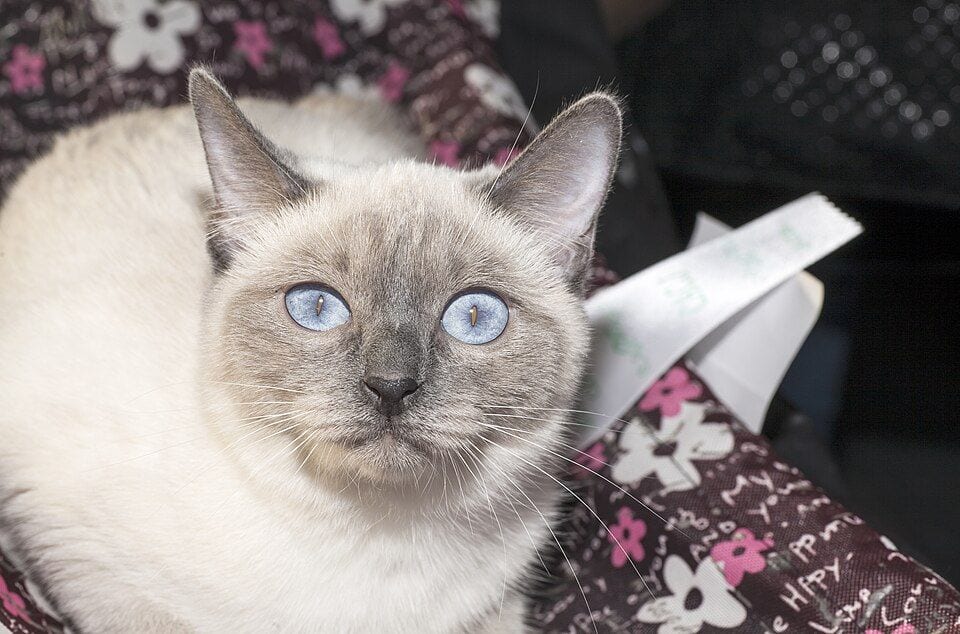
The Thai Cat: The Old-Style Siamese That Remained Unchanged
Cats brought from Siam (modern-day Thailand) to the West in the 19th and early 20th centuries had a more moderate build than today's Siamese cats. After World War II, increasingly long, slender, fine-boned cats with distinct wedge-shaped heads began to dominate cat shows, and this modern type became the standard Siamese look. In the 1980s, clubs emerged in North America and Europe dedicated to preserving the early 20th-century Siamese type, which still lives in Thailand.
The WCF recognized the old style as a distinct Thai cat breed with full championship status in 1990. In Great Britain and North America, these cats were long registered as Siamese; in 1999, the US club PREOSSIA coined the name "Old-Style Siamese," and in 2000, the Old-style Siamese Club was founded in Britain. TICA declined to use this name, so breeders adopted the European name "Thai," and in January 2010, TICA granted the breed championship status. FIFe gave the Thai preliminary recognition in 2015 and full recognition in 2017. Since 2001, cats have been additionally imported directly from Thailand to preserve the traits of the native cats.
Appearance: The Moderate Siamese Type
Thai and Siamese cats share the same dark point gene and the same personality—they differ only in body and head type. The Thai cat is of medium size and bone structure, muscular, and heavier than it appears. Its body is longer than that of an average domestic cat, but significantly less so than the modern Siamese or Oriental. The head is a modified wedge, longer than it is wide, with a long flat forehead and a nose that has at most a slight dip at eye level. The ears are fairly large, and the eyes are oval, fairly large, and deep blue.
The coat is short, close-lying, and single-layered, lacking the longhair gene. Under the FIFe standard, the recognized natural point colors are seal, blue, chocolate, lilac, red, and tortoiseshell, as well as their tabby (lynx) variants. Like other colorpoint cats, Thai kittens are born light, and their points darken over several weeks.
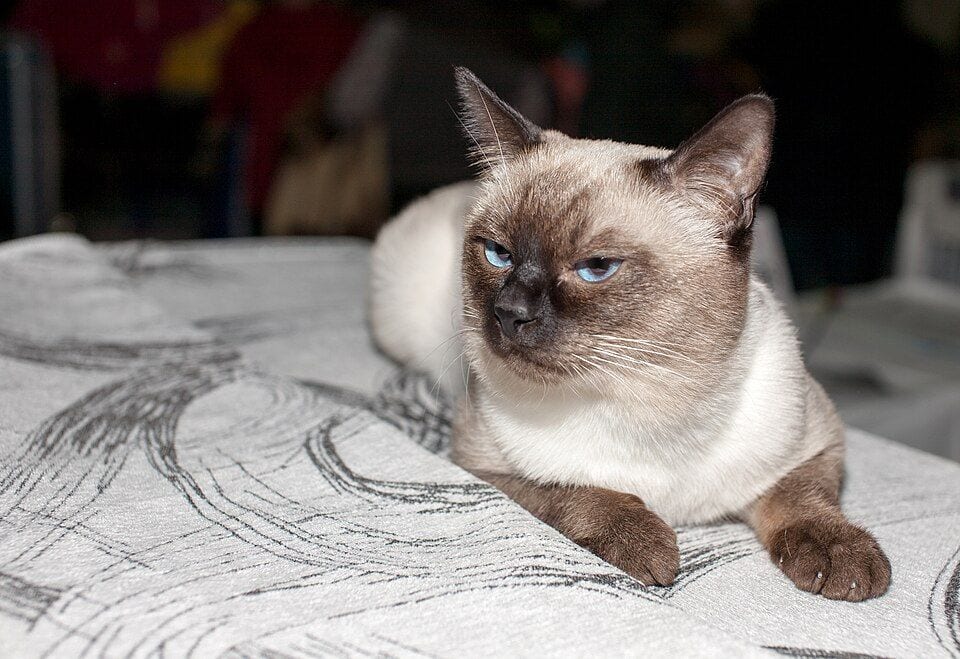
Personality: Affectionate, Vocal, and Always Involved
Breed standards describe Thai cats as affectionate and very deeply attached to their families. They are highly vocal, though perhaps not quite as loud as some other breeds, and they clearly express their feelings when they think it is necessary. A Thai cat always participates in its owner's daily routine, loves to be involved, and enjoys learning tricks. They are incredibly intelligent and sensitive, getting along wonderfully with children and other pets. Like Siamese cats, they dislike being left alone for long periods, so if you are away from home often, it is worth considering getting them a feline companion.
Health: The Siamese Group Heritage
Few diseases are described as specific to the Thai cat breed, but because it shares the same roots as the Siamese, it is worth being aware of conditions common to the Siamese group. These include progressive retinal atrophy (PRA), which can be identified through a genetic test, and amyloidosis. The issue of genetic diversity is also important, which is why breeding programs are supplemented with cats from Thailand. Like other active cats, they require regular veterinary check-ups and dental care.
Care: Simple Grooming, High Attention Needs
- Coat. The short, single coat only needs to be wiped with a damp hand or a rubber brush a few times a month.
- Activity. Trick training, puzzle toys, wand toys, and tall cat trees are essential.
- Warmth. With very little undercoat, this cat loves warm spots.
- Companionship. A second cat is highly recommended if the house is empty for long hours.
Thai, Siamese, and Balinese Cats
| Trait | Thai | Siamese | Balinese |
|---|---|---|---|
| Body | medium, moderate | very slender, long | slender |
| Head | modified wedge | distinct wedge | distinct wedge |
| Coat | short | short | semi-long |
| FIFe kittens in 2025 | 138 | 861 | 73 |
Daily Life with a Vocal and Social Cat
The Thai cat wants to be involved in everything you do: following you to the kitchen, checking what is happening on your desk, and loudly announcing when they need something. They are best suited for homes where someone is frequently around, or a family that has two cats. Set aside time every day for play and trick training—this intelligent cat quickly learns to come when called or give a paw. The short, single coat offers little protection from the cold, so in winter, they will seek out the warmest spot, whether that is a radiator bed or their owner's lap.
How to Choose a Thai Kitten
When looking for a reputable breeder, ask which registry the kitten is enrolled with, as registry rules for Thai cats differ (in the US, the breed is registered by TICA). Always meet the parents to evaluate their type and temperament, and ask to see health test results, particularly for PRA. Because kittens are born light, their final color is best predicted by looking at their parents' pedigrees. Reputable breeders typically do not let kittens go to their new homes before 12 to 14 weeks of age. We discuss standard US practices like microchipping and registration in our cat breeds directory introduction.
You can find the modern Siamese type in the Siamese profile, and another ancient Thai breed in the Korat description.
Frequently asked questions
How does the Thai cat differ from the Siamese?
Both originate from the same cats of Thailand, share the same dark point gene, blue eyes, and a vocal, social nature. They differ only in type: the modern Siamese is very slender and long, with a distinct wedge-shaped head and huge ears, while the Thai cat has a more moderate build, medium size, a modified wedge-shaped head, and medium ears.
Why is the Thai cat called an "applehead"?
In the 1950s, breeders of modern Siamese cats mockingly called the old-style cats with rounder heads "appleheads." Today, this term is mostly used without negative connotations, although the breed is officially called the Thai.
What colors do Thai cats come in?
Under the FIFe standard, the recognized natural point colors are seal, blue, chocolate, lilac, red, and tortoiseshell, as well as their tabby (lynx) variants. The eyes are always deep blue.
Is the Thai cat vocal?
Yes, but as noted by breed standards, not quite as much as some other breeds. They clearly express their feelings when they think it is necessary, love to participate in their owner's daily life, and enjoy learning tricks.
Do these cats still live in Thailand?
Yes. Wichien Maat type cats remain popular in Thailand, and since 2001, cats imported directly from Thailand have been added to Western Thai cat breeding programs. TICA allows the registration of Thai cats with import documentation, while WCF and FIFe do not.
Sources
- Wikipedia: Thai cat
- FIFe (Fédération Internationale Féline): Thai breed standard
- Wikipedia: Siamese cat
- FIFe Breeding Statistics 2025 (registrations by breed and country)
- FIFe Breeding & Registration Rules (2.3.3 – kittens no earlier than 14 weeks)
- Wikimedia Commons photo: Light pointed Thai cat at a show
- Wikimedia Commons photo: Seal point Thai cat lying down at a show
Log in to comment
No comments yet. Be the first.