Savannah Cat: Size, Generations, Temperament & Care
- The first Savannah was born on April 7, 1986, when a male serval was crossed with a Siamese cat.
- F1 generations are half serval; later-generation (F4–F5) show cats weigh about 11–18 lbs.
- TICA registered the breed in 2001 and granted championship status to F4 and later generations in 2012; FIFe does not recognize them.
- Because of their wild ancestry, ownership of early-generation hybrids is heavily restricted or banned by various local and state laws.
- Early-generation Savannahs can be territorial and challenging to litter train; the breed also has a higher risk of HCM.
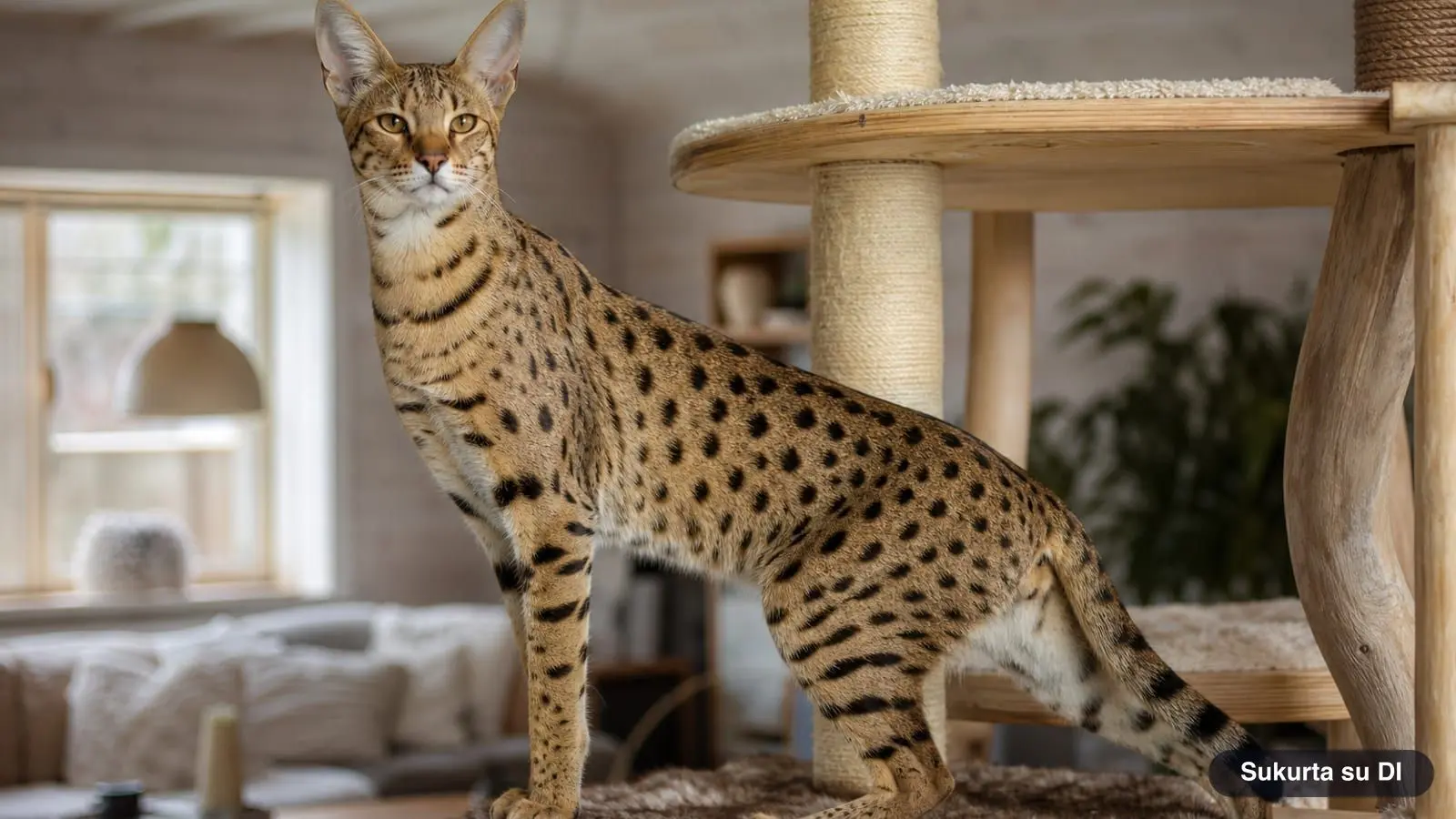
- The Savannah Cat – A Serval and Domestic Cat Hybrid
- Generations F1 to F5: The Higher the Number, the More Domestic
- Tall Legs and Huge Ears Inherited From the Serval
- Temperament: Dog-Like Loyalty and Wild Energy
- Ownership Restrictions in Different Regions
- Health: HCM, PRA, and PK Deficiency
- Care: Space, Activity, and High-Quality Food
- Savannah, Chausie, and Bengal – Three Hybrid Breeds
- What to Consider Before Getting a Savannah
This article is part of the 77.today cat breeds guide, prepared by the 77.today editors from the sources listed at the end.
The Savannah cat is the tallest domestic cat in the world and one of the most controversial. Its long legs, long neck, huge upright ears, and striking black-spotted coat clearly reveal its ancestor—the African serval. Known simply as the Savannah, this is a hybrid breed, so before bringing one home, it is essential to understand the differences between generations, the challenges of its wild heritage, and how local laws regulate hybrid ownership. We cover all of this in our cat breed guide profile.
| Origin | US; serval × domestic cat (first was Siamese) |
|---|---|
| Recognition | TICA (registered 2001, championship status 2012); FIFe – not recognized |
| Weight | F1–F2: 10–24 lbs; later generations: 8–18 lbs |
| Body | tall, lean, long neck and legs |
| Coat | short to medium, spotted |
| Standard Colors | brown, silver, black, and black smoke spotted |
| Eyes | green, brown, gold; "cheetah tear" markings |
| Activity Level | very high |
| Hybrid Status | Heavily regulated by state and local laws |
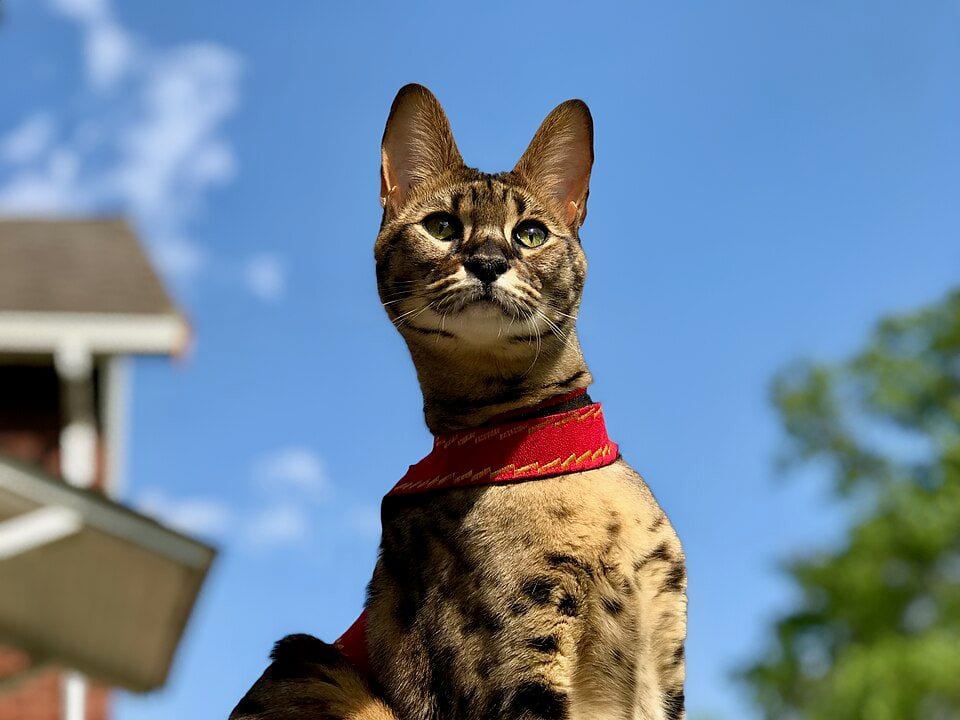
The Savannah Cat – A Serval and Domestic Cat Hybrid
On April 7, 1986, breeder Judee Frank crossed a male serval with a Siamese cat, resulting in the first hybrid of this kind—a female named Savannah. She was later bred with a Turkish Angora male, and in 1989, the second generation of kittens was born. In 1996, Patrick Kelley and Joyce Sroufe drafted the breed standard and presented it to TICA. TICA registered Savannahs as a new breed in 2001, and in May 2012, granted championship status to F4 and later generations. FIFe and many European organizations do not recognize the Savannah.
Producing F1 generation kittens is incredibly difficult: a serval's pregnancy lasts about 75 days, while a domestic cat's is about 65 days, and the sex chromosomes of the two species are incompatible. Pregnancies often fail, kittens are born premature, and servals are notoriously picky about their mates, sometimes even attacking the domestic cat. Males up to the fifth generation are usually sterile, so females are primarily used for breeding.
Generations F1 to F5: The Higher the Number, the More Domestic
- F1 – one parent is a serval (about 50% serval genes). The largest, with a wild temperament; males are sterile.
- F2 – serval is a grandparent (25–37.5%).
- F3 – serval is a great-grandparent (at least 12.5%).
- F4 – the first generation TICA considers "purebred" (stud book tradition, SBT) and allows in shows.
- F5 and later – similar in size to large domestic cats; males are usually fertile.
Generations are also marked with letters A, B, C, and SBT, which indicate how many consecutive generations of parents were Savannahs. It is important to understand that while TICA recognizes SBT cats as purebred, local and state laws in the US often have a broader definition of a hybrid. Many jurisdictions heavily restrict or outright ban the ownership and breeding of early-generation hybrids (F1–F4) due to their wild ancestry. Always check your local ordinances, state laws, and homeowners insurance policies before bringing a Savannah into your home.
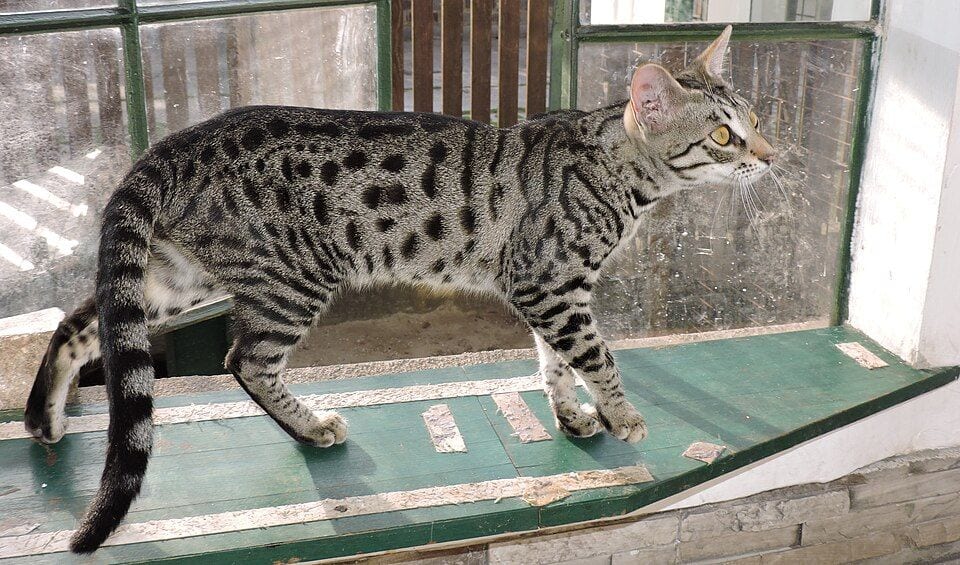
Tall Legs and Huge Ears Inherited From the Serval
The Savannah's appearance is shaped by its serval traits: large upright ears, a long body and legs, a wide nose, and hooded eyes. When standing, a Savannah's hindquarters are often higher than its prominent shoulders. The head is small, taller than it is wide, and the neck is long and slender. The backs of the ears feature light ocelli spots with dark borders that resemble eyes, and the tail is short with black rings and a black tip. Ideally, dark "cheetah tear" lines run from the corners of the eyes down the sides of the nose to the whiskers. An adult cat's eyes can be green, brown, gold, or a mix.
The TICA standard only allows a spotted pattern and four colors: brown spotted, silver spotted, black, and black smoke. Size depends heavily on generation and sex: F1–F2 Savannahs typically weigh 10–24 lbs, sometimes more, while later generations weigh 8–18 lbs, similar to a Maine Coon. Because of its tall and lean build, the Savannah appears much larger than its actual weight. In 2016, an F2 Savannah male set the world record for the tallest cat at 19.05 inches.
Temperament: Dog-Like Loyalty and Wild Energy
Savannahs are often described as confident, outgoing, curious, and friendly. Many possess "dog-like" traits—they will fetch thrown toys and love playing in water. Many Savannahs are completely unafraid of water and will happily jump right in. However, early-generation Savannahs, in particular, can sometimes display wild and territorial behavior; males may be aggressive and mark their territory. Litter box issues are one of the most common reasons owners surrender Savannahs to rescues.
A Savannah needs plenty of space, vertical height, and activity: tall cat trees, wall shelves, daily active play, and harness walks. Small household pets, such as rodents or birds, are not safe around them.
Ownership Restrictions in Different Regions
Because the Savannah descends from a wild predator, many regions heavily restrict their ownership. In the United States, regulations vary wildly by state, county, and city. Some states, such as Hawaii, Massachusetts, Texas, and Georgia, have strict rules or outright bans on owning certain hybrid generations. New York City completely bans Savannahs of all generations, even though New York State allows F5 and later generations. Internationally, countries like Australia and New Zealand ban their import due to threats to native wildlife, and several European nations prohibit early-generation hybrids. Always verify your local breed-specific legislation and check with your landlords or insurance providers, as many have strict policies regarding hybrid pets.
Health: HCM, PRA, and PK Deficiency
Savannahs are more prone to hypertrophic cardiomyopathy (HCM) than many other domestic breeds. The Savannah Cat Association recommends screening cats for HCM, progressive retinal atrophy (PRA), and pyruvate kinase (PK) deficiency—conditions that cause blindness and anemia, respectively. For anesthesia, Savannahs and servals can safely be given the same medications as other domestic cats. Savannahs typically live 12 to 15 years or longer.
Care: Space, Activity, and High-Quality Food
- Space. Savannahs jump incredibly high and love to observe from above, so they need sturdy, tall cat trees and safe wall shelves.
- Activity. Daily hunting games, food puzzles, trick training, and harness walks are essential.
- Litter Box. Provide several large litter boxes in different locations and be consistent with training from a young age.
- Diet. A high-quality, meat-rich diet; fresh water must always be available.
- Coat. Their short coat only needs an occasional brush to stay healthy.
Savannah, Chausie, and Bengal – Three Hybrid Breeds
| Trait | Savannah | Chausie | Bengal |
|---|---|---|---|
| Wild Ancestor | serval (Africa) | jungle cat (Asia) | Asian leopard cat |
| Coat | spotted | ticked, no spots | rosettes or marble |
| Size | tallest domestic cat | large, long-legged | medium-large |
| FIFe | not recognized | not recognized | recognized |
What to Consider Before Getting a Savannah
First, find out the kitten's generation and ask for documentation verifying their lineage. Early-generation (F1–F3) Savannahs require significant experience and space, and their ownership is often restricted by local laws, making later-generation cats the best fit for most families. Ask the breeder for the parents' echocardiogram results and PRA/PK deficiency tests. Inquire about how the kittens are socialized and litter-trained. Keep in mind that if you travel or move, you may need to prove the cat's generation to local authorities. When looking for a reputable breeder, ensure they provide a clear contract, health guarantees, and allow you to meet the parents—never buy from a pet store or kitten mill, as we outline in our guide introduction.
If you want a wild look without the hybrid ancestry, consider an Ocicat or Egyptian Mau; for a smaller hybrid, check out the Bengal profile.
Frequently asked questions
What do F1, F2, and F3 Savannah generations mean?
F1 is a direct offspring of a serval and a domestic cat (about 50% serval), F2 has a serval grandparent (25–37.5%), and F3 has a serval great-grandparent (at least 12.5%). TICA considers the F4 generation a "purebred" (SBT). The higher the number, the smaller and more domestic the cat.
How much does a Savannah cat weigh?
Early-generation (F1–F2) Savannahs typically weigh 10–24 lbs, with some occasionally weighing more. Later generations weigh about 8–18 lbs and are similar in size to Maine Coons or Norwegian Forest Cats, but they appear larger due to their tall legs and long bodies.
Are Savannah cats legal to own in the US?
Later-generation Savannahs are widely considered domestic cats. However, because of their wild ancestry, early generations (F1–F4) are heavily restricted. Several states, including Hawaii, Massachusetts, Texas, and Georgia, have strict regulations, and cities like New York ban them entirely. Always check your local ordinances and state laws before getting one.
What is the tallest cat in the world?
In 2016, an F2 Savannah male set the record for the tallest domestic cat, measuring 19.05 inches tall. Another famous Savannah, Arcturus Aldebaran Powers, weighed about 30 lbs.
Do Savannah cats like water?
Many Savannahs are not afraid of water; they enjoy playing in it or even jumping right in. They also frequently learn to fetch thrown toys, which is why they are often compared to dogs.
Log in to comment
No comments yet. Be the first.