Siberian Cat: Temperament, Coat, Allergies & Care
- The Siberian is an ancient, natural forest cat from Russia; registered as a breed since 1987 and recognized by the FIFe in 1997.
- They have a triple coat (guard hairs, awn hairs, and down), with water-resistant guard hairs; the coat is much denser in the winter.
- Adult cats typically weigh 10–20 lbs and do not fully mature until they are about five years old.
- The colorpoint variety of the Siberian is registered by the FIFe as a separate breed called the Neva Masquerade.
- In studies, some Siberian cats produced less of the Fel d 1 allergen, though it is still present in all of their samples.
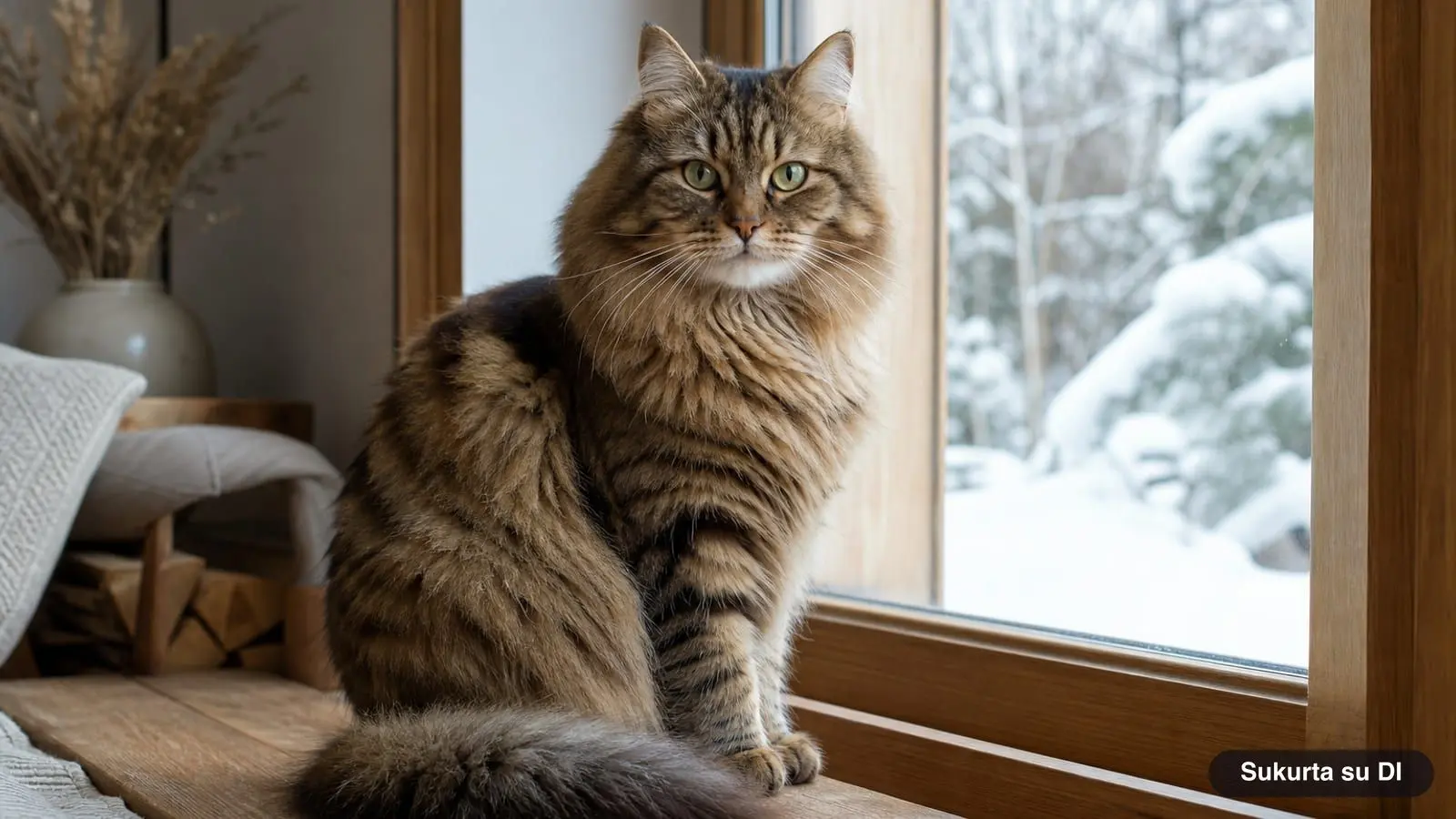
- The Siberian cat grew up in a harsh climate, resulting in a triple coat
- Neva Masquerade: The colorpoint Siberian
- History: From the Tobolsk cat to the 1987 breeding program
- Temperament: 90% calm and 10% mischief
- Siberians and allergies: Less Fel d 1, but not zero
- Health: HCM, PKD, and deafness testing for white cats
- Care: Coat layers require combing
- Siberian, Norwegian Forest Cat, and Maine Coon: Differences in head and origin
- How to choose a Siberian kitten
This article is part of the 77.today cat breeds guide, prepared by the 77.today editors from the sources listed at the end.
The Siberian cat looks like a character straight out of a fairy tale: large, sturdy, and covered in a dense, fluffy coat with a thick ruff and a bushy tail, all framing a round, sweet face. This is Russia's national cat, whose ancestors lived for centuries in Siberian forests and rural farmsteads. Today, it is one of the fastest-growing breeds in Europe and the US: in the 2025 FIFe statistics, the Siberian was the fourth most registered breed. In our cat breeds guide, you will discover what makes them special, what the Neva Masquerade is, whether Siberians are truly suitable for allergy sufferers, and how to care for them.
| Origin | Russia, natural Siberian forest cat |
|---|---|
| Recognition | WCF 1991, FIFe 1997, TICA championship status 1996, CFA 2006 |
| Weight | average 10–20 lbs; females are smaller |
| Body | strong, barrel-shaped torso, powerful hind legs |
| Coat | semi-long to long, triple-layered, water-resistant |
| Colors | all "Western" colors (except chocolate, lilac, cinnamon, fawn); brown tabby is most common |
| Eyes | large, round; green to gold and copper |
| Temperament | friendly, playful, calm |
| Grooming | comb a few times a week |
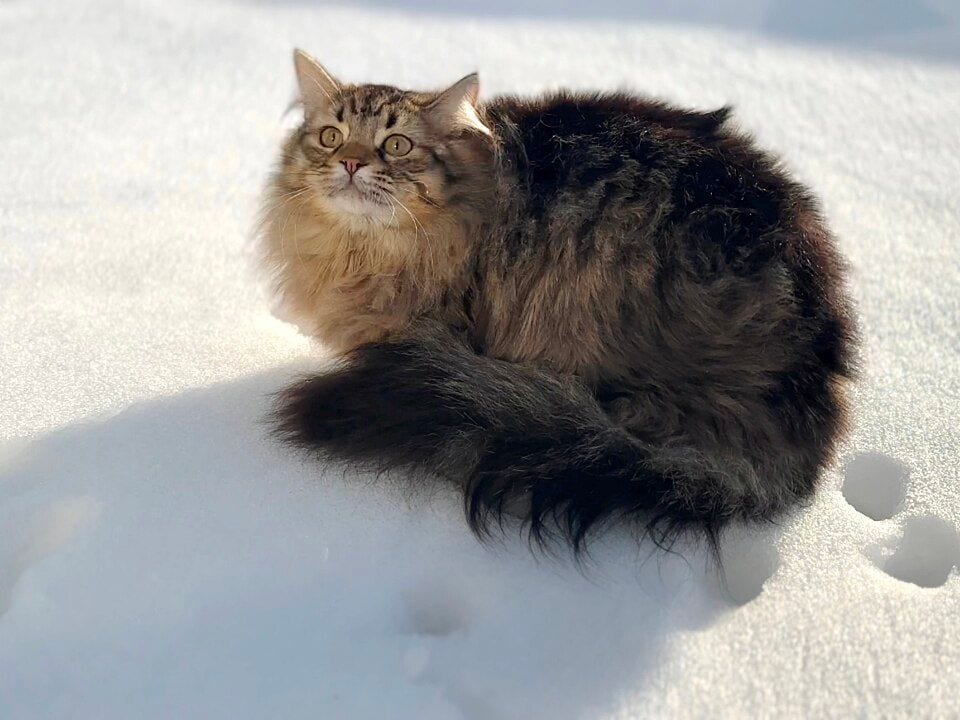
The Siberian cat grew up in a harsh climate, resulting in a triple coat
Most cats do not have all three types of hair, but the Siberian has them all: long guard hairs, awn hairs, and a dense downy undercoat. Together, they form a semi-long to long, incredibly dense triple coat with water-resistant guard hairs. This coat protected them from the freezing Siberian winters. The winter coat is significantly longer and thicker than the summer coat, and a young cat may take several years to develop its full coat.
The body is strong and powerful: a barrel-shaped torso, heavy boning, large round paws, and a bushy tail that is slightly shorter than the body. The hind legs are slightly longer than the front legs, giving the back a slight arch—this makes the Siberian an exceptionally good jumper. The head is broad with rounded contours, the muzzle is short and full, the eyes are large and almost round, and the ears are medium-sized, broad at the base, rounded at the tips, and may have lynx tufts. The overall impression is one of roundness, which distinguishes the Siberian from the more angular Maine Coon.
The most common color is brown (black) tabby, but all Western colors and patterns are permitted, with or without white. Chocolate, lilac, cinnamon, and fawn are not recognized. Siberians also have a unique golden variation called "sunshine," which is caused by a CORIN gene variant found only in this breed; when combined with silver, it is referred to as "bimetallic."
Neva Masquerade: The colorpoint Siberian
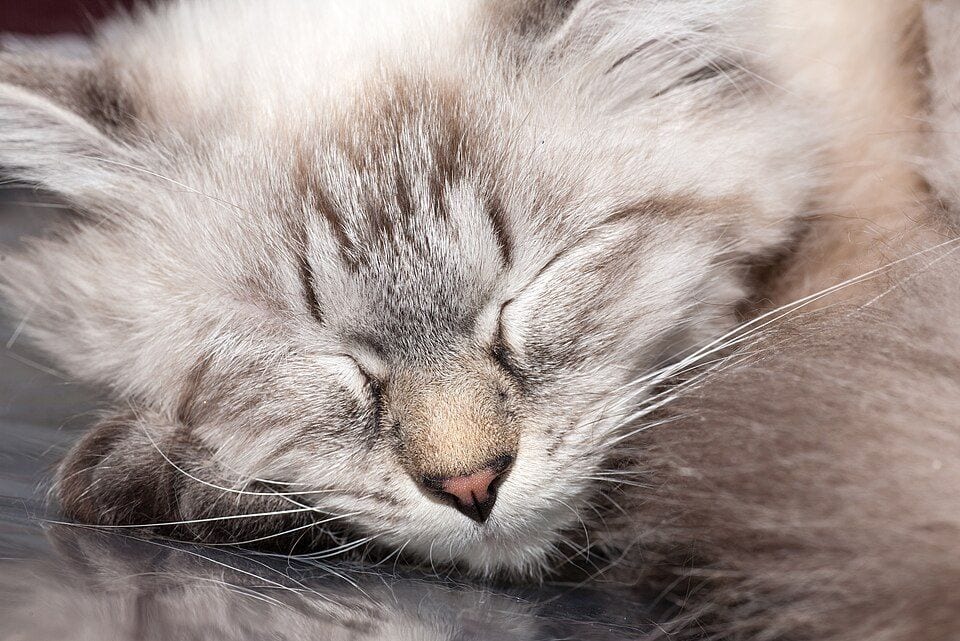
Siberian cats with dark points on their face, ears, legs, and tail, along with blue eyes, are called the Neva Masquerade. They carry the same colorpoint gene as Siamese or Himalayan cats. The FIFe, WCF, and some other organizations have registered the Neva Masquerade as a separate breed since 2011, while others classify it as a color division of the Siberian. The gene pools of both breeds overlap heavily, as they were crossbred for a long time. In 2025, 2,983 Neva Masquerade kittens were registered in FIFe studbooks.
History: From the Tobolsk cat to the 1987 breeding program
Siberian cats are mentioned in Slavic fairy tales and folklore, and the CFA notes that their history in Russia dates back to around the year 1000, when they were kept by farmers and tradesmen. Outside of Russia, the breed was first mentioned in 1864 in the German book "Brehms Tierleben" by Alfred Brehm as the "red Tobolsk cat from Siberia." In 1889 and 1892, Harrison Weir described them as Russian longhairs, but in the West, they quickly blended with other longhaired cats.
The world rediscovered Siberian cats after the fall of the Soviet Union. In 1987, a cat enthusiast from St. Petersburg brought a young pair to Berlin and started a registered breeding program, and that same year, the Kotofei cat club in St. Petersburg published one of the first breed standards. The WCF recognized Siberians in 1991, TICA granted championship status in 1996, the FIFe in 1997, and the CFA in 2006. The first registered Siberians arrived in the US in 1990 and the UK in 2002. Genetically, they are most closely related to Norwegian Forest Cats and Northern European domestic cats.
Temperament: 90% calm and 10% mischief
Siberian cats are friendly, playful, and adventurous, yet calm. The CFA quotes owners who describe them as "90% calm and 10% mischief." They are inquisitive, love to inspect cabinets and suitcases, want to know what is happening in the house, and enjoy being near their owners without being overly demanding. They quickly pick up on human moods, which is why they are sometimes recommended as emotional support animals.
These cats are often described as "dog-like": they are loyal, learn easily, and will even fetch thrown toys. They get along well with dogs, other pets, and children. The Siberian is vocal not in volume, but in frequency: it "talks" with melodic chirps, trills, and deep purring. Many of them are fascinated by water.
Siberians and allergies: Less Fel d 1, but not zero
Siberian cats are often marketed as hypoallergenic. A study of native Siberians in the Russian region where the breed originated showed that they produced less of the primary cat allergen, Fel d 1, than other cats. By 2010, a Siberian breeder association had tested over 300 cat samples: about half had lower Fel d 1 levels than other breeds, and under a fifth had very low levels. However, the allergen was present in all samples. Therefore, allergy sufferers are advised to spend time with a kitten's parents before bringing one home and to choose a female, as females of all breeds tend to produce less Fel d 1.
Health: HCM, PKD, and deafness testing for white cats
The CFA notes that Siberian breeders generally conduct very thorough genetic testing and carefully select breeding pairs to maintain the breed's diversity. The following conditions are monitored in the breed:
- Hypertrophic cardiomyopathy (HCM) – breeding cats undergo cardiac ultrasounds (echocardiograms).
- Polycystic kidney disease (PKD) – checked via genetic testing and kidney ultrasounds.
- Deafness – more common in solid white, blue-eyed cats, so they undergo a hearing test (BAER) before breeding.
- Other recessive diseases for which breeders use genetic screening.
Care: Coat layers require combing
- Coat. Siberian coats vary greatly: some need weekly combing, while others can go weeks without it. The CFA recommends feeling the belly, tail, and "britches" a few times a week—mats usually form there—and gently untangling them with your fingers or a comb.
- Shedding seasons. The most hair is lost in the spring when the cat sheds its winter coat; this molting is triggered by day length rather than temperature.
- Exercise. As excellent jumpers, a tall scratching post and cat shelves are essential for them.
- Diet. A balanced diet is important for this slow-maturing cat, and moderate portions are key for adults.
Siberian, Norwegian Forest Cat, and Maine Coon: Differences in head and origin
| Feature | Siberian | Norwegian Forest Cat | Maine Coon |
|---|---|---|---|
| Head | broad, rounded contours | triangular, straight profile | square, boxy muzzle |
| Coat | triple, very dense | double, glossy | uneven length, shaggy |
| Origin | Russia | Norway | US |
| FIFe kittens in 2025 | 4,718 | 3,952 | 24,488 |
How to choose a Siberian kitten
Due to growing demand, the CFA notes that Siberian kittens are often reserved months in advance. Always ask for pedigree papers and the parents' health test results, including cardiac ultrasounds, PKD screening, and hearing tests for white cats. If anyone in your family has allergies, spend a few hours with both parents and make sure to agree with the breeder that the kitten can be returned if an allergic reaction occurs. Those looking for a colorpoint kitten should ask whether it will be registered as a Neva Masquerade. Reputable breeders will not let kittens go to their new homes before they are 12 to 14 weeks old. We discussed general tips on finding responsible breeders, checking CFA or TICA registrations, and the importance of veterinary microchipping in the introduction to our cat breeds guide.
You can find similar-sized semi-longhaired breeds in the Norwegian Forest Cat and Maine Coon profiles, and low-shedding breeds in the Devon Rex and Cornish Rex guides.
Frequently asked questions
Is the Siberian cat hypoallergenic?
Not entirely. In a study of over 300 cats by Siberian breeders, about half produced less of the primary allergen Fel d 1 than other breeds, and under 20% produced very little. However, Fel d 1 was found in all samples, so allergy sufferers must spend time with a specific cat or its parents beforehand.
What is the difference between a Siberian and a Neva Masquerade?
The Neva Masquerade is a Siberian cat with dark colorpoints on the face, ears, legs, and tail, along with blue eyes. The FIFe and some other registries have recognized it as a separate breed since 2011, while others consider it a color division of the Siberian.
How much does a Siberian cat weigh?
Adult Siberians average 10–20 lbs, with females being significantly smaller than males. The CFA notes that mature males weigh about 12–18 lbs, while females weigh 8–12 lbs. The breed matures slowly, reaching full physical development around five years of age.
How often does a Siberian cat shed?
Siberians shed the most in the spring when they lose their heavy winter coat, followed by a lighter "mini-molt" at the end of summer. They also shed moderately year-round, so their coat requires combing a few times a week, especially on the belly, tail, and hind legs.
Do Siberian cats like water?
Many Siberians are fascinated by water and are not afraid to get wet, thanks to their water-resistant guard hairs. Some will dip their paws into their water bowl or watch a running faucet.
Sources
- Wikipedia: Siberian cat
- FIFe: Siberian breed standard
- FIFe: Neva Masquerade breed standard
- CFA: Siberian breed profile
- Wikipedia: Fel d 1
- FIFe Breeding Statistics 2025
- FIFe Breeding & Registration Rules
- Wikimedia Commons: One-year-old Siberian cat with a dense triple coat
- Wikimedia Commons: Neva Masquerade cat with dark points and blue eyes
Log in to comment
No comments yet. Be the first.