Burmese Cat: Types, Temperament, Care & Health
- Most modern Burmese cats trace back to Wong Mau, a cat brought from Burma to San Francisco in 1930.
- The breed has two standards: the British (European) type is more slender, while the American type is stockier with a round head and short muzzle.
- Burmese cats weigh about 9–13 lbs and are highly muscular; their color is determined by the sepia gene, with the original color being sable brown.
- This is one of the most affectionate, human-oriented breeds; they do not tolerate being left alone.
- The breed is prone to hereditary hypokalemia and has a higher rate of diabetes; a UK study found an average lifespan of 14.4 years.
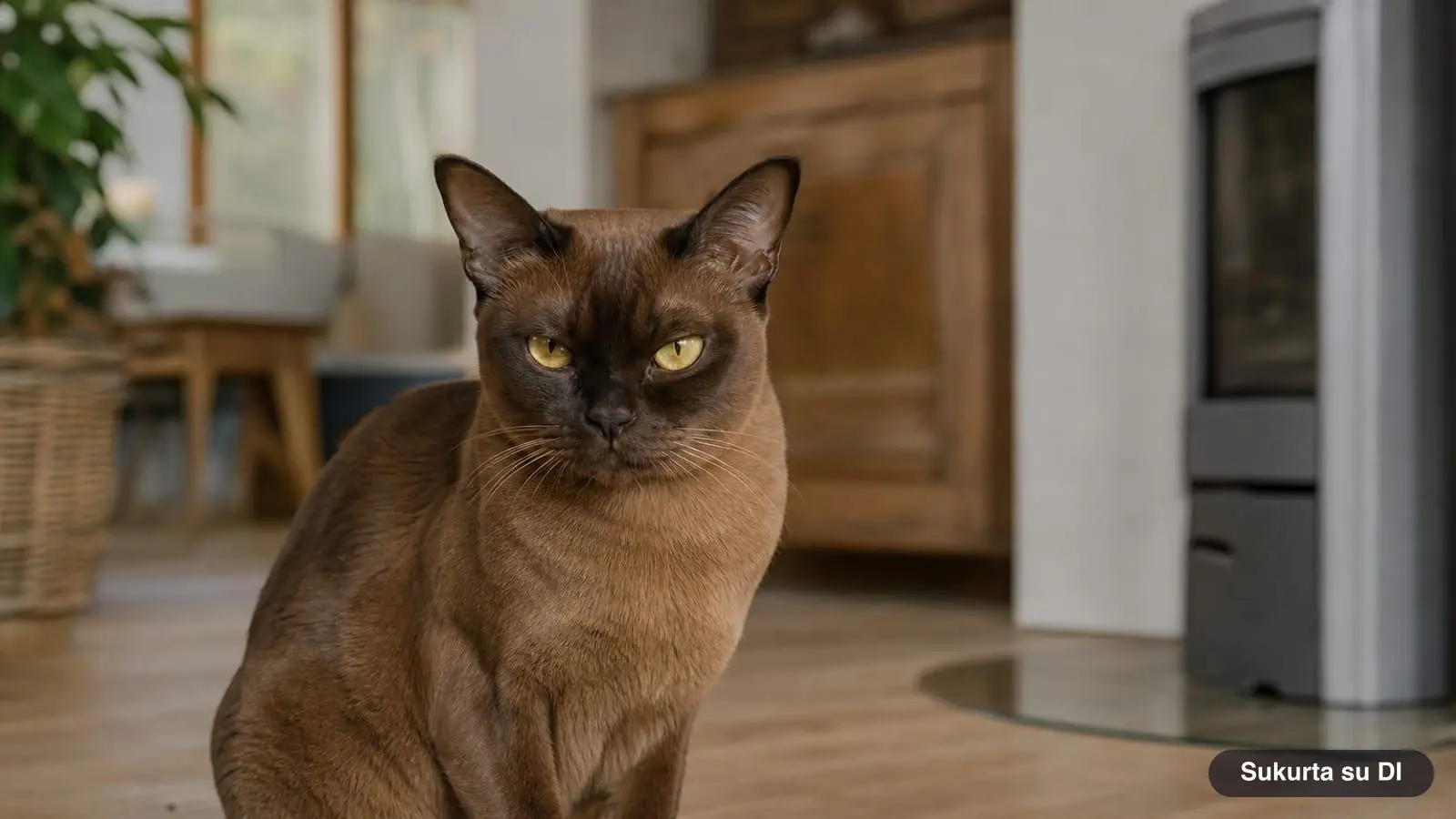
- The Sepia Gene Determines the Burmese Cat's Color
- Two Standards: European and American Types
- History: From Wong Mau to Two Breed Branches
- Temperament: Dog-Like Affection and Forever Playful
- Health: Hypokalemia, Diabetes, and Head Defect
- Care: A Weekly Brush and Lots of Attention
- Burmese, Tonkinese, and Bombay Cats: A Family Tree
- How to Choose a Burmese Kitten
This article is part of the 77.today cat breeds guide, prepared by the 77.today editors from the sources listed at the end.
At first glance, the Burmese cat doesn't look large, but when you pick one up, the weight is surprising—so much muscle is packed into a compact body. The British call this cat a "brick wrapped in silk": they have a short, soft, satin-like coat, usually rich brown, and large golden eyes. The CFA notes that looking into them makes you feel like the cat can see straight into your soul. In this cat breed guide profile, you will find the origins of the Burmese, its two breed types, temperament, care, and health characteristics.
| Origin | Burma (Myanmar) and Thailand; breed developed in the US and Great Britain |
|---|---|
| Recognition | CFA registry in 1936, championship status in 1959; GCCF in 1952; FIFe |
| Weight | about 9–13 lbs; males are larger |
| Body | compact, muscular, heavy for its size |
| Coat | very short, fine, satin-like gloss |
| Colors | sable brown, chocolate, blue, lilac, red, cream, tortoiseshell |
| Eyes | golden or green |
| Temperament | highly social, playful, affectionate |
| Grooming | rubber brush once a week |
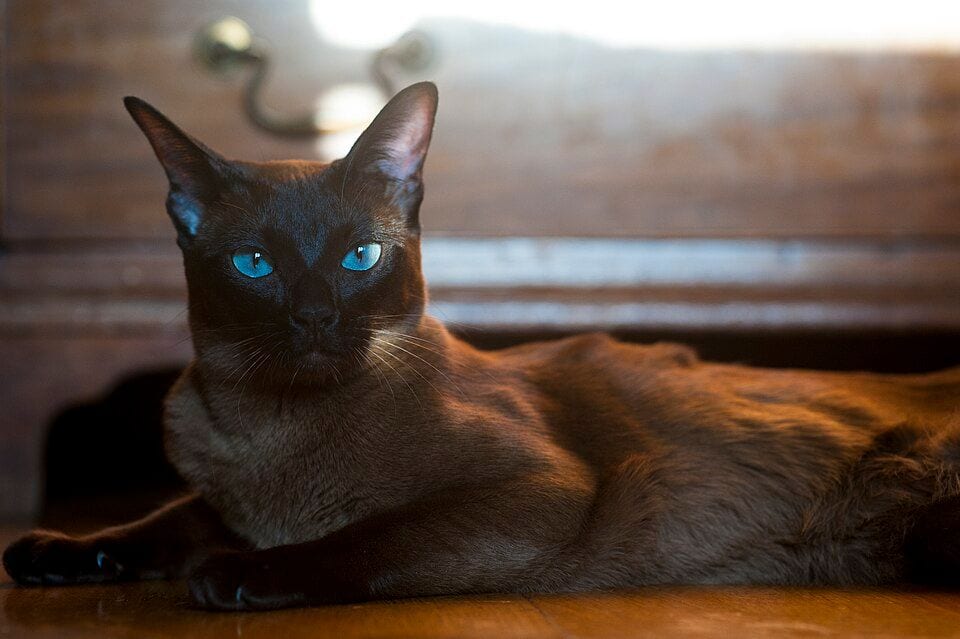
The Sepia Gene Determines the Burmese Cat's Color
The Burmese cat carries a unique form of the dark-pointing gene known as sepia. Like the Siamese gene, it is temperature-sensitive, but its effect is weaker: the body is almost a uniform color that gradually lightens toward the belly, and kittens, whose bodies are warmer, have more distinct points. The original breed color is a rich dark brown, genetically black, called sable in the US and brown in Britain. The first blue Burmese was born in Britain in 1955. Later, red, cream, and tortoiseshell appeared, while chocolate and lilac were developed in the US.
Combining the sepia gene with the Siamese pointing gene produces an intermediate "mink" shade, which the Tonkinese is famous for. The sepia gene is always present in the Singapura, and Burmese cats also helped create the Bombay and the Burmilla.
Two Standards: European and American Types
It is rare for the standards of a single breed to differ so drastically. The British, or traditional, Burmese is more slender, with a longer body, a wedge-shaped head, large pointed ears, a longer tapering muzzle, almond-shaped eyes, long legs, and oval paws. The American, or contemporary, Burmese is noticeably stockier, with a broad, round head, round eyes, a short, flattened muzzle, wide ear bases, and round paws. The CFA compares it to a little bulldog.
What both types share is that they are small to medium-sized, yet heavy-boned and highly muscular cats weighing about 9–13 lbs. Most organizations do not separate the types into distinct breeds, though some refer to the British type as the European Burmese. Since most European and Commonwealth countries adopted their standards from Britain, this type is more commonly found in Europe.
History: From Wong Mau to Two Breed Branches
Dark Siamese-type cats were exhibited as early as the 1871 Crystal Palace show in London, but in Britain, they were long considered "chocolate Siamese" and eventually disappeared. The modern breed began in 1930 when Dr. Joseph Cheesman Thompson brought a dark cat named Wong Mau from Burma to San Francisco. She was bred to a Siamese male, and later to her own son, and the resulting dark brown kittens became the foundation of the new breed. It was later discovered that Wong Mau herself was a Siamese and Burmese cross—this intermediate type was later developed into the Tonkinese.
The CFA recognized the breed in 1936, but due to extensive outcrossing with Siamese cats, they suspended recognition a decade later, only reinstating it in 1954 and granting championship status in 1959. In Britain, three pure generations had already been bred by 1952, and the GCCF recognized the breed. The two branches subsequently developed separately: the CFA phased out the European type in the 1980s, while the GCCF banned the registration of Burmese cats imported from the US.
Temperament: Dog-Like Affection and Forever Playful
Burmese cats are one of the most human-oriented breeds. They maintain their kitten-like energy into old age, learn to play fetch and tag, follow their owners from room to room, seek out warm laps, and happily sleep in bed with you. Veterinarian Joan O. Joshua compared the dog-like attachment of Burmese and Abyssinian cats to their owners. The CFA notes that they distribute their love among all family members, get along well with children, and generally tolerate the family dog.
Burmese cats are as vocal as their Siamese ancestors, though their voices are softer. The CFA jokes that most of them are convinced running the household is their job. They cannot be left alone for long periods—this is not a breed for those who travel frequently or work long hours away from home.
Health: Hypokalemia, Diabetes, and Head Defect
- Hypokalemia. Burmese cats are the most common feline sufferers of hereditary potassium deficiency. The congenital form is caused by a recessive mutation in the WNK4 gene, which can be identified with a genetic test. The disease causes muscle weakness.
- Diabetes mellitus. In England, it was found in 2.27% of Burmese cats (compared to an overall rate of 0.58%), while an Australian study found it in 22.1% of the Burmese cats examined.
- Burmese head defect. A deletion in the ALX1 gene is prevalent in the American line: one copy results in a short muzzle, while two copies cause a universally fatal skull deformity. Genetic testing allows breeders to avoid mating two carriers.
- Feline orofacial pain syndrome (FOPS). In some British lines, kittens experience severe pain when teething, causing them to frantically paw and scratch at their faces.
- GM2 gangliosidosis – a rare hereditary nervous system disorder caused by a mutation in the HEXB gene.
American Burmese cats have one of the lowest genetic diversities among studied breeds, so the breed council permits outcrossing with Bombay, Tonkinese, and cats imported from Southeast Asia. Despite this, a UK study found that the life expectancy of Burmese cats reached 14.4 years—the highest of all the breeds studied.
Care: A Weekly Brush and Lots of Attention
- Coat. The short satin coat sheds very little. The CFA recommends running a rubber brush over them once a week to remove dead hair and maintain their shine.
- Diet. Due to the risk of diabetes, monitor their weight and carbohydrate intake, and have regular blood work done for older cats.
- Socialization. Daily play sessions, games of fetch, and lap time are essential. If you are away from home for long periods, consider getting a second cat.
- Safe environment. These curious and bold cats will investigate everything—keep household chemicals and small swallowable items locked away.
Burmese, Tonkinese, and Bombay Cats: A Family Tree
| Trait | Burmese | Tonkinese | Bombay |
|---|---|---|---|
| Color expression | sepia – almost uniform color | mink – medium contrast | solid black |
| Eyes | golden or green | aquamarine | copper |
| Origin | Wong Mau line, US and Britain | Siamese × Burmese | Burmese × black American Shorthair |
| FIFe recognition | recognized | not recognized | recognized (preliminary) |
How to Choose a Burmese Kitten
First, decide which type of cat you want—European or American—as their lines are rarely mixed. Ask the breeder for the parents' hypokalemia (WNK4) test results, and for American lines, the head defect (ALX1) test as well. Inquire about any history of diabetes or teething pain in the pedigree. The CFA notes that Burmese cats are considered fully grown at around 18 months. Reputable breeders will not let kittens go to their new homes before 14 to 16 weeks of age. When bringing a kitten home, ensure they are microchipped and registered, as recommended by veterinarians and often required by local city or state ordinances. We cover general adoption and registration tips on our main guide page.
For a cat with a similar temperament but more distinct points, consider the Tonkinese; for a solid black "miniature panther," look into the Bombay.
Frequently asked questions
What is the difference between the European and American Burmese?
The British (European or traditional) type is more slender with a longer body, a wedge-shaped head, large pointed ears, and a longer muzzle. The American (contemporary) type is stockier with a broad, round head, round eyes, and a short, flattened muzzle. Most organizations consider them one breed, but some classify the British type as the European Burmese.
How long do Burmese cats live?
In a UK veterinary records study of 45 Burmese cats, the life expectancy was 14.4 years—the highest among the studied breeds and well above the average for all cats (11.7 years).
Why are Burmese cats called 'Velcro kitties'?
The CFA calls Burmese cats 'Velcro kitties' because they are physically attached to their humans. They will follow you from room to room, seek out warm laps, and happily sleep in their owner's bed. At the same time, they share their love with the whole family rather than just one person.
What colors do Burmese cats come in?
The original color is a rich dark brown, known in the US as sable. The UK's GCCF recognizes brown, chocolate, blue, lilac, red, cream, and tortoiseshell, while the CFA only recognizes sable, blue, champagne (chocolate), and platinum (lilac). Their eyes are green or golden, depending on the coat color.
Do Burmese cats get diabetes?
Burmese cats have a higher incidence of diabetes mellitus. In an English veterinary records study, it was found in 2.27% of Burmese cats, compared to an overall rate of 0.58%. For older cats, regular check-ups and a moderate carbohydrate intake are important.
Log in to comment
No comments yet. Be the first.