Siamese Cat: Temperament, Colors, Health & Care
- The Siamese originates from native cats of Thailand (known as Siam until 1939), described in the Tamra Maew (Treatise on Cats).
- The first pair was brought to Great Britain in 1884 by Edward Gould, the British Consul-General in Bangkok.
- Their dark points are caused by a heat-sensitive enzyme: pigment forms on cooler parts of the body, which is why kittens are born white.
- They are highly social, vocal, and affectionate cats that do not tolerate being left alone for long periods.
- The breed is prone to progressive retinal atrophy and amyloidosis; the former can be detected with a genetic test.
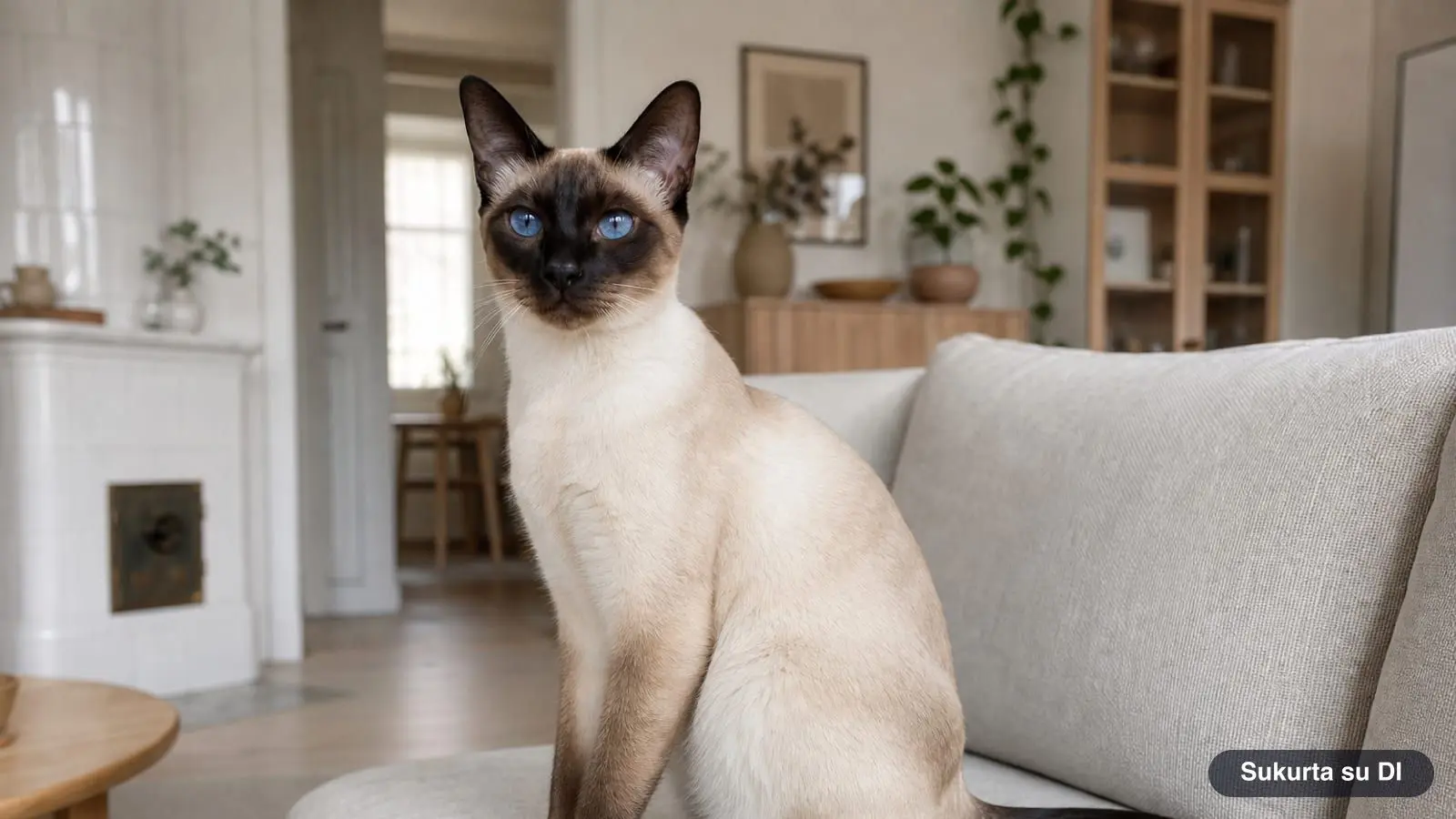
- The Siamese coat color is painted by temperature
- The modern Siamese is slender, long, and wedge-headed
- Temperament: Vocal, affectionate, and attention-seeking
- History: From Ayutthaya manuscripts to London cat shows
- Health: Eye and liver diseases, and susceptibility to tumors
- Care: Hands are enough for the coat, but playtime takes the most effort
- Siamese, Thai, and Oriental Shorthair: The same source, different types
- What to ask a breeder when buying a Siamese kitten
This article is part of the 77.today cat breeds guide, prepared by the 77.today editors from the sources listed at the end.
Even those who know nothing about cat breeds can recognize a Siamese: a cream body, an almost black facial "mask" triangle, dark ears, legs, and tail, and most importantly, striking blue almond-shaped eyes. It is one of the first recognized cat breeds in the West, without which, in the words of the CFA, the modern cat fancy would hardly exist. Over a dozen other breeds have been developed from or are related to it. In this cat breeds guide profile, we explain where the Siamese comes from, why its kittens are born white, what its temperament is like, and what to look for when buying one.
| Origin | Thailand (Siam), native Wichianmat cats |
|---|---|
| Recognition | CFA since founding in 1906; FIFe - Siamese group main breed |
| Body type | slender, long, tubular, long legs |
| Head | wedge-shaped, large wide-set ears |
| Coat | short, glossy, close-lying, almost no undercoat |
| Color | light body with dark points (colorpoint) |
| Eyes | almond-shaped, vivid blue |
| Temperament | social, vocal, highly affectionate to humans |
| Grooming | minimal, a damp hand or rubber brush is enough |
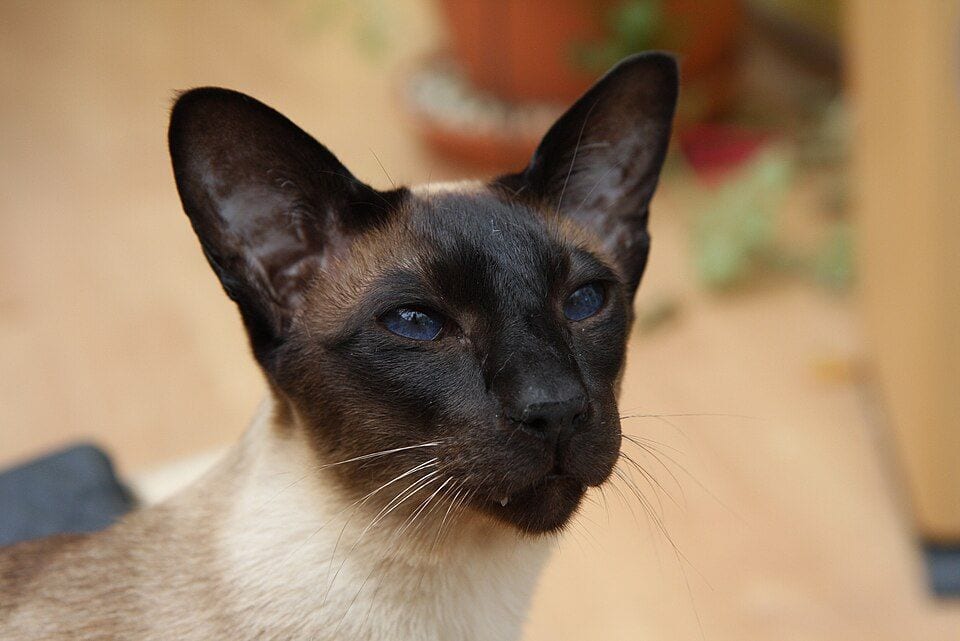
The Siamese coat color is painted by temperature
The dark points of a Siamese are a form of partial albinism. Due to a mutation in the tyrosinase gene, this pigment-producing enzyme becomes heat-sensitive: it is inactive at normal body temperatures but activates in skin areas cooler than about 91 °F. As a result, the face (cooled by air passing through the respiratory tract), ears, paws, and tail become dark. Kittens are born cream or almost white, and their points develop over the first few weeks: by four weeks old, a kitten's point color can usually be determined.
Initially, almost all Siamese cats had dark brown, nearly black points (seal point). Later, bluish (blue), chocolate, and lilac points were recognized—these are the four classic colors. The CFA recognized the blue point in 1934, the chocolate point in 1952, and the lilac point in 1955. Many European organizations also allow red, cream, tabby (lynx), and tortoiseshell points; the FIFe standard permits all colors except silver and smoke. The body typically darkens with age and in cooler climates.
The modern Siamese is slender, long, and wedge-headed
Under the FIFe standard, the Siamese must be graceful, with a long tubular body, long legs, and a long tapering tail. The head resembles a wedge: the lines from the tip of the nose to the tips of the ears form a triangle, the ears are large with a wide base, and the eyes are slightly slanted and deep blue. The coat is short, fine, close-lying, and has almost no undercoat.
Early Siamese cats were rounder and more massive, often with kinked tails and crossed eyes. These traits were later considered faults and disappeared from show lines. In the 1950s and 1960s, breeders began selecting for increasingly slender, longer, and narrower-headed cats. The old-style cats, which a few enthusiasts continued to breed (especially in the UK), have been registered as a separate breed, the Thai cat, since the 1980s.
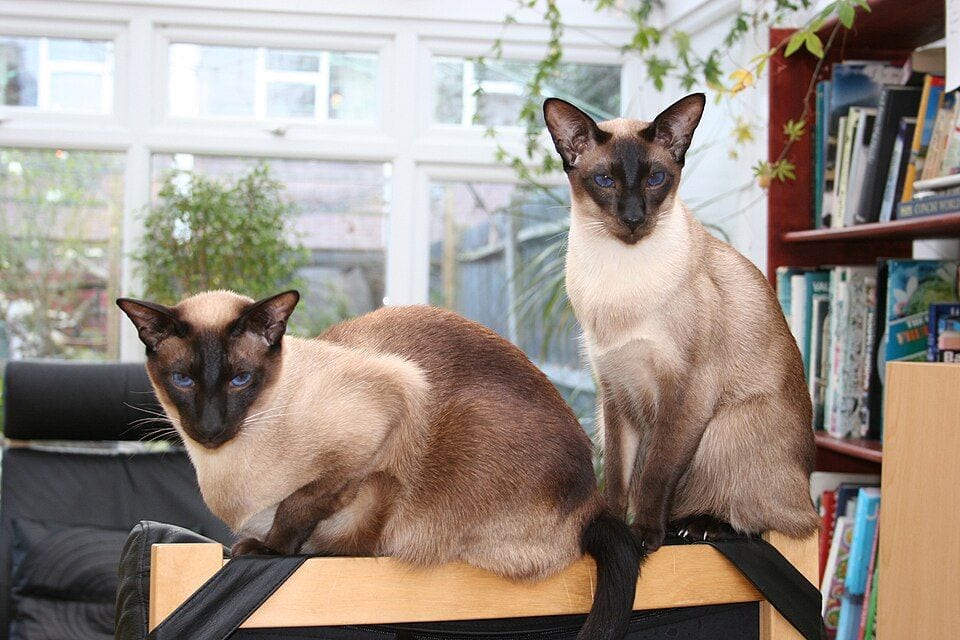
Temperament: Vocal, affectionate, and attention-seeking
The Siamese is not the kind of cat that quietly sleeps in a corner all day. FIFe describes them as active, curious, strongly human-oriented, and extremely vocal, with a characteristic raspy meow. The CFA adds that no other breed is as adept at communicating its desires to humans, whether through body language or a wide range of vocalizations. They are often called the "dogs of the cat world": they will fetch a thrown toy and generally do not mind being walked on a leash.
You must be prepared for this level of interaction. A Siamese wants to be near you, on you, or involved in whatever you are doing, and closed doors are often met with loud protests. They seek out the warmest spot in the house, which is frequently their owner's lap. It is not recommended to leave Siamese cats alone for long periods, so those who work outside the home are often advised to keep two cats. They usually get along well with other cats and dogs, but they often bond closely with one specific person.
History: From Ayutthaya manuscripts to London cat shows
Pointed cats are described and illustrated in the Thai manuscripts Tamra Maew (Treatise on Cats), which are associated with the Ayutthaya Kingdom (1351–1767). In these texts, the cats are called Wichianmat. The first documented Siamese in the US was gifted to President Rutherford B. Hayes in 1878. In 1884, the British Consul-General in Bangkok, Edward Blencowe Gould, brought a pair of cats—Pho and Mia—back to his sister Lilian, who later founded the Siamese Cat Club. Their kittens were exhibited at the London Crystal Palace show in 1885.
Many modern breeds carry Siamese blood: the Oriental Shorthair and Balinese belong to the same group, the Tonkinese was developed by crossing with the Burmese, and the Himalayan by crossing with the Persian. The Siamese point gene has also spread among Ragdolls and Birmans.
Health: Eye and liver diseases, and susceptibility to tumors
The same albinism gene that paints their points also alters the optic nerve connections between the eyes and the brain—which is why many early Siamese cats were cross-eyed. Thanks to selective breeding, this trait has become rare, and unlike in many white, blue-eyed cats, it does not impair their hearing. Responsible breeders screen for several hereditary conditions:
- Progressive retinal atrophy (PRA): a recessive disease leading to blindness; carriers can be identified with a genetic test.
- Amyloidosis: protein deposits that damage the liver; the responsible gene is still being researched, so it is worth asking if the kitten's relatives have been affected.
- Tumors: according to Swedish insurance data, Siamese and related breeds have a higher mortality rate than others, most commonly due to mammary tumors. Young cats can also develop cutaneous mast cell tumors.
- GM1 gangliosidosis: a rare hereditary nervous system disorder associated with a mutation in the GLB1 gene.
In a UK veterinary records study, the life expectancy of Siamese cats was 11.7 years, practically the same as the average for all cats. The risk of urinary tract diseases is lower for this breed than for others.
Care: Hands are enough for the coat, but playtime takes the most effort
- Coat. The CFA suggests a simple grooming routine for their short coat: stroke the cat with a damp hand until your hand dries, which collects loose hair. A rubber brush also works well. Bathing is rarely necessary.
- Enrichment. This active and intelligent cat needs daily playtime, food puzzle toys, high shelves, and a window to watch birds.
- Warmth. With very little undercoat, this cat loves warm beds—a heated pad or a hammock hung near a radiator will be their favorite spot.
- Companionship. If your home is empty for long hours, consider getting a second cat, ideally one with a similar temperament.
Siamese, Thai, and Oriental Shorthair: The same source, different types
| Trait | Siamese | Thai | Oriental Shorthair |
|---|---|---|---|
| Body and head | very slender, wedge-shaped head | medium build, rounder head | same as Siamese |
| Color | only with dark points | with dark points | solid, tabby, spotted - no points |
| Eyes | blue | blue | usually green |
| Status | recognized by all major organizations | TICA, WCF, FIFe | FIFe, CFA, TICA |
What to ask a breeder when buying a Siamese kitten
Because kittens are born light, determining the exact color of a very young Siamese is difficult—it is most reliable to look at the parents' pedigrees. Ask for the PRA genetic test results for both parents and inquire about any history of amyloidosis or tumors in their lineage. Crossed eyes and a kinked tail are not dangerous to their health, but they indicate that the cat does not meet the breed standard. Reputable breeders associated with organizations like the CFA or TICA will typically not let kittens go to their new homes until they are at least 12 to 14 weeks old and fully vaccinated. For more general advice on finding a responsible breeder, avoiding kitten mills, and understanding registration papers, see the beginning of our guide.
If you love the Siamese look but prefer a calmer temperament, it is worth looking into the Birman or the Ragdoll. If you want a long-haired relative, check out the Balinese breed profile.
Frequently asked questions
Why are Siamese kittens born white?
Siamese coat color is determined by a heat-sensitive tyrosinase enzyme: it is inactive at normal body temperature but activates in cooler areas of the skin. In the womb, the kitten is entirely warm, so it is born cream or white, and the dark points on the face, ears, legs, and tail develop over the first few weeks and months.
Do Siamese cats meow a lot?
Yes. The Siamese is famous for its loud, somewhat raspy voice and a desire to 'talk' with its owner. It will vocally announce what it wants and protest when ignored, so for owners expecting a quiet, calm cat, this breed might be too noisy.
How long do Siamese cats live?
In a UK veterinary records study, the life expectancy of Siamese cats was 11.7 years, almost the same as the average for all cats. According to Swedish insurance data, 68% of Siamese and related breeds lived to be at least 10 years old.
What is the difference between a Siamese and a Thai cat?
Both originate from the same native cats of Thailand, but in the mid-20th century, Western breeders began breeding Siamese cats to be increasingly slender, long, and with a wedge-shaped head. The older, rounder type of cat has been registered as a separate breed, the Thai cat, since the 1980s.
Do Siamese cats get darker with age?
Yes. Because their pigment is temperature-dependent, the bodies of Siamese cats typically darken as they age and if they live in colder climates, while those in warmer regions tend to keep a lighter coat.
Log in to comment
No comments yet. Be the first.