Birman Cat: Temperament, Size, Care & Health
- The breed's name comes from the French word for Burma, Birmanie; it was first recognized in France in 1925.
- Their distinguishing features are dark color points and symmetrical white "gloves" on all four paws.
- The coat is semi-long, silky, and lacks an undercoat, making it much less prone to matting than a Persian's.
- After World War II, only two Birmans remained in Europe; the breed was revived by crossing with Persians and Siamese cats.
- Birmans have very low genetic diversity and a higher risk of chronic kidney disease, though a UK study showed a life expectancy of 14.4 years.
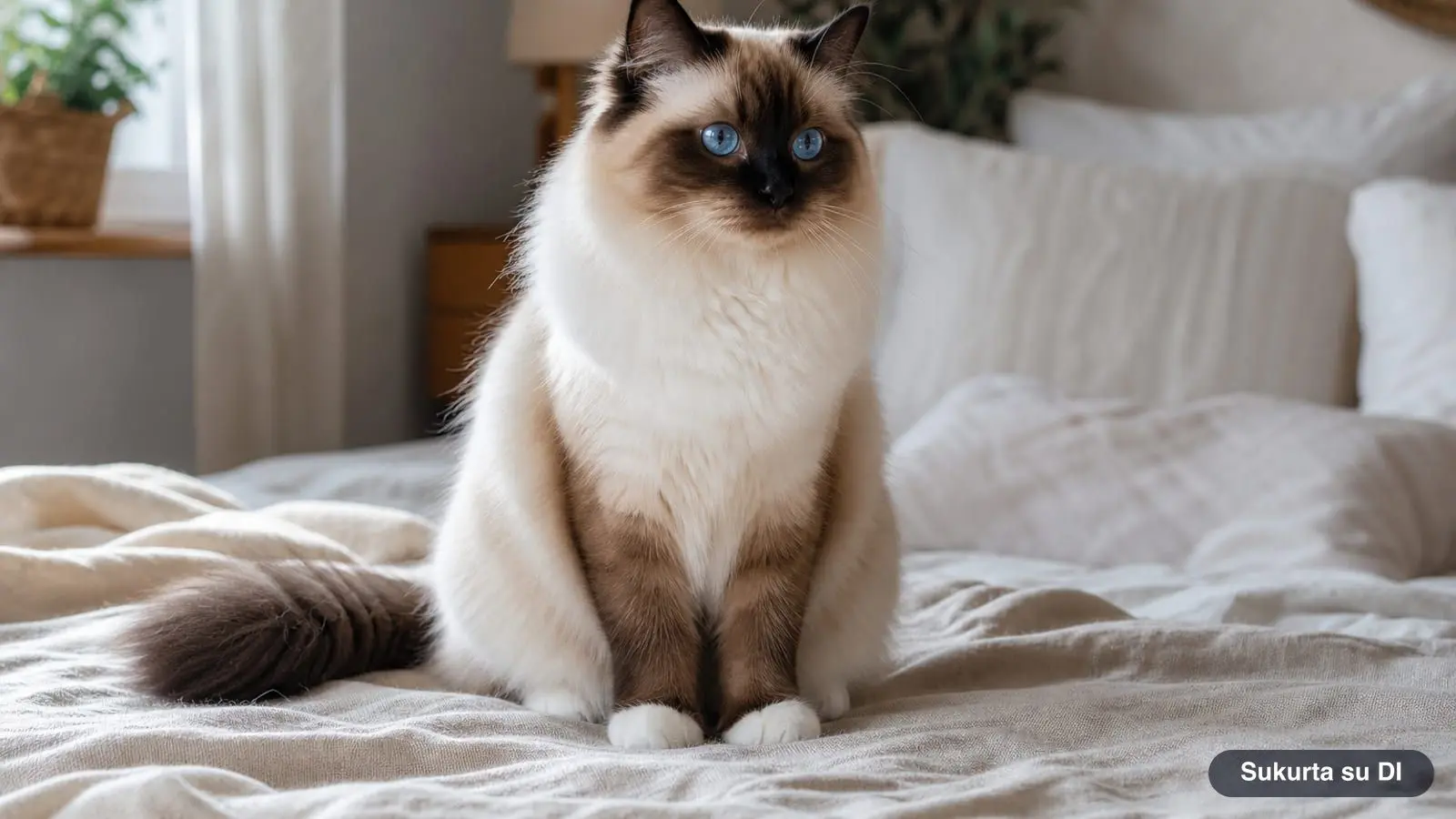
- White "gloves"—the Birman's calling card
- History: Temple legends and post-war revival
- Temperament: Gentle, patient, and craving company
- Health: Low genetic diversity and kidney concerns
- Care: Longhaired but low-maintenance
- Birman, Ragdoll, and Balinese: Same points, different traits
- How to choose a Birman kitten
This article is part of the 77.today cat breeds guide, prepared by the 77.today editors from the sources listed at the end.
At first glance, the Birman resembles a semi-longhaired Siamese: a light cream body, dark face, ears, legs, and tail, with deep blue eyes. However, its paws instantly give it away—all four are adorned with snow-white "gloves." This breed is often called the Sacred Birman because its origins are steeped in legends of temple cats. In this cat breed guide profile, you will learn what we actually know about the Birman's origins, as well as their appearance, temperament, care, and health.
| Origin | France; according to legend, Burma (Myanmar) |
|---|---|
| Recognition | French Cat Club 1925, FIFe 1949, GCCF 1966, CFA 1967 |
| Size | Medium to large, elongated body |
| Coat | Semi-long, silky, no undercoat |
| Pattern | Colorpoint with white paws |
| Colors | Seal, chocolate, red, blue, lilac, cream; tabby and tortoiseshell points |
| Eyes | Round, deep sapphire blue |
| Temperament | Gentle, patient, social |
| Grooming | Brush once a week |
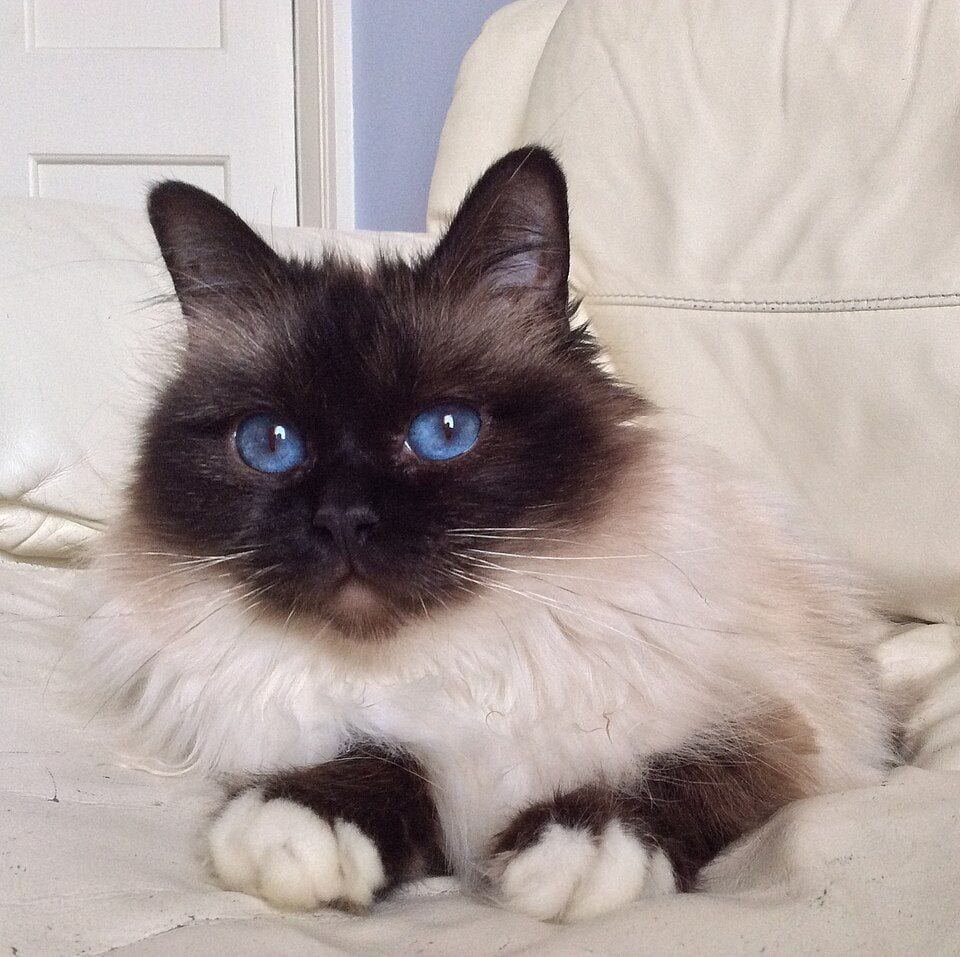
White "gloves"—the Birman's calling card
The Birman cat carries both colorpoint and white spotting genes. The first colors the face, ears, legs, and tail, while the second colors the paws. The breed standard requires the white to cover all toes and be symmetrical: on the front paws, it ends at the joint between the toes and the metacarpals, while on the back legs, it extends higher up the back of the leg, ending in an inverted V shape known as "laces." Any other white spot on the points is considered a serious fault. The body is white or cream with a soft tint of the point color, which the CFA describes as a "golden mist."
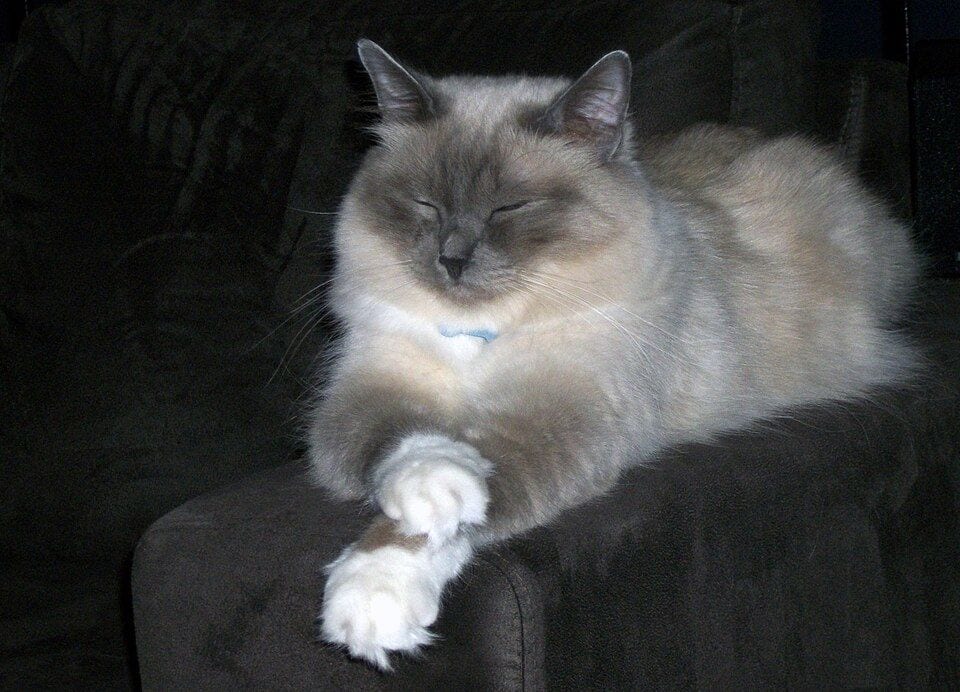
The body is medium to large, elongated, and sturdy. The head is broad and rounded, the nose is of medium length with a Roman profile, and the eyes are round and deep blue. Recognized colors include seal, chocolate, red, and their dilute versions—blue, lilac, and cream—as well as tabby and tortoiseshell point variations. Birmans mature slowly, taking about three years to reach full size, and females are generally smaller than males.
History: Temple legends and post-war revival
There is no exact data on the origins of Birman cats. The most common story is that they were the companions of temple priests in northern Burma and arrived in France either as a gift for helping defend a temple or were smuggled out. The CFA notes that around 1919, a pair was shipped from Burma to France, and the pregnant female that survived the journey became the foundation of the breed. The name comes from Birmanie, the French word for Burma. In 1925, the French Cat Club became the first to recognize the breed.
During World War II, Birman cats nearly went extinct: after the war, only one pair remained in Europe—Orloff and Xenia de Kaabaa. The breed had to be revived through intensive outcrossing with Persians and Siamese cats, and it wasn't until the early 1950s that purebred Birman kittens began to be born again. The first cats only had seal points; blue points were introduced in 1959 through blue Persian lines, and English breeders later added chocolate, red, and tabby points. Birman blood was also used in the development of Ragdolls. The most famous representative of this breed is fashion designer Karl Lagerfeld's cat, Choupette.
Temperament: Gentle, patient, and craving company
The CFA describes Birman cats as intelligent, eager to learn, and easy to train. They are social, people-oriented, playful, and crave attention. While moderately active, they are very "helpful" and will gladly "assist" you with work or chores. They are patient and even-tempered, making them an excellent fit for families with children and other pets. General breed profiles often note that Birmans appreciate a quiet environment, dislike loud noises, and tend to bond closely with one primary owner.
Birmans do not like being left alone for long periods, so if you work outside the home and have no other pets, the CFA recommends considering a pair. They are generally quiet, speaking in soft, chirp-like tones, but if an owner responds to every meow, a Birman can turn into quite the chatterbox.
Health: Low genetic diversity and kidney concerns
A 2008 study found that Birman cats have one of the lowest levels of genetic diversity among the breeds tested. This increases the risk of hereditary diseases, which is why reputable breeders perform health screenings, such as testing for hypertrophic cardiomyopathy. Other known risks include:
- Chronic kidney disease. Birmans are considered a high-risk group; when testing kidney function, it has been noted that they naturally have higher levels of creatinine in their blood, so test results should be evaluated by a veterinarian familiar with this trait.
- Feline infectious peritonitis (FIP) – Birmans have a higher risk.
- Urate bladder stones – In a large review, Birmans were significantly more affected than average.
- Feline audiogenic reflex seizures (FARS) – A recently described form of epilepsy that is believed to be particularly common in Birmans.
Despite these concerns, a UK veterinary records study found that the life expectancy of 38 Birman cats was 14.4 years—one of the highest among the breeds studied.
Care: Longhaired but low-maintenance
- Coat. Because there is no undercoat, the fur rarely mats. According to the CFA, brushing once a week is sufficient, and baths are rarely needed.
- Water and diet. Due to the risk of kidney issues and bladder stones, encourage drinking by using a pet water fountain and offering wet food.
- Companionship. Daily play and interaction are essential, and a second cat is recommended if you are away from home for long hours.
- Veterinarian. Annual blood and urine tests help catch any kidney changes early.
Birman, Ragdoll, and Balinese: Same points, different traits
| Trait | Birman | Ragdoll | Balinese |
|---|---|---|---|
| White markings | Only paw "gloves" and "laces" | Depends on pattern; mitted has a white chin and belly stripe | None |
| Body | Elongated, sturdy | Very large, heavy | Slender, oriental |
| Coat | Semi-long, no undercoat | Semi-long, almost no undercoat | Semi-long, silky |
| Temperament | Calm, patient | Very calm, "floppy" | Active, vocal |
How to choose a Birman kitten
Birman kittens, like other colorpoint cats, are born almost entirely white. Their points and the symmetry of their gloves develop over several weeks, so a breeder cannot immediately evaluate a kitten's show quality. Ask about the parents' heart screenings and kidney health, and inquire if there is any history of FIP or epileptic seizures in their lineage. According to major registries like the CFA and TICA, kittens should not go to their new homes before they are 14 weeks old. When bringing a kitten home, ensure they are microchipped and registered according to your local city or state ordinances, as recommended by US veterinarians.
If you are looking for a cat with a similar appearance but an even calmer demeanor and larger size, check out the Ragdoll profile. For a more slender and vocal companion, read up on the Balinese.
Frequently asked questions
How is a Birman different from a Ragdoll?
Both have dark points and blue eyes, and mitted Ragdolls are often confused with Birmans. Ragdolls are generally larger, have a white chin, and a white stripe on their belly. A Birman's chin is colored, and only their paw "gloves" and back leg "laces" are white. Head shape also differs: Birmans have a Roman nose.
Do Birman cats shed a lot?
Less than most longhaired cats. Their coat has no undercoat, so it rarely mats. According to the CFA, brushing them once a week is sufficient.
Why do Birman cats have white paws?
The white "gloves" are caused by a white spotting gene that Birmans carry alongside the colorpoint gene. According to the breed standard, the white must cover all toes symmetrically and extend higher on the back legs, ending in an inverted V shape known as "laces."
How long do Birman cats live?
In a UK veterinary records study, the life expectancy of 38 Birman cats was 14.4 years—significantly higher than the overall cat average of 11.7 years, though the sample size was small.
Why do Birman kitten names start with the same letter?
Many Birman breeders follow a French tradition where all kittens born in the same year have names starting with the same letter of the alphabet. The CFA notes that kittens born in 2023 had names starting with U, and in 2024 with V.
Log in to comment
No comments yet. Be the first.