Bengal Cat: Temperament, Generations F1-F5, Care & Health
- The Bengal was created by crossing the Asian leopard cat (Prionailurus bengalensis) with domestic cats; the modern breed was pioneered by American Jean Mill in 1963.
- A 2024 study found an average of 3.48% leopard cat DNA in the genomes of 947 Bengals.
- TICA recognized the breed in 1986, FIFe in 1999, and CFA in 2016 (only generations far removed from the wild ancestor).
- While early generations (F1–F4) are considered hybrids and may be restricted by local US city or state ordinances, later generations are widely accepted as domestic pets.
- Major health risks include HCM, Bengal progressive retinal atrophy (PRA-b), and pyruvate kinase (PK) deficiency; the latter two can be detected via genetic testing.
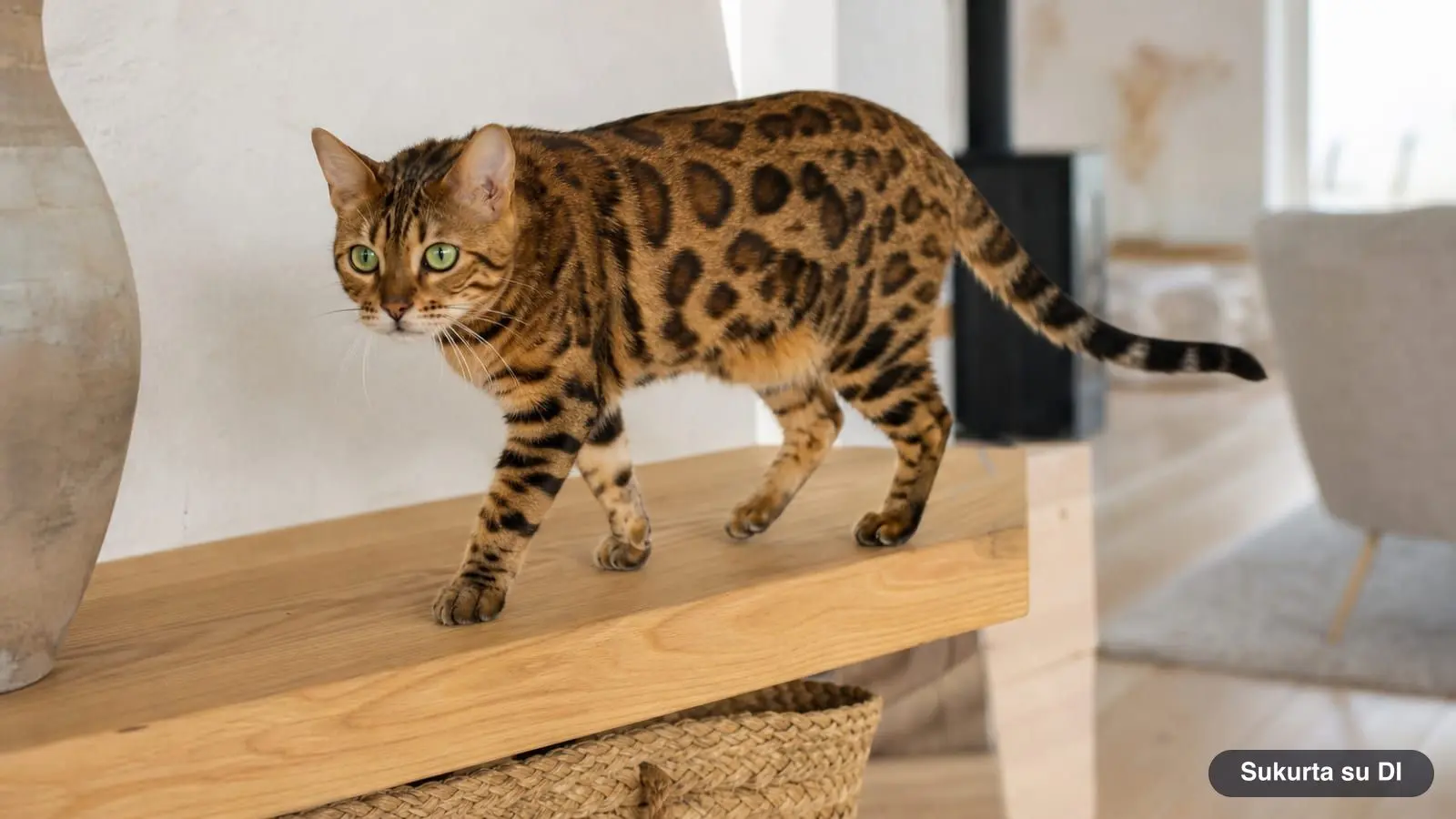
- Bengals are the only domestic breed with leopard rosettes
- History: From Jean Mill's experiments to TICA's most popular breed
- F1-F4 generations: Hybrids and local US regulations
- Temperament: A perpetual kitten that needs a job
- Health: HCM, PRA-b, PK deficiency, and nasal dermatitis
- Care: Low maintenance for the coat, high maintenance for the mind and muscles
- Bengal, Egyptian Mau, and Ocicat: Three spotted cats
- What to ask a Bengal breeder
This article is part of the 77.today cat breeds guide, prepared by the 77.today editors from the sources listed at the end.
The Bengal is an attempt to invite a little leopard into your home. Its short, silky coat is patterned with rosettes or marbling, the tips of the hair glitter in the light, and its muscular body moves like a wild predator. Behind the exotic appearance lies a highly energetic and intelligent domestic cat that needs plenty of activity. In our cat breeds guide, you will find out where Bengals come from, what the F generations mean, how local US laws might affect hybrid ownership, and what health tests to ask for.
| Origin | US; Asian leopard cat × domestic cats (especially spotted ones) |
|---|---|
| Recognition | TICA in 1986 (championship status in 1991), GCCF in 1997, FIFe in 1999, CFA in 2016 |
| Size | Medium to large, muscular |
| Coat | Short, very soft, often with a "glitter" effect; a longhaired variety also exists |
| Patterns | Spotted and rosetted or marbled |
| Colors | Brown, blue, snow (point, sepia, mink), with or without silver |
| Eyes | Large, bright |
| Activity | Very high |
| Grooming | Soft brush once a week |
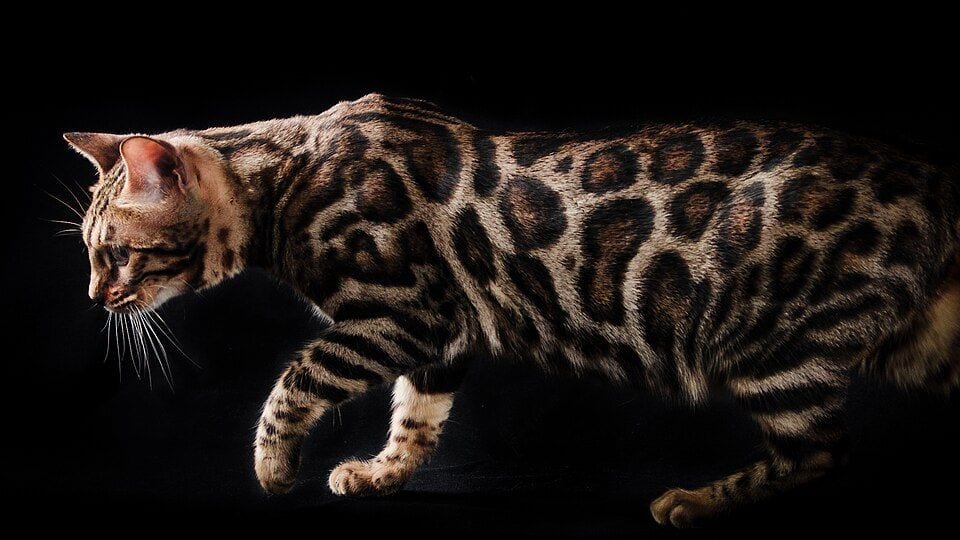
Bengals are the only domestic breed with leopard rosettes
Domestic cats have four tabby coat patterns: ticked, mackerel, classic (marbled), and spotted. The Bengal is the only one that also has rosettes--spots with a dark outline and a lighter center, inherited from the Asian leopard cat. Another variety is marble: asymmetrical, dark-outlined patterns created on the basis of the classic tabby pattern. Many Bengals have a coat with a glitter effect, where the tips of the hair sparkle in the light as if dusted with gold.
The most well-known color is brown spots or rosettes on a golden, orange, or sandy background. There are also blue Bengals, silver ones, those with a charcoal tint, and light "snow" Bengals--with darker points, sepia, or mink shades. The body is muscular and powerful, the hind legs are slightly longer than the front ones, the ears are small to medium, and the muzzle has prominent whisker pads and a broad nose--all of which enhance the wild look. Longhaired kittens have been born since the beginning of the breed; TICA has recognized the longhaired Bengal (Cashmere) in championship shows since 2017.
History: From Jean Mill's experiments to TICA's most popular breed
The first hybrid of a leopard cat and a domestic cat was described back in 1889 in Harrison Weir's book. The modern breed was started in 1963 by Californian Jean Mill, who crossed an Asian leopard cat with a black domestic tomcat. Around the same time, Dr. Willard Centerwall was crossing these cats to study whether the leopard cat's resistance to feline leukemia could be passed on to domestic cats. Jean Mill later acquired cats from him and, by adding spotted domestic cats (especially the Egyptian Mau), developed calm-tempered cats that were five generations removed from their wild ancestor.
TICA accepted Bengals as a new breed in 1986 and granted them championship status in 1991. The GCCF recognized them in 1997, and FIFe in 1999. The CFA only began registering the breed in 2016, requiring five generations of purely domestic ancestry, and granted championship status in 2018. The Bengal became the most popular TICA breed, and in the 2025 FIFe statistics, it ranked seventh with 3,535 kittens registered.
F1-F4 generations: Hybrids and local US regulations
F1 is the direct offspring of a leopard cat and a domestic cat, F2 is their offspring, and so on. The first three generations are called foundation cats; their males are often sterile, so foundation females are mated with fertile later-generation Bengals. While early generations are considered hybrids, regulations on owning them vary widely in the US. Some states and cities have strict local ordinances or breed-specific legislation that ban or heavily restrict the ownership of F1-F4 hybrid cats.
Internationally, rules can be even stricter. For example, Australia banned the import of Bengals starting in March 2025, and certain parts of Europe have banned the keeping and breeding of F1-F4 generations. In the US, Bengals sold as household pets are typically F5 or later generations, which are legally considered domestic cats and are widely accepted, though it is always wise to check your local laws and homeowners insurance policies before bringing one home.
Temperament: A perpetual kitten that needs a job
The CFA describes Bengals as confident, curious, and athletic, retaining their kitten-like energy well into old age. They are highly intelligent, quickly learn tricks, and many gladly walk on a leash with a harness. Water fascinates Bengals: they will watch you brush your teeth, stick their paws under the faucet, or even climb into the shower. Some Bengals are very vocal, while others are quiet.
Bengals get along well with children and other pets if introduced gradually, but small rodents or birds are not safe around them--their hunting instinct is strong. A bored Bengal will find its own entertainment, often not the kind the owners would prefer, so before getting one, consider whether you can dedicate time to daily active play.
Health: HCM, PRA-b, PK deficiency, and nasal dermatitis
- Hypertrophic cardiomyopathy (HCM) - one of the breed's biggest issues. A 2013 study indicated a 16.7% prevalence. There is no genetic test for Bengals, so breeding cats are screened annually via echocardiogram.
- Bengal progressive retinal atrophy (PRA-b) - vision begins to fail around 7 weeks, and by two years of age, the cat has very poor eyesight. It is detected by a genetic test.
- Pyruvate kinase (PK) deficiency - an inherited anemia; breeders test for it so that two carriers are not mated.
- Bengal ulcerative nasal dermatitis - scaling, scabs, and cracks appear on the nose of cats aged 4 to 12 months; it is considered hereditary and is treated with topical ointments.
In a UK veterinary records study, the life expectancy of Bengals was 8.5 years--shorter than the 11.7-year average for all cats. In one UK study, all 100 tested Bengals had blood type A.
Care: Low maintenance for the coat, high maintenance for the mind and muscles
- Coat. The soft coat rarely mats and, according to the CFA, sheds less than most shorthairs. A weekly brush with a soft bristle brush is enough.
- Exercise. Tall scratching posts, wall shelves, a cat exercise wheel, daily hunting games, and walks on a harness.
- Mental stimulation. Food puzzles, trick training with treats, and toy rotation.
- Safety. Keep the bathroom and washing machine doors closed--a curious, water-loving Bengal will be the first to explore inside.
Bengal, Egyptian Mau, and Ocicat: Three spotted cats
| Feature | Bengal | Egyptian Mau | Ocicat |
|---|---|---|---|
| Origin | Hybrid with Asian leopard cat | Natural breed from Egypt | Siamese and Abyssinian cross in the US |
| Spots | Rosettes or marble | Natural spots | Thumbprint-shaped spots |
| Wild ancestor blood | Yes, distant | No | No |
| Activity | Very high | High | High |
What to ask a Bengal breeder
Ask which generation the kitten and its parents are, and request the pedigree paperwork to confirm it. Demand the results of both parents' PRA-b and PK tests, as well as the latest echocardiogram report for HCM. Choose a well-socialized kitten accustomed to home life, no younger than 12 to 14 weeks, which is standard practice for reputable breeders. Be wary of offers to buy "almost wild" early-generation cats--they can be restricted by local laws and are much harder to care for. We discussed mandatory paperwork, checking a reputable breeder, and avoiding puppy mills or pet stores in the introduction to our guide.
Cats with a similar wild look but without a hybrid history include the Ocicat and the Toyger; an even larger and "wilder" hybrid is the Savannah.
Frequently asked questions
Is the Bengal cat wild?
No. Today's Bengals are domestic cats, many generations removed from their wild ancestor, the Asian leopard cat. A 2024 study found an average of only 3.48% leopard cat DNA in their genome. They inherited mostly their exotic looks and high energy from their wild ancestor.
What do F1, F2, and F3 Bengal generations mean?
F1 is the direct offspring of a leopard cat and a domestic cat, F2 is the next generation, and so on. The first three generations are called foundation cats; the males are often sterile. While early generations (F1–F4) are considered hybrids and may face local ownership restrictions in the US, Bengals sold as pets are usually much later generations.
Is the Bengal cat hypoallergenic?
There is no scientific proof of this. Breeders often claim Bengals produce fewer allergens, but feline geneticist Leslie Lyons emphasizes that there are no truly hypoallergenic cats: Bengals can still cause allergic reactions in sensitive individuals.
What is the lifespan of a Bengal cat?
A UK veterinary records study found the life expectancy of Bengals to be 8.5 years, compared to the overall cat average of 11.7 years. This is one of the shorter lifespans among studied breeds, making health testing and regular vet checkups especially important.
Do Bengals like water?
Many Bengals are fascinated by water: they will watch you brush your teeth, dip their paws into running water, or even try to join you in the shower. This is common for the breed, though not every single cat will love it.
Log in to comment
No comments yet. Be the first.