Chartreux Cat: Size, Personality, Care & Health
- Blue French cats have been mentioned in literature since the 16th century: in 1558, Joachim du Bellay wrote a poem about a small cat's death.
- Legend links the breed to the Carthusian monks at the Grande Chartreuse monastery, but in 1972, the prior denied any such records existed in their archives.
- FIFe has recognized the Chartreux since its founding in 1949; in the 1960s, it was briefly crossed with the British Shorthair before standards separated again in 1977.
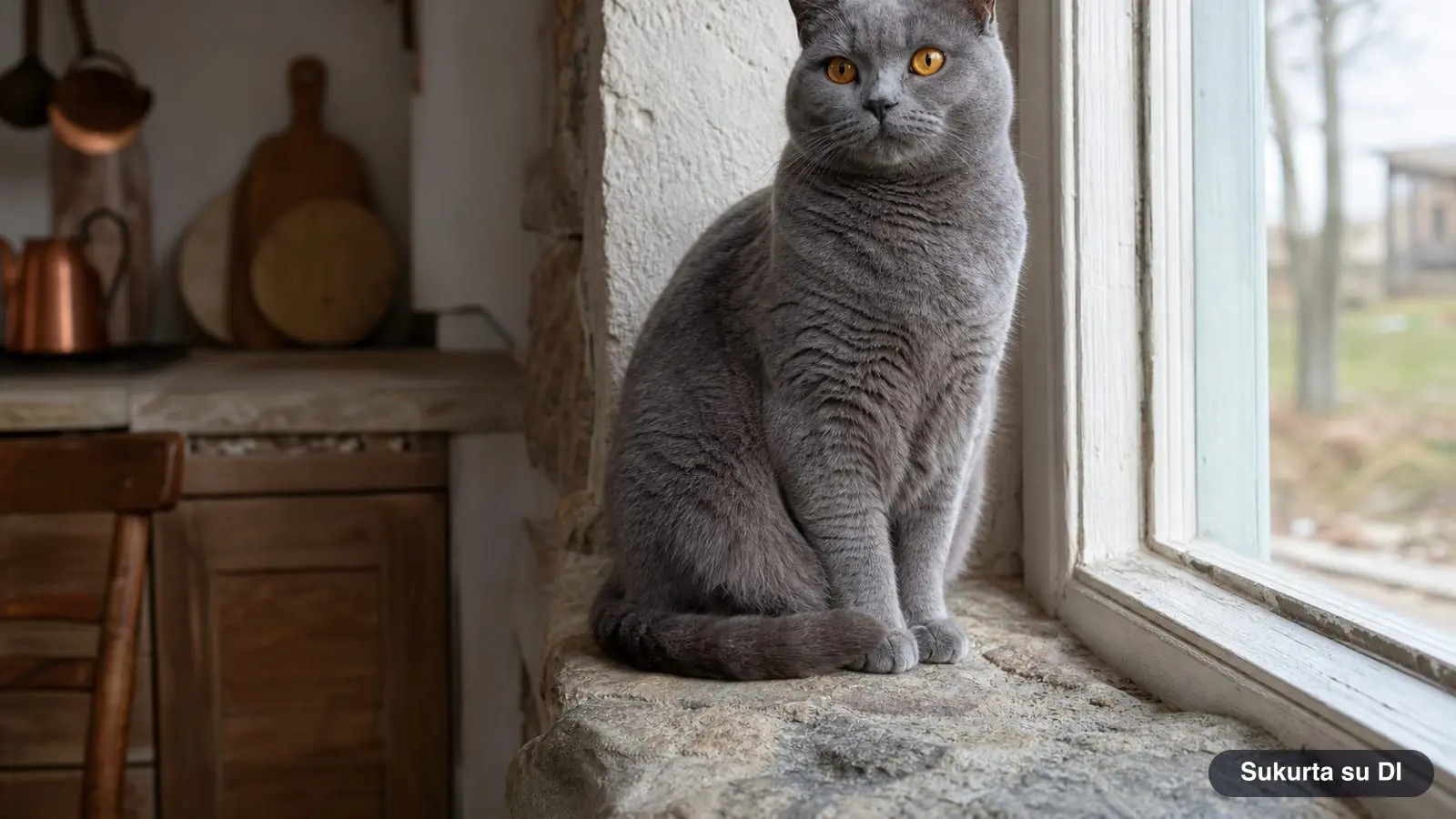
- Only the blue color is permitted under the breed standard; eyes range from gold to copper, and the head is trapezoid-shaped.
- Their temperament is calm, quiet, and loyal; some Chartreux cats rarely meow at all.
This article is part of the 77.today cat breeds guide, prepared by the 77.today editors from the sources listed at the end.
The Chartreux is the national cat of France and one of the oldest European breeds. It is easy to recognize: a dense woolly blue-gray coat, broad shoulders, relatively fine legs, large gold or copper eyes, and a muzzle shape that gives the cat a perpetual smile. In French, it is called the Chartreux. Its famous owners have included the writer Colette, the poet Charles Baudelaire, and President Charles de Gaulle. In our cat breeds guide, you will find the history, appearance, temperament, and care requirements of this calm blue cat.
| Origin | France |
|---|---|
| Recognition | FIFe since 1949; CFA championship status in 1987 |
| Size | Medium to large; males up to about 14 lbs |
| Body | Broad shoulders, muscular, relatively fine legs |
| Head | Trapezoid-shaped, tapering muzzle ("smile") |
| Coat | Short, dense, woolly, somewhat water-resistant |
| Color | Blue only, as uniform as possible |
| Eyes | Gold to copper |
| Temperament | Calm, quiet, loyal |
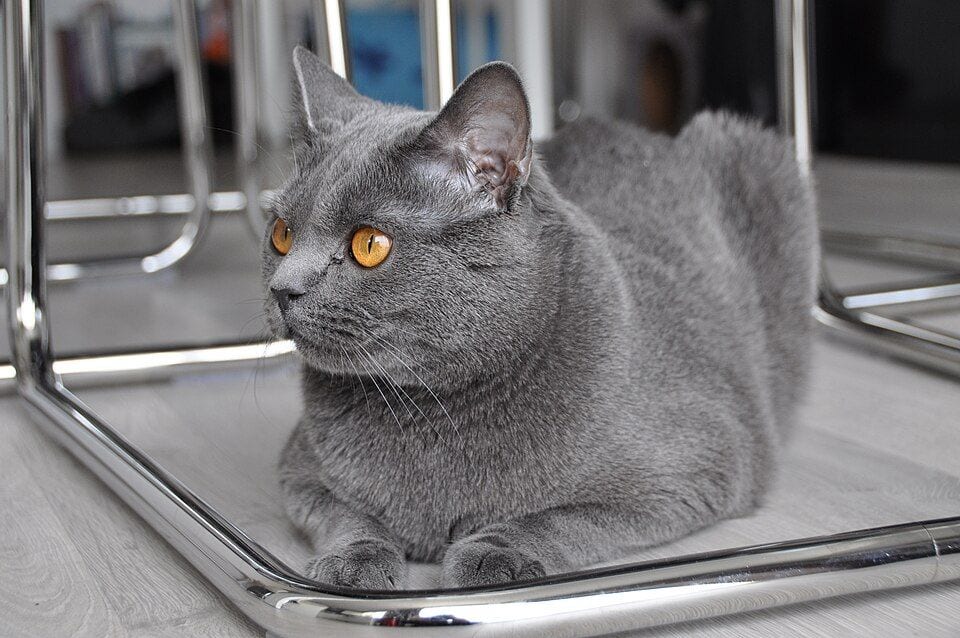
Chartreux: A woolly blue coat and a perpetual smile
The most important features of the Chartreux are its coat and head. The coat is short, very dense, slightly woolly, with an insulating undercoat, making it partially water-resistant and often "breaking" like sheep's wool. The color can range from medium to light blue but must be as uniform as possible; it is noted that the hair on the nose, whisker pads, and paws is more silvery. The Chartreux does not come in any other colors.
Under the FIFe standard, the head is described as a trapezoid: its broad lower edge is formed by chubby cheeks, while the narrower upper edge is the top of the skull. The muzzle tapers, and the whisker pads give the face the impression of a smile. The ears are medium-sized, set high and erect, and the eyes are round and expressive, ranging from amber and gold to copper. The body has broad shoulders, a powerful chest, and is muscular, while the legs are relatively fine—a combination that gives the Chartreux lightning-fast reflexes.
History: Monastic legends and Spanish wool
Blue French cats have been mentioned in literature as early as the 16th century: in 1558, the poet Joachim du Bellay wrote a poem about the death of a small cat, and in 1747, Jean-Baptiste Perronneau painted a portrait featuring one. In the 18th century, blue cats were described by the French naturalist Buffon. According to popular legend, the Chartreux descends from cats kept by Carthusian monks at the Grande Chartreuse monastery near Grenoble, but in 1972, the prior denied that any records of such cats existed in their archives.
FIFe indicates that the breed likely originated in Turkey or Iran, later spread to Syria, and arrived in France with the Crusaders in the 13th century. The name most likely came from a highly valued 18th-century Spanish wool called "la pile des Chartreux." Directional breeding in France began in the 1920s, and after World War I and especially World War II, feral populations were almost entirely wiped out; the Léger sisters bred the best cats on the island of Belle-Île. In the 1960s, Chartreux cats were so heavily inbred that FIFe allowed them to be crossed with British Shorthairs, and for a time, both breeds shared a common standard until they were separated again in 1977. Chartreux cats were brought to the US in 1970–1971, and the CFA granted them championship status in 1987.
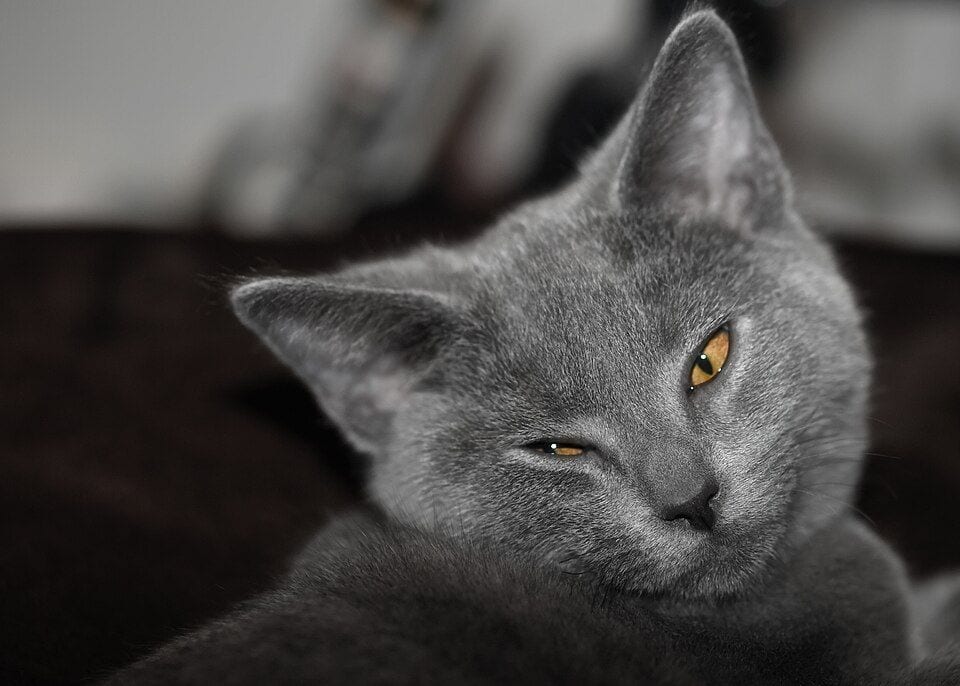
Temperament: Quiet, calm, and loyal
The CFA notes that the legend of the monks' cats taking a vow of silence is a myth, but Chartreux cats are indeed quieter than most breeds. Many have a soft voice they rarely use, and some are completely mute. They communicate through purrs, chirps, expressive eyes, and subtle body language—tapping you with a paw to ask to be let onto your lap, or bringing a toy to initiate play.
Chartreux cats are highly intelligent with quick reflexes; some learn to walk on a leash, fetch toys, and respond to their names. They love routines and rituals, often following their owner from room to room. They typically bond closely with one person but are affectionate with all family members. FIFe describes them as very calm, easy to handle, and gentle-natured, preferring quiet spaces away from daily noise. They get along well with children and other pets, are non-aggressive, and travel easily. Chartreux cats reach full maturity in 3 to 5 years.
Health: A sturdy breed prone to weight gain
The Chartreux is considered a very healthy breed. FIFe notes that they love to eat a lot, and neutered or spayed cats easily gain weight, so their diet must be strictly controlled. The CFA also mentions patellar luxation—a hereditary condition that can affect mobility; cats can be checked by a veterinarian, and those with a mild form usually do not have mobility issues but should not be bred.
Care: A comb during shedding season
- Coat. Chartreux cats shed seasonally—mostly in the fall and spring, when they need to be combed more frequently. The CFA recommends a wide-toothed metal comb, which prevents matting and reduces hairballs.
- Bathing. Usually unnecessary; their water-resistant coat is difficult to get thoroughly wet.
- Weight. Weigh their food portions, especially for altered cats; regular play helps maintain their muscular build.
- Allergies. Due to their dense woolly undercoat, the CFA does not recommend Chartreux cats for people with allergies.
Chartreux, British Shorthair, and Russian Blue
| Feature | Chartreux | British Shorthair | Russian Blue |
|---|---|---|---|
| Head | Trapezoid, tapering muzzle | Round, chubby cheeks | Modified wedge |
| Eyes | Gold to copper | Copper | Emerald green |
| Coat | Woolly, like sheep's wool | Plush, crisp | Double, with silver tips |
| FIFe kittens in 2025 | 747 | 16,207 (all colors) | 2,466 |
How to choose a Chartreux kitten
Chartreux breeders are relatively rare in the US, so it is worth starting your search for a kitten early. Ask for the parents' veterinary patella screening results and CFA or TICA registration papers. A French tradition, which breeders in other countries often follow, starts kittens' names with a specific letter for that year (skipping K, Q, W, X, Y, and Z), so you can guess the birth year from the name. Reputable breeders typically allow kittens to go to their new homes no earlier than 14 weeks of age. We discuss standard veterinary recommendations for microchipping and local registration at the beginning of our guide.
You can find other blue breeds in our profiles for the British Shorthair, the Russian Blue, and the Korat.
Frequently asked questions
How is the Chartreux different from the British Shorthair?
Both are blue and sturdy, but the Chartreux has a trapezoid-shaped head tapering to a "smiling" muzzle, while the British Shorthair has a round head with chubby cheeks. The Chartreux has relatively finer legs, gold to copper eyes, and a woolly, sheep-like coat. Chartreux cats are only blue, whereas British Shorthairs come in many colors.
Do Chartreux cats meow?
Rarely. Chartreux cats are considered quiet: many have a very soft voice they seldom use, and some are entirely mute. They communicate through purrs, chirps, eye contact, and body language—like tapping you with a paw to ask for lap time.
Are Chartreux cats hypoallergenic?
No. The CFA notes that because of their dense, woolly undercoat, Chartreux cats are not recommended for people with allergies.
How much does a Chartreux cat weigh?
This is a medium to large, muscular cat. The CFA notes that mature males can weigh up to about 14 lbs, while females are significantly smaller. A Chartreux reaches full maturity in 3 to 5 years.
Where does the name Chartreux come from?
Traditionally, it is associated with Carthusian monks and their Grande Chartreuse monastery, though this is unproven. FIFe and the CFA mention another theory: the name may come from a well-known 18th-century Spanish wool called "la pile des Chartreux," which the cats' woolly coats resemble.
Sources
- Wikipedia: Chartreux
- FIFe (Fédération Internationale Féline): Chartreux breed standard
- CFA (Cat Fanciers' Association): Chartreux breed profile
- FIFe Breeding Statistics 2025 (registrations by breed and country)
- FIFe Breeding & Registration Rules (2.3.3 - kittens no earlier than 14 weeks)
- Wikimedia Commons photo: Adult blue-gray Chartreux cat
- Wikimedia Commons photo: Four-month-old Chartreux kitten portrait
Log in to comment
No comments yet. Be the first.