Singapura Cat: Size, Temperament, Care & Health
- The Singapura is considered the smallest recognized cat breed: females weigh about 4 lbs, and males weigh about 6 lbs.
- The breed was established in 1975 by Americans Tommy and Hal Meadow, who brought cats from Singapore, though their origins later proved more complex.
- Only one color is recognized: sepia agouti, featuring dark brown ticking over a warm old ivory background.
- In Singapore, the breed is called Kucinta (from the Malay words "kucing" for cat and "cinta" for love) and served as a tourism mascot.
- The breed has one of the lowest genetic diversities; they are prone to pyruvate kinase deficiency and uterine inertia.
This article is part of the 77.today cat breeds guide, prepared by the 77.today editors from the sources listed at the end.
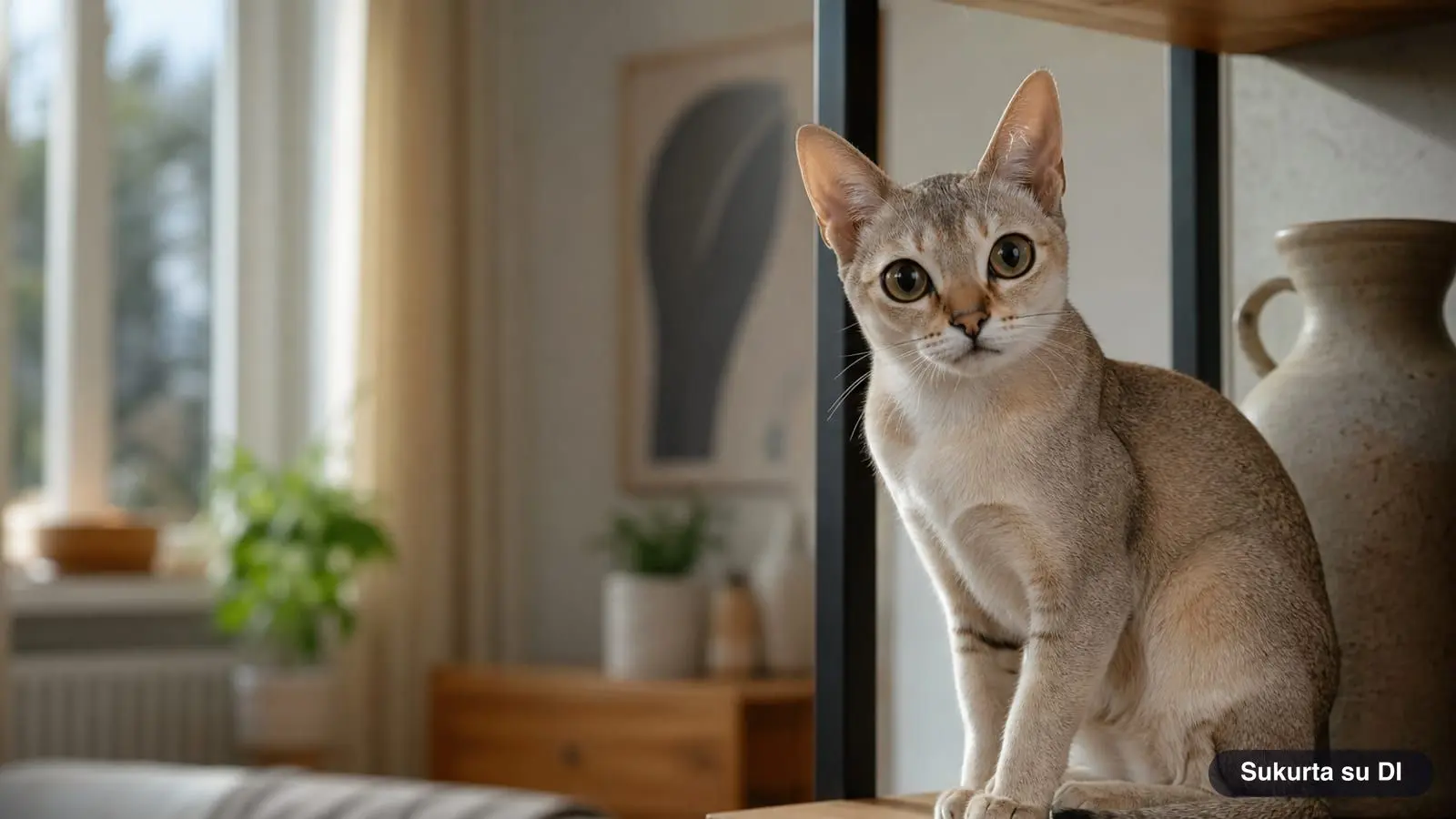
The Singapura cat is all about large eyes and ears on a small body. It is considered the smallest widely recognized domestic cat breed: an adult female usually weighs about 4 lbs (1.8 kg), and a male about 6 lbs (2.7 kg). Its coat is ticked, a warm ivory shade with dark brown hair tips, and its gaze, in the words of the CFA, is so pleading that it looks like the cat is saying "please." In Singapore, it is called Kucinta—the "love cat." In our cat breeds guide, you will find the history of the Singapura with all its twists and turns, as well as its appearance, temperament, and health specifics.
| Origin | Singapore (breed developed in the US since 1975) |
|---|---|
| Recognition | TICA in 1979; CFA registry in 1981–1982, championship status in 1988; FIFe in 2014 |
| Weight | females about 4 lbs, males about 6 lbs (FIFe: 4.5–8 lbs) |
| Body | small but sturdy and muscular |
| Coat | very short, fine, close-lying, ticked |
| Color | only sepia agouti |
| Eyes | large, almond-shaped; hazel, green, or yellow |
| Temperament | curious, playful, affectionate |
| Grooming | brush once a week |
The Smallest Breed with the Largest Eyes
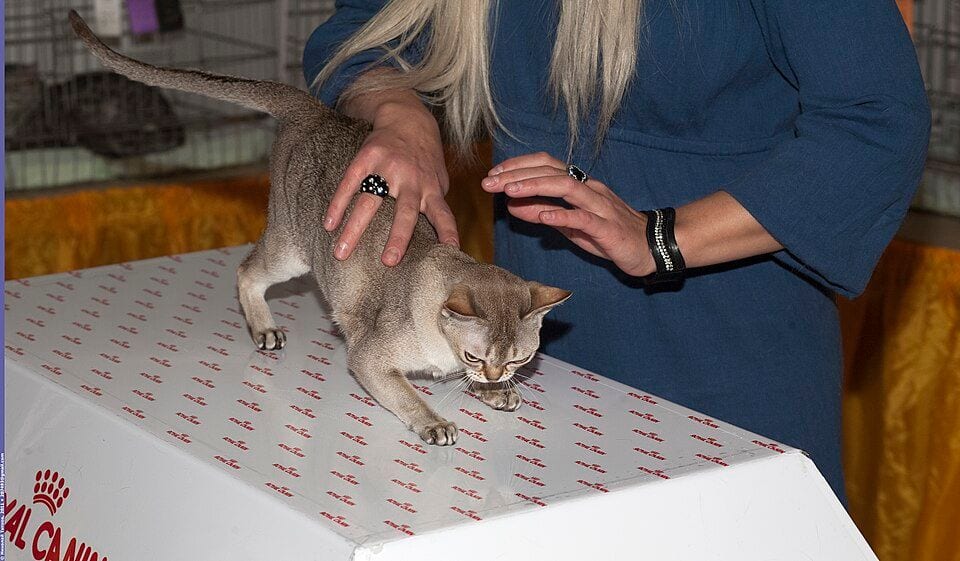
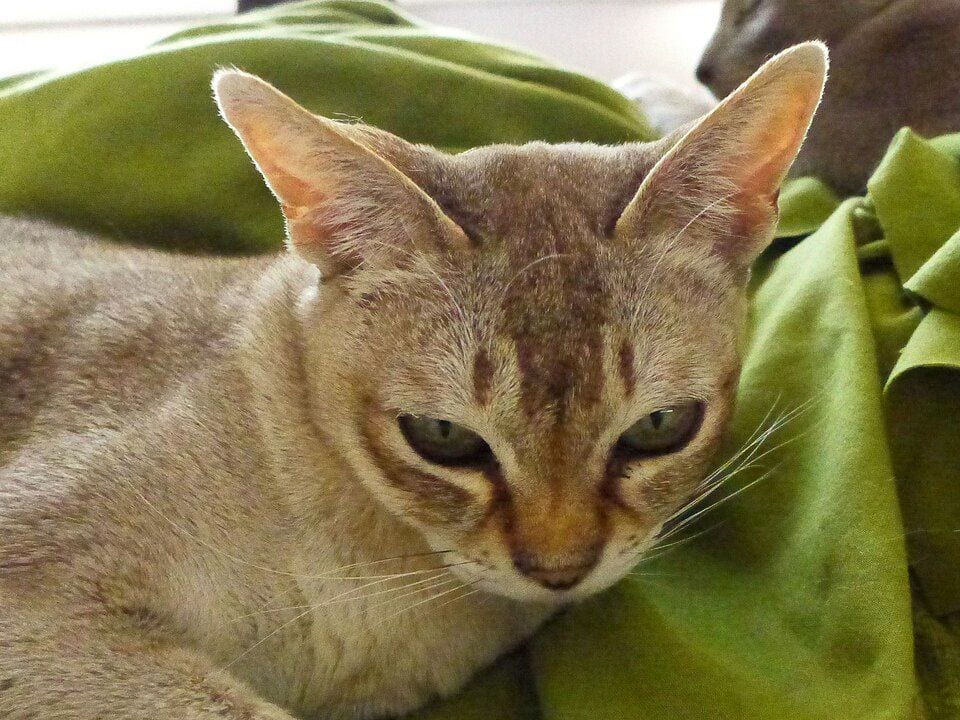
The Singapura is small but not fragile: the CFA emphasizes that it is sturdy, muscular, and strong. The head is rounded and of medium length, the ears are very large, slightly pointed, and deeply cupped, and the eyes are large, almond-shaped, and hazel, green, or yellow. Dark "cheetah lines" run down from the inner corners of the eyes along the sides of the nose, giving the face an exotic expression. The tail is slender, slightly shorter than the body, with a blunt tip.
The coat is very short, fine, and close-lying. Only one color is recognized—sepia agouti: each hair alternates between dark and light bands (usually two dark bands separated by two light ones, with a dark tip), making the coat shimmer in the sun. The underside of the body—chest, muzzle, chin—is the color of the light bands. Singapura cats always carry the sepia gene, which is also characteristic of Burmese cats.
An Origin Story with an Unexpected Twist
In 1975, Americans Tommy and Hal Meadow returned from working in Singapore and brought back what they claimed were several local brown ticked cats. These became the foundation of the breed, named Singapura after the Malay word for Singapore. In 1981, another breeder found a suitable cat at the Society for the Prevention of Cruelty to Animals in Singapore and added her to the breeding program. TICA recognized the breed in 1979, and the CFA registered it in 1981–1982, granting it championship status in 1988.
In 1987, breeder Gerry Mayes discovered import documents in Singapore showing that the three foundation cats had actually been imported into Singapore from the US in 1974 as Abyssinians. Since the Meadows bred Abyssinian, Burmese, and Siamese cats, speculation arose that the Singapura was actually a Burmese and Abyssinian mix. The CFA investigated the case, found no wrongdoing, and retained its natural breed status: Hal Meadow explained that these were the grandchildren of cats he had previously sent out of Singapore. In 2007, DNA studies showed very few genetic differences between Singapura and Burmese cats. Despite this, the Singapore Tourist Promotion Board chose the breed as a mascot named Kucinta in 1990–1991, and sculptures of it stand by the Singapore River. FIFe recognized the breed in October 2014.
Temperament: Small but Involved in Everything
The CFA describes the Singapura as extroverted, curious, and highly playful, feeling a duty to investigate every corner of their environment, especially whatever currently holds your attention. They will "help" you cook dinner, type on the computer, make the bed, and then curl up under the covers next to you. FIFe notes that some Singapuras like to observe household life from their owner's shoulder or even snuggle inside a sweater sleeve.
These cats are confident in familiar surroundings but can become anxious if things change drastically, so they need time to adjust. Their playfulness does not diminish with age. They are relatively quiet and do best in a calm environment, though their voices can be surprisingly loud when necessary. Some breed enthusiasts note that Singapuras can be wary of strangers.
Health: Low Genetic Diversity
- Uterine inertia. Weak uterine muscles prevent the expulsion of the fetus; this condition affected one of the foundation cats and occurs in some females, often requiring a C-section.
- Pyruvate kinase (PK) deficiency. This causes hemolytic anemia: lethargy, diarrhea, lack of appetite, weight loss, and jaundice. A genetic test can show whether a cat is affected, a carrier, or clear; affected cats often live normal lives.
- Progressive retinal atrophy. The CFA advises asking breeders if this has occurred in their lines.
In a 2007 study, the Singapura (along with the Burmese) had the lowest genetic diversity of the 22 breeds tested. The UK's GCCF has allowed outcrossing with other breeds since 2013 to increase diversity. The CFA points out that because of their street cat ancestry, most Singapuras are vigorous and healthy.
Care: Weekly Brushing and Lots of Attention
- Coat. The short coat sheds very little; the CFA recommends brushing once a week, which also serves as a bonding ritual.
- Warmth. Their small bodies lose heat faster, so they love warm beds and a spot on your lap.
- Activity. Toys, shelves, and climbing spaces should be tailored to a small but agile cat.
- Calmness. They thrive in a stable environment and need time to adapt to changes.
Singapura, Abyssinian, and Burmese Cats
| Trait | Singapura | Abyssinian | Burmese |
|---|---|---|---|
| Size | smallest (about 4–6 lbs) | medium (about 10 lbs) | small–medium (9–13 lbs) |
| Coat | ticked, sepia | ticked | solid, sepia |
| Colors | only one | several | several |
| FIFe kittens in 2025 | 55 | 934 | 1,503 |
How to Choose a Singapura Kitten
Breeders are scarce, so as the CFA notes, you may have to wait for a kitten. Ask for the parents' PK deficiency test results and inquire how the breeder maintains genetic diversity—such as whether they use unrelated cats from other regions. Ask if the mother's deliveries were natural. Reputable registries like FIFe stipulate that kittens should not go to new homes before 14 weeks of age—this time is especially crucial for a small breed. We discussed standard microchipping and registration practices recommended by US veterinarians in our guide introduction.
For a cat with a similar ticked coat but a larger build, check out the Abyssinian profile, and for a related breed with sepia coloring, see the Burmese description.
Frequently asked questions
What is the smallest cat breed?
Most breed organizations consider the Singapura the smallest: an adult female typically weighs about 4 lbs, and a male about 6 lbs. Under the FCI/FIFe standard, they range from 4.5 to 8 lbs, with males clearly larger than females.
Is the Singapura cat really from Singapore?
It is highly debated. The breed's founders, the Meadows, claimed to have brought the cats from the streets of Singapore, but documents found in 1987 showed those cats were imported to Singapore from the US in 1974. The CFA investigated and kept their natural breed status; additionally, a cat taken from a Singapore shelter in 1981 is in the pedigree of many lines. In 2007, DNA studies showed very few differences between Singapura and Burmese cats.
What colors do Singapura cats come in?
Only one—sepia agouti. Each hair alternates between dark and light bands, creating an overall impression of dark brown ticking on a warm old ivory background. The belly, chest, muzzle, and chin are the color of the light bands.
Is a Singapura cat good for an apartment?
Yes, they are small and adapt well to limited spaces. However, this is a highly active and people-oriented cat that wants to be involved in everything, so they need plenty of playtime and attention. The CFA notes that they do best in a calm environment.
What health issues are common in Singapura cats?
Pyruvate kinase (PK) deficiency, which causes hemolytic anemia (a genetic test is available), and uterine inertia—weak uterine muscles that may require a C-section. The CFA also advises asking breeders about progressive retinal atrophy in their lines.
Log in to comment
No comments yet. Be the first.