Norwegian Forest Cat: Temperament, Size, Care & Health
- The Norwegian Forest Cat adapted to the cold Scandinavian climate; their ancestors likely arrived in Norway with the Vikings around 1000 AD.
- The breed almost went extinct during WWII. It was registered by the FIFe in the 1970s, and King Olav V declared it the official cat of Norway in the 1950s.
- Females weigh 8–18 lbs, while males weigh 10–20 lbs; the cat only reaches its full size at around five years of age.
- The head is shaped like an equilateral triangle with a straight profile; a square or round head is considered a fault.
- The breed is routinely screened for Glycogen Storage Disease Type IV (GSD IV) and Hypertrophic Cardiomyopathy (HCM).
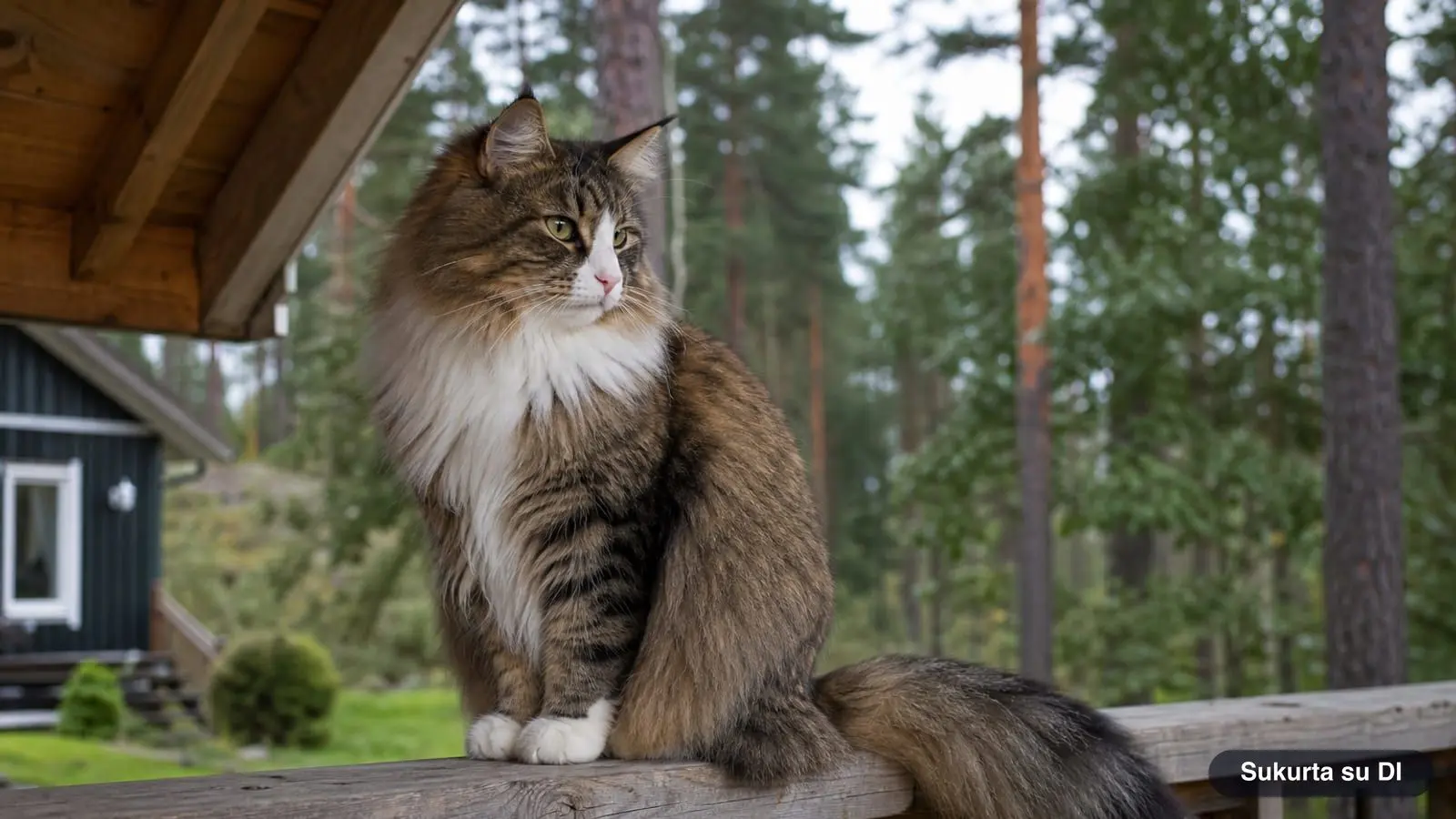
- A Double Coat to Survive Scandinavian Winters
- History: From Viking Ships to King Olav V
- Temperament: Independent but Friendly Climbers
- Health: GSD IV, HCM, and Hip Dysplasia
- Care: Spring Brushing and Tall Cat Trees
- Norwegian Forest Cat, Maine Coon, and Siberian: How to Tell Them Apart
- How to Choose a Norwegian Forest Cat Kitten
This article is part of the 77.today cat breeds guide, prepared by the 77.today editors from the sources listed at the end.
The Norwegian Forest Cat looks as if it just stepped out of a snowy pine forest: large, sturdy, with a long glossy coat, a fluffy ruff on its chest, a bushy tail, and lynx tips on its ears. In Norway, it is called the norsk skogkatt—forest cat—and Scandinavian legends mention it as a mountain-dwelling fairy cat capable of climbing sheer rock faces. In our cat breed guide, you will find out where the Norwegian Forest Cat comes from, how much it weighs, what its temperament is like, and how to tell it apart from similar large semi-longhaired cats.
| Origin | Norway, natural forest and farm cat |
|---|---|
| Recognition | FIFe in the 1970s; CFA championship status in 1993 |
| Weight | females 8–18 lbs, males 10–20 lbs |
| Body | long, sturdy, long legs, hind legs higher than front |
| Coat | double: long glossy waterproof topcoat and woolly undercoat |
| Head | equilateral triangle shape, straight profile |
| Colors | all traditional colors, plus sepia and mink |
| Eyes | almond-shaped, set obliquely, any color |
| Grooming | brush regularly, more frequently in spring |
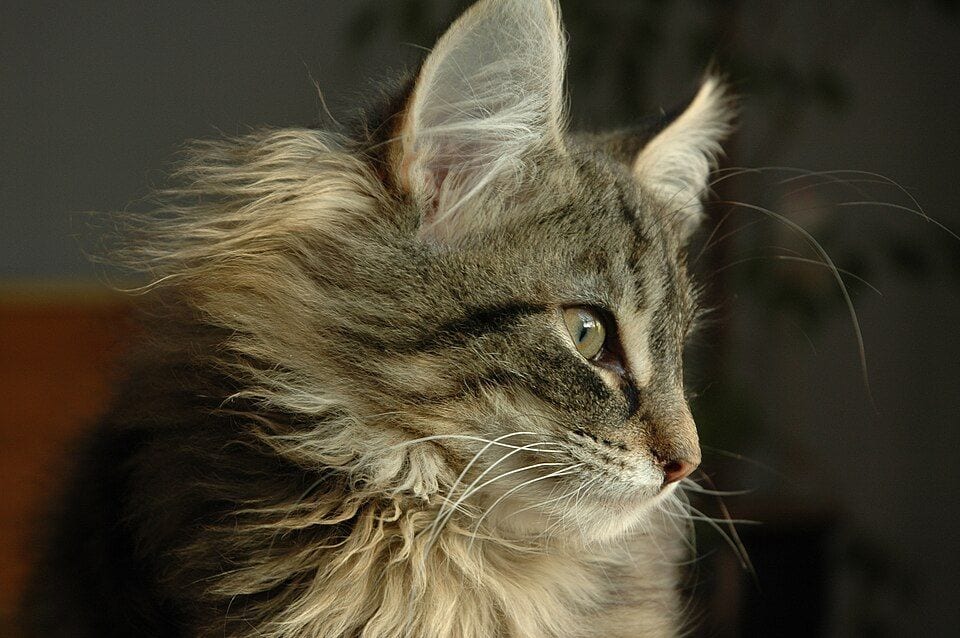
A Double Coat to Survive Scandinavian Winters
The Norwegian Forest Cat's coat consists of two layers: a topcoat of long, dense, glossy, waterproof guard hairs, and a warm woolly undercoat. The coat is thickest on the legs, chest, and head, forming an impressive ruff around the neck and chest. A bushy tail, tufts of hair between the toes, and heavily furnished ears help them withstand wind and snow. The coat reaches its full glory in the winter, and in the spring, the cat sheds it for a lighter summer coat.
The head is the breed's most defining feature: it is long, shaped like an equilateral triangle, with a strong chin and a straight profile from the brow to the tip of the nose. A square or round head is considered a fault. The ears are large, wide at the base, set high, continuing the triangle of the head, and ending with lynx tips. The eyes are large, almond-shaped, set obliquely, and can be any color. The body is long and sturdy, with long legs—the hind legs being higher than the front ones. All traditional colors are allowed, as well as sepia and mink varieties; tabby with white is the most commonly seen pattern.
History: From Viking Ships to King Olav V
Their exact origins remain unknown. It is believed that the ancestors of the Norwegian Forest Cat might have been shorthaired cats brought from Britain by the Vikings around 1000 AD, and longhaired cats that arrived in Norway later, perhaps with the Crusaders. The Siberian and Turkish Angora are also mentioned among possible ancestors. On Viking ships, they likely caught rodents, and later spent centuries living in Norwegian forests and farms. In Norse mythology, two giant forest cats pulled the chariot of the goddess Freyja.
The first breed club was founded in Oslo in 1938, but World War II interrupted its work, and the cats nearly went extinct due to crossbreeding with free-roaming domestic cats. After the war, a breeding program revived the breed. In the 1950s, King Olav V designated it the official cat of Norway. Because the cats did not leave Norway until the 1970s, the FIFe only registered the breed when Norwegian cat enthusiast Carl-Fredrik Nordane took charge of their registration, officially recognizing them in 1977. The first breeding pair arrived in the US in 1979, and the CFA granted them championship status in 1993.
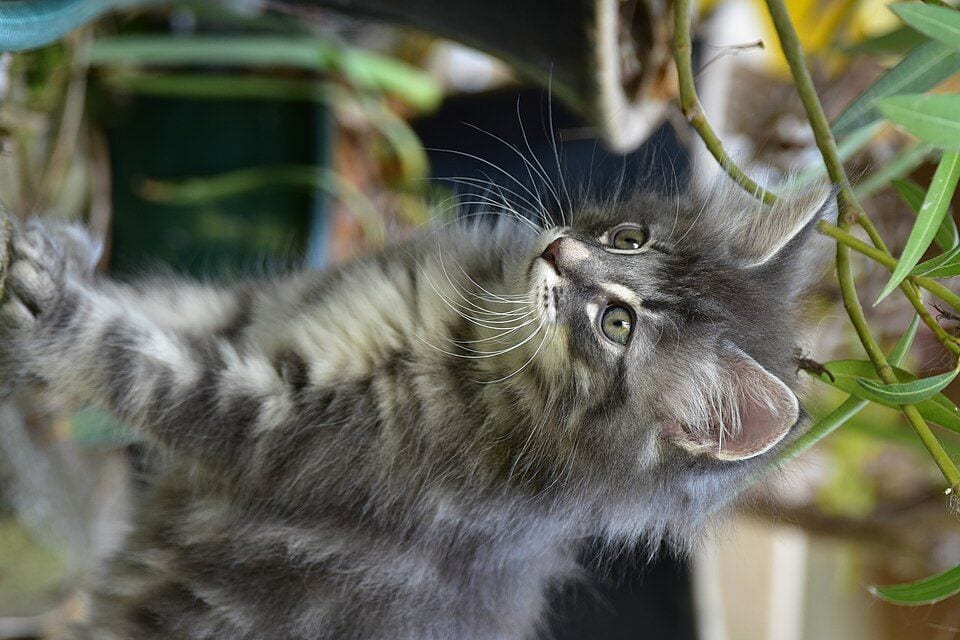
Temperament: Independent but Friendly Climbers
The CFA describes the Norwegian Forest Cat as an independent, intelligent breed, fitting its long history of self-reliance. They are not overly demanding, but if left alone for a long time, they will seek out company. They might sit on your lap, but they always decide when to get on and when to get off. These cats are moderately active, sensitive, friendly, and adaptable. They enjoy participating in the family's daily routine and sometimes experience sudden bursts of energy—chasing toys, hiding, and pouncing on them like prey. When excited, they make high-pitched, bird-like chirping sounds.
Strong claws make Norwegian Forest Cats excellent climbers—they can even scale rocks. They get along well with other cats, dogs, and children. They tend to bond closely with one person and will thoroughly inspect everything when introduced to a new environment. A study comparing Norwegian Forest kittens with Siamese-group and Abyssinian kittens showed that Norwegian Forest Cats are more likely to explore their surroundings and attempt to escape.
Health: GSD IV, HCM, and Hip Dysplasia
- Glycogen Storage Disease Type IV (GSD IV). A rare but fatal inherited disease caused by a rearrangement in the GBE1 gene. It can cause neonatal collapse due to low blood sugar or neuromuscular degeneration that appears later in life. Carriers are identified through genetic testing.
- Hypertrophic Cardiomyopathy (HCM). Analysis of pedigree books of English origin indicates an inherited cardiomyopathy; breeding cats undergo echocardiograms.
- Hip Dysplasia. A rare, partially hereditary disorder of the hip joint.
- Eosinophilic Granuloma. A 2005 study found pedigree links among affected Norwegian Forest Cats, suggesting a hereditary predisposition.
The CFA notes that breeders today routinely test their cats for HCM and GSD IV, removing carriers from their breeding programs.
Care: Spring Brushing and Tall Cat Trees
- Coat. According to the CFA, the impressive double coat does not require much maintenance and rarely mats—regular brushing with a stainless steel comb is sufficient. Brush more frequently in the spring when they shed their winter coat.
- Bathing. Rarely needed; keep in mind that their waterproof coat takes a long time to get wet and even longer to dry.
- Vertical Space. Tall, sturdy scratching posts and shelves are essential, or the cat will choose the top of your kitchen cabinets as their favorite spot.
- Diet. Balanced nutrition is important for a slow-growing kitten, while weight control is key for adults.
Norwegian Forest Cat, Maine Coon, and Siberian: How to Tell Them Apart
| Feature | Norwegian Forest Cat | Maine Coon | Siberian |
|---|---|---|---|
| Head | equilateral triangle, straight profile | square, square muzzle | broad, rounded contours |
| Coat | double, glossy, smooth | uneven length, shaggy | triple, very dense |
| Origin | Norway | USA, Maine | Russia |
| FIFe kittens in 2025 | 3,952 | 24,488 | 4,718 |
How to Choose a Norwegian Forest Cat Kitten
Ask the breeder if the parents have been tested for GSD IV (ideally, both should be negative) and if they have had an echocardiogram to screen for HCM. Evaluate the head shape and profile: if you want a show cat, the triangular head and straight profile are the most important features. Remember that the Norwegian Forest Cat matures slowly, so a kitten's coat and head will continue to develop for several years. Reputable breeders associated with organizations like the CFA or TICA typically do not let kittens go to their new homes before 14 to 16 weeks of age. For more information on finding a responsible breeder, checking health clearances, and understanding the adoption process, see the beginning of our cat breed guide.
For similar large, semi-longhaired breeds, check out the Maine Coon and the Siberian; if you are looking for a sturdy and calm shorthair, you will find it in the British Shorthair profile.
Frequently asked questions
How does the Norwegian Forest Cat differ from the Maine Coon?
The main difference is the head: the Norwegian Forest Cat has an equilateral triangle shape with a straight profile from brow to nose tip, while the Maine Coon has a square muzzle. The Wegie's double coat is glossy and smoother, whereas the Maine Coon's coat is shaggy and uneven. Maine Coons are also generally larger.
How much does a Norwegian Forest Cat weigh?
Adult females weigh 8–18 lbs, and males weigh 10–20 lbs. The CFA notes that these slow-maturing cats can take up to five years to reach their full size.
Is the Norwegian Forest Cat a lap cat?
They can be, but only on their own terms. The CFA describes the breed as independent and intelligent: they are not overly demanding and like to be near their owners, but will seek out company if left alone for too long.
Is the Norwegian Forest Cat's coat hard to maintain?
Not as hard as it looks. According to the CFA, the double coat rarely mats, so regular brushing with a stainless steel comb is usually enough. They do require more attention in the spring when they shed their winter coat.
Is a Norwegian Forest Cat suitable for an apartment?
Yes, as long as they have enough vertical space. The breed loves to climb, so you will need a tall, sturdy scratching post or cat shelves—otherwise, the top of your kitchen cabinets might become their favorite spot.
Sources
- Wikipedia: Norwegian Forest cat
- FIFe: Norwegian Forest Cat breed standard
- CFA: Norwegian Forest Cat breed profile
- Wikipedia: Glycogen storage disease type IV
- FIFe Breeding Statistics 2025
- FIFe Breeding & Registration Rules
- Wikimedia Commons: Brown classic tabby Norwegian Forest Cat
- Wikimedia Commons: Norwegian Forest Cat sitting
Log in to comment
No comments yet. Be the first.