Korat Cat: Temperament, Size, Care & Health
- The Korat originates from the Phimai area in Thailand's Nakhon Ratchasima (Korat) province and is one of the oldest stable breeds.
- Known as the Si sawat in Thailand, it is considered a good luck cat—traditionally, Korats were gifted to newlyweds rather than sold.
- Only one color is recognized: blue with silver tips. Adult cats have striking peridot-green eyes.
- The first breeding pair arrived in the US in 1959, and the Korat achieved championship status in 1966.
- The breed can be prone to GM1 and GM2 gangliosidosis, so reputable breeders perform genetic testing on their cats.
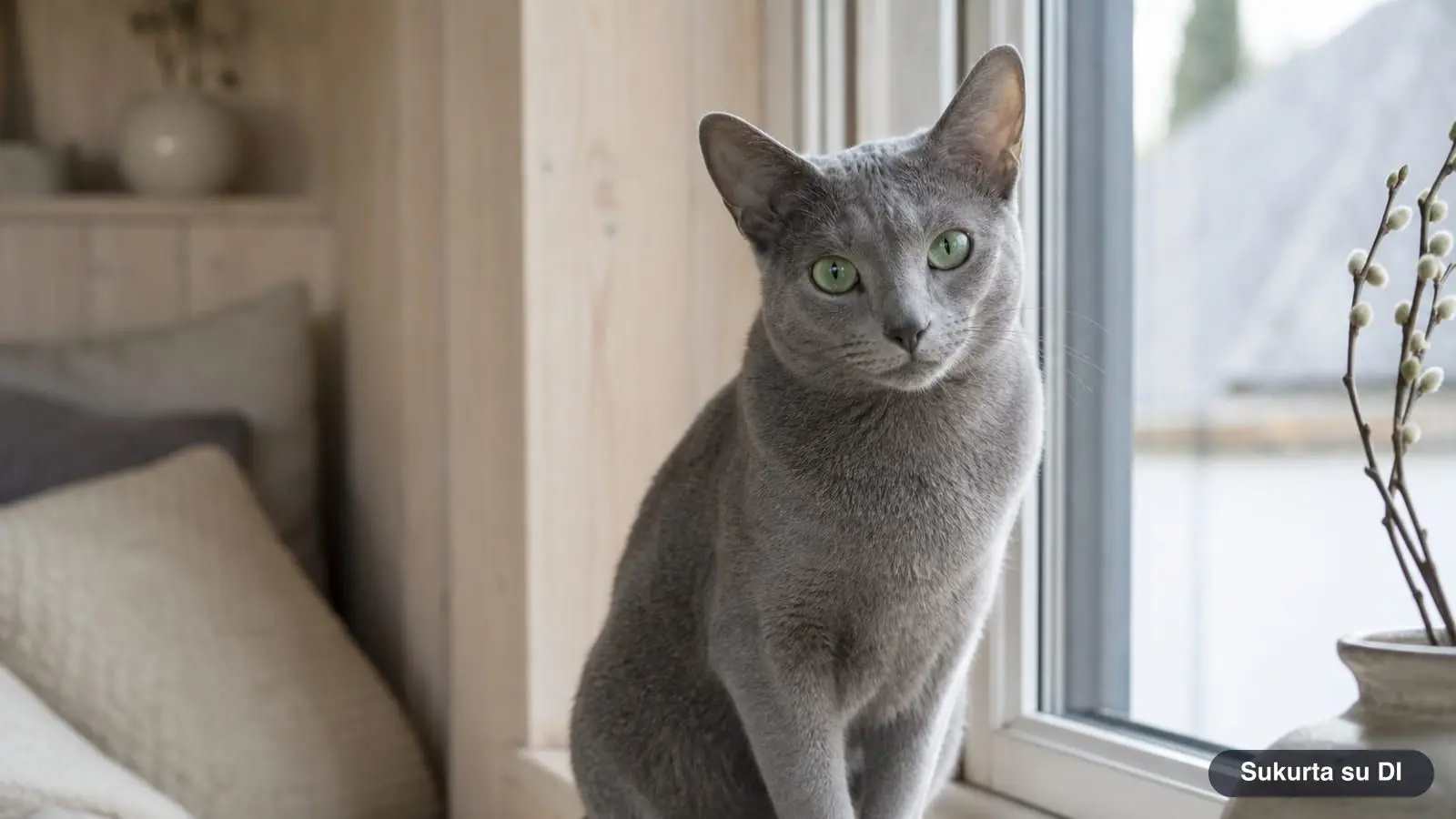
- The Korat is Defined by its Heart-Shaped Head and Green Eyes
- History: From the "Cat-Book Poems" to British Cat Shows
- Thai Lilac and Other Unusual Korat Varieties
- Temperament: An Intelligent "Head of the Household"
- Health: Gangliosidosis Testing
- Care: Weekly Brushing and Puzzle Toys
- The Korat, Russian Blue, and Chartreux
- How to Choose a Korat Kitten
This article is part of the 77.today cat breeds guide, prepared by the 77.today editors from the sources listed at the end.
The Korat is a cat that, for centuries in Thailand, was not bought but given as a gift: presented in pairs to newlyweds or highly respected people to bring good luck. Its coat is blue with silver tips—Thais call this color "rain-cloud gray" and the shimmer "sea foam." The head is heart-shaped, and the eyes are large and bright green like peridot. In our cat breed directory, you will find the history, appearance, temperament, and health profile of the Korat.
| Origin | Thailand, Nakhon Ratchasima (Korat) province |
|---|---|
| Recognition | Championship status in the US in 1966; CFA, TICA, FIFe, GCCF |
| Size | Small to medium, but heavy for its size |
| Coat | Short, single coat, glossy |
| Color | Only blue with silver tips |
| Head | Heart-shaped |
| Eyes | Large, green (amber in kittens) |
| Temperament | Intelligent, vocal, affectionate |
| Grooming | Brush once a week |
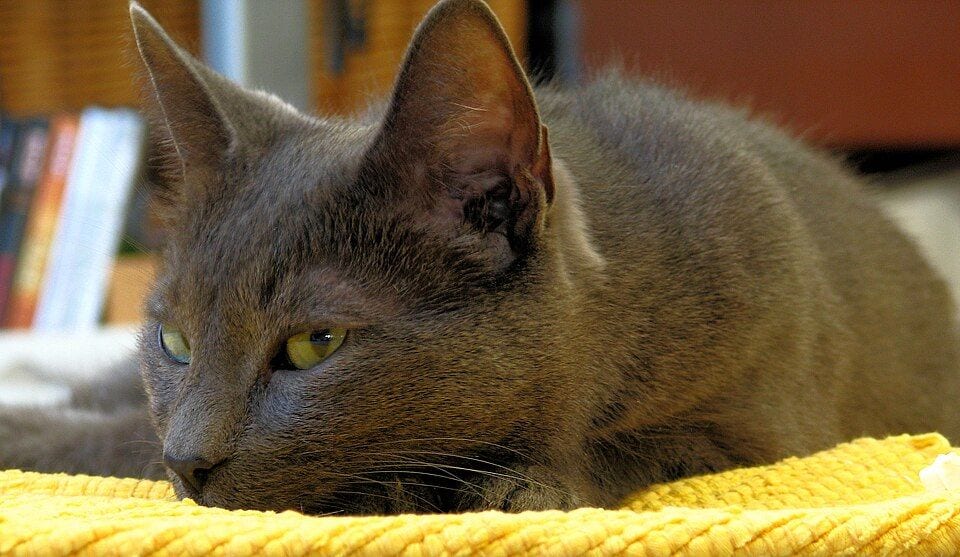
The Korat is Defined by its Heart-Shaped Head and Green Eyes
The Korat's most important feature is its coat: short, single-layered, light silver-blue at the roots, darkening toward the tips, and finishing with silver ends that are especially prominent on the muzzle and toes. This gives the coat a shimmering appearance. This is the only recognized color for the Korat. Occasional white markings or faint tabby stripes can occur—these are show faults but do not affect the cat's health or temperament.
The CFA describes the Korat's head as heart-shaped: prominent eyebrow ridges, strong cheekbones, and a rounded, tapering muzzle, while large, wide-based ears with rounded tips complete the heart contour. The eyes are large, luminous, and expressive. The body is medium-sized, compact, and muscular with very little body fat, making the Korat surprisingly heavy when picked up. The front legs are slightly shorter than the hind legs. Kittens' eyes are usually amber or yellow-green, turning fully green over the course of two to four years.
History: From the "Cat-Book Poems" to British Cat Shows
It is highly likely that the Korat is mentioned in the Thai manuscripts known as the Tamra Maew ("Cat-Book Poems"), written between 1350 and 1767. The CFA notes that these texts describe 17 "good luck" cats of Thailand, with the Korat being the most famous. The breed originates from the Phimai area in the Nakhon Ratchasima province, which the Thai people call Korat, while in Thailand itself, the cat is known as the Si sawat—meaning the color of the "sawat seed." The Korat is considered one of the few breeds whose appearance has remained unchanged over the centuries.
Korats first arrived in Great Britain in 1889 and 1896 under the name "Blue Siamese," but show judges were displeased that these solid blue cats did not meet the Siamese standard, and they disappeared by 1901. The first breeding pair—Nara and Darra—was brought to the US in 1959 by the Cedar Glen cattery, and the breed achieved championship status in 1966. In 1969, Daphne Negus brought nine more Korats from Thailand to strengthen the breeding lines.
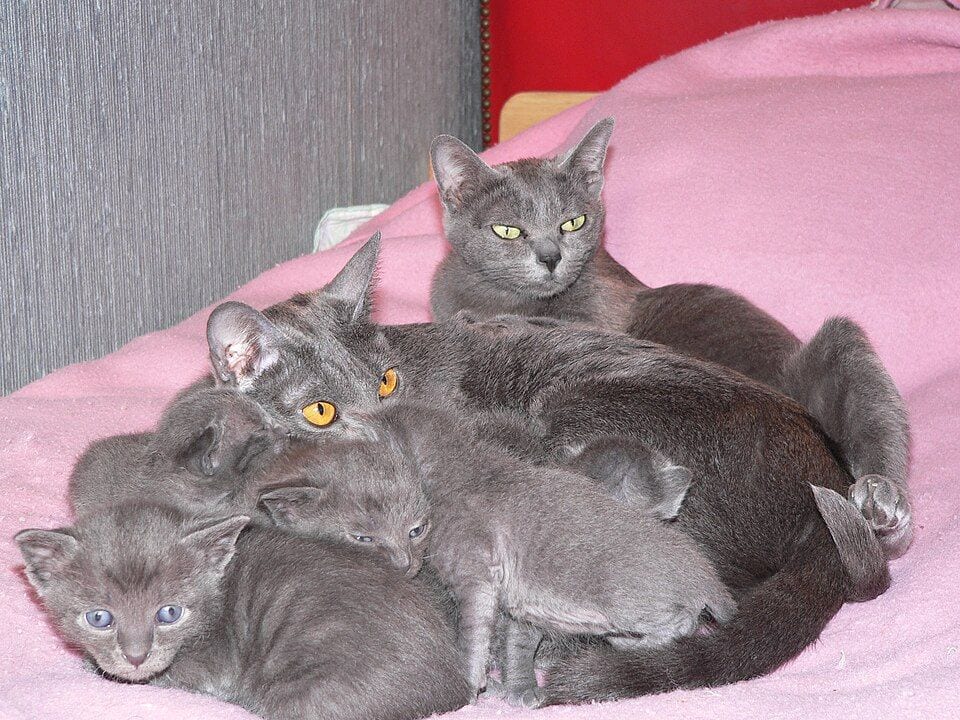
Thai Lilac and Other Unusual Korat Varieties
Occasionally, two Korats will produce kittens of unusual colors. Recessive genes for lilac coloration and dark points were introduced into the breed by new cats imported from Thailand. The first recorded lilac kitten, Jenanca Lilac Lillee, was born in the UK in 1989 to two Korat parents, and the first lilac point was born in 2014. The British GCCF registers these cats in an experimental register as Thai Lilac, Thai Blue Point, or Thai Lilac Point cats. They should not be confused with the Thai cat, which is the old-style Siamese. Only solid blue kittens are fully registered as Korats.
Temperament: An Intelligent "Head of the Household"
The CFA describes the Korat as a highly intelligent cat that can be taught tricks—but only if it agrees to participate. Because of this intelligence, the Korat needs mental stimulation: interactive toys, puzzle feeders, and treats. This cat demands attention, considers itself the head of the household, forms strong bonds with its owners, seeks physical contact, and takes an interest in every activity. Korats are very vocal, and their repertoire of sounds is broad and distinct from other breeds.
Korats are energetic but not hyperactive, and they generally get along well with other household pets. However, when a new pet is introduced, the CFA advises giving the Korat extra attention to prevent jealousy. It is also noted that Korats can learn to play fetch and enjoy climbing.
Health: Gangliosidosis Testing
- GM1 and GM2 gangliosidosis. The Korat is one of the breeds more frequently affected by these inherited neurological disorders. They are caused by recessive mutations in the GLB1 and HEXB genes. Reputable registries like the British GCCF require genetic gangliosidosis testing to ensure the breed remains free of the disease.
- Atherosclerosis. An unusual condition resembling human atherosclerosis has been described in Korats; it is believed to have a genetic predisposition.
The CFA notes that as a natural breed, Korats are generally quite healthy. However, before purchasing a kitten, you should always ask the breeder for health clearances and proof of vaccinations.
Care: Weekly Brushing and Puzzle Toys
- Coat. The glossy single coat sheds very little; the CFA recommends brushing it once a week.
- Nails, teeth, and ears. Regularly trim their nails, brush their teeth, and clean their ears.
- Mental stimulation. Provide puzzle toys, teach them tricks, and use interactive toys.
- Attention. The Korat wants to be the center of the family—daily interaction is essential.
The Korat, Russian Blue, and Chartreux
| Trait | Korat | Russian Blue | Chartreux |
|---|---|---|---|
| Head | Heart-shaped | Modified wedge | Trapezoid |
| Coat | Single coat | Double, plush | Woolly |
| Eyes | Green (peridot) | Emerald green | Gold to copper |
| FIFe kittens in 2025 | 87 | 2,466 | 747 |
How to Choose a Korat Kitten
Because there are relatively few breeders, the CFA advises being prepared to wait for a kitten. Always ask for the parents' GM1 and GM2 gangliosidosis test results, as well as vaccination and health records. Remember that a kitten's eyes will still be amber or yellow—they will turn green over a few years. Reputable breeders and registries generally require that kittens stay with their mother until they are at least 14 weeks old. When bringing a cat home, ensure they are microchipped and registered according to your local ordinances and vet recommendations.
You can find other blue breeds in our Russian Blue, Chartreux, and British Shorthair profiles, and another ancient Thai breed in the Siamese description.
Frequently asked questions
How does the Korat differ from the Russian Blue?
Both are silver-tipped blue cats with green eyes, but the Korat has a heart-shaped head, a single coat, and a more compact, surprisingly heavy body. The Russian Blue has a dense double coat, a modified wedge-shaped head, and a more graceful build. The Korat hails from Thailand, while the Russian Blue originated in northern Russia.
When do a Korat's eyes turn green?
Kittens' eyes are typically cloudy, amber, or yellow-green. They gradually develop their brilliant green adult color over the course of two to four years.
Is the Korat suitable for people with allergies?
The CFA notes that a Korat's hair does not easily float in the air when petted, so the allergen levels in the home might be tolerable for occasional guests with allergies. However, the Korat is not a hypoallergenic breed.
Why is the Korat called a good luck cat?
In Thailand, Korats were traditionally given in pairs to newlyweds or highly respected individuals to bring good fortune. The CFA notes that an ancient 'Cat-Book Poems' manuscript describes 17 'good luck' cats of Thailand, with the Korat being the most famous.
How much does a Korat weigh?
The Korat is a medium-sized cat but surprisingly heavy for its size. The CFA notes that adult males often weigh about 10 pounds or more, while females are smaller. A Korat reaches full maturity in two to four years.
Log in to comment
No comments yet. Be the first.