Ragdoll Cat: Temperament, Size, Patterns, Health & Care
- Developed in California in the 1960s by Ann Baker, all Ragdolls trace their lineage back to a white, longhaired cat named Josephine.
- The name "Ragdoll" comes from their unique tendency to go completely limp and relax when picked up.
- As one of the largest domestic cat breeds, females weigh 8–15 lbs and males 12–20 lbs, reaching full size at around 4 years of age.
- All Ragdolls have colorpoint markings and blue eyes, with recognized patterns including colorpoint, mitted, and bicolor.
- The breed is prone to the HCM mutation R820W, which can be identified via genetic testing; a 2025 UK study showed a median lifespan of 12.9 years.
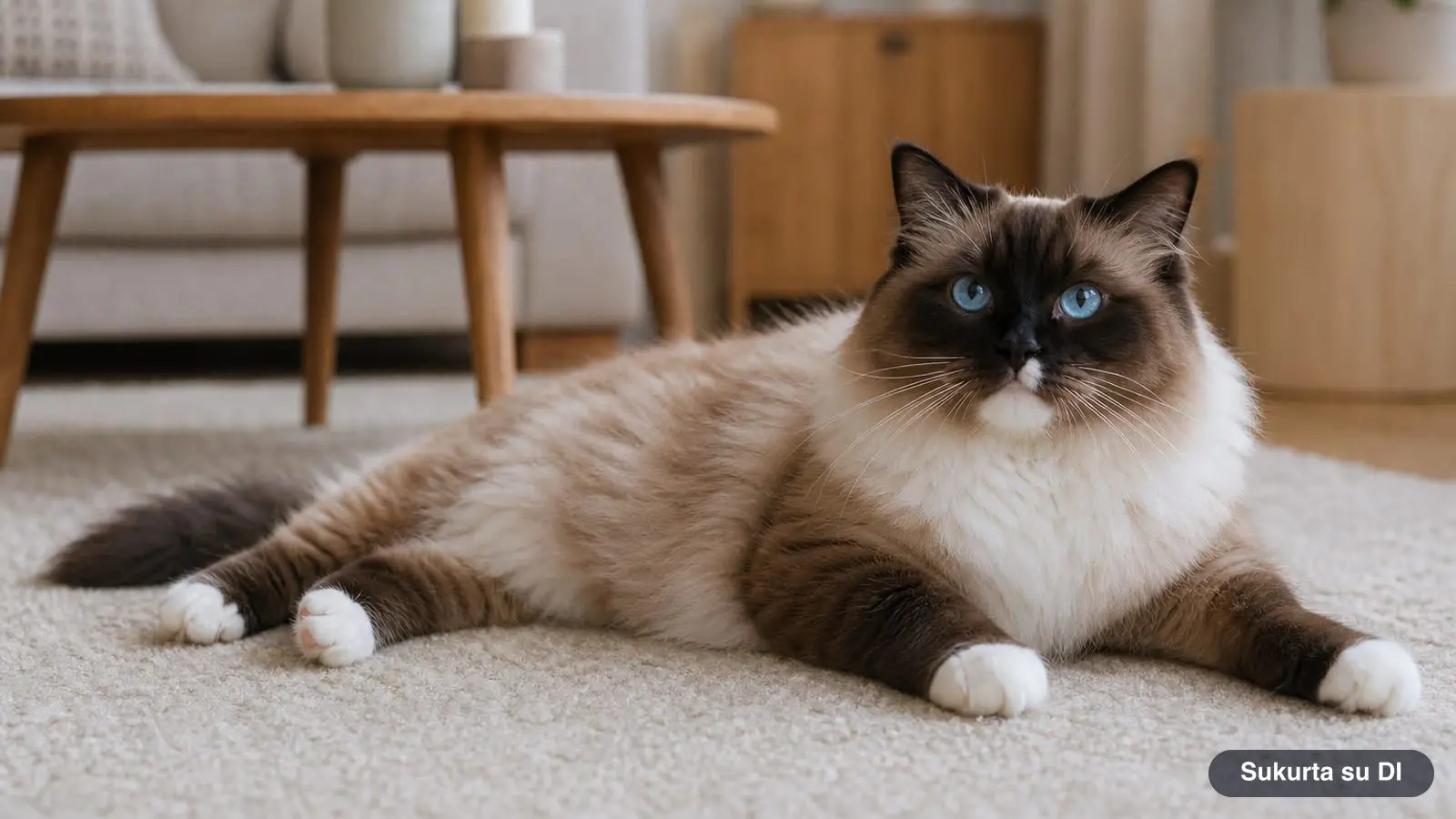
- The Ragdoll Name Comes From the Docile Nature of the Foundation Cat
- A Large, Slow-Maturing Cat With Blue Eyes
- Three Patterns: Colorpoint, Mitted, and Bicolor
- Temperament: An Affectionate But Undemanding "Dog-Like" Companion
- Health: The HCM R820W Mutation and a Tendency to Gain Weight
- Care: Combing Twice a Week and Moderate Portions
- Ragdoll, Birman, and RagaMuffin: Similar, But Not the Same
- How to Choose a Ragdoll Kitten
This article is part of the 77.today cat breeds guide, prepared by the 77.today editors from the sources listed at the end.
The Ragdoll is a cat that will often greet its owner at the door, follow them from room to room, and happily allow itself to be picked up and held. It is a large breed with a soft, semi-long coat, dark points on its face, ears, and tail, and deep blue eyes. According to CFA registration data, it has risen from obscurity over a few decades to become one of the most popular breeds in the world. In this cat breed guide profile, you will learn where the Ragdoll comes from, how much it weighs, what patterns it comes in, and how to care for its health.
| Origin | Riverside, California, USA, 1960s |
|---|---|
| Recognition | CFA registered in 1993, championship status in 2000; FIFe, GCCF, TICA |
| Weight | males 12–20 lbs, females 8–15 lbs |
| Coat | semi-long, silky, almost no undercoat |
| Patterns | colorpoint, mitted, bicolor (+ lynx and tortie variants) |
| Colors | seal, chocolate, red, blue, lilac, cream |
| Eyes | large, oval, always blue |
| Activity | medium |
| Grooming | comb 1–2 times a week |
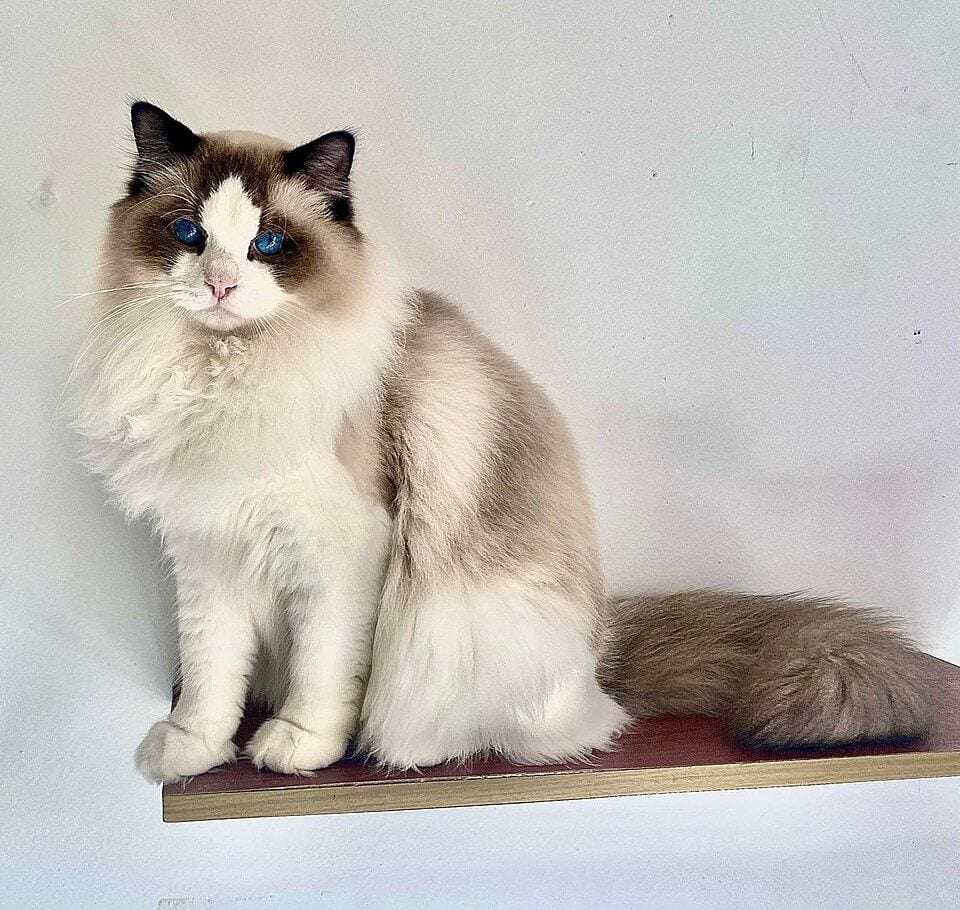
The Ragdoll Name Comes From the Docile Nature of the Foundation Cat
The breed was created in the 1960s in Riverside, California, by breeder Ann Baker. Her foundation cat was a white, non-pedigreed longhaired female named Josephine, who carried the gene for dark points. Baker herself said the first Ragdolls were "alley cats." Josephine's litters produced exceptionally calm and affectionate kittens that would go limp when picked up. All modern Ragdolls descend from her offspring—a black male named Blackie and a pointed, white-pawed male named Daddy Warbucks—and their matings with Josephine's daughters, Fugianna and Buckwheat.
Baker trademarked the name "Ragdoll" and around 1971 founded her own registry, the IRCA, with strict rules. In 1975, Denny and Laura Dayton broke away and began seeking recognition in major organizations. The standard they developed is used today by the CFA and FIFe: the CFA registered Ragdolls in 1993 and granted them championship status in 2000. While some myths claim a Persian cat hit by a car suddenly became incredibly affectionate and passed this on, Ragdolls actually have various longhaired cat bloodlines, and their temperament is the result of selective breeding.
A Large, Slow-Maturing Cat With Blue Eyes
The Ragdoll is one of the largest domestic cats. Females weigh 8–15 lbs, while males range from 12–20 lbs or more. The body is long and muscular, with a broad chest, short neck, sturdy legs, large round paws with tufts of hair, and a long, bushy tail. The head is large and modified wedge-shaped, with a flat plane between widely set ears. Ragdolls mature slowly: they develop their full color at around two years of age and reach their final size and weight at about four years old.
The coat is semi-long and silky, consisting mostly of long guard hairs with almost no dense undercoat, which, according to the CFA, means it mats and sheds less. Adults have "britches" on their hind legs and a ruff around their neck. All Ragdolls carry the colorpoint gene and have blue eyes. Kittens are born white, with their color starting to develop at 8–10 weeks.
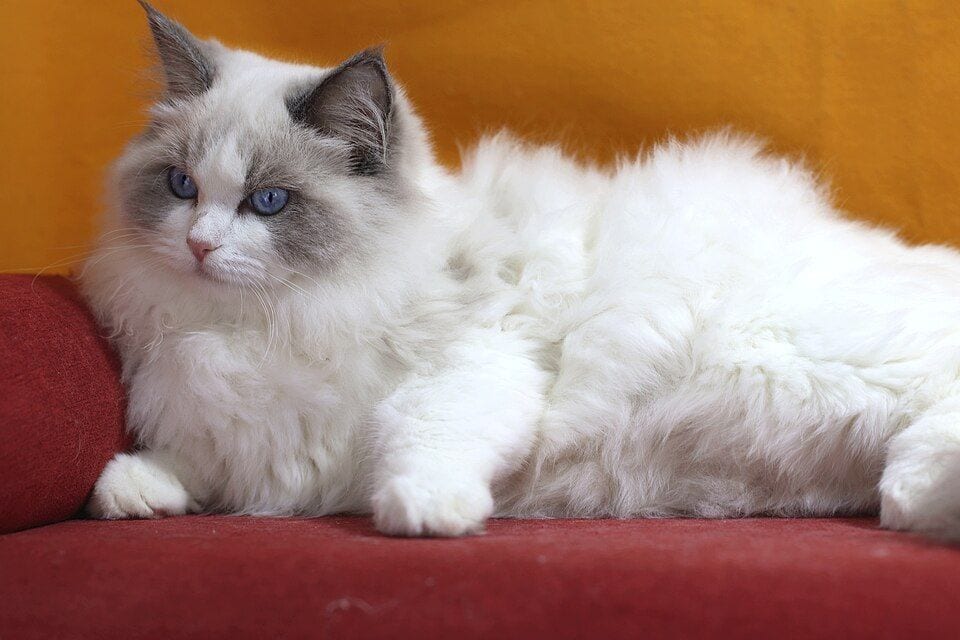
Three Patterns: Colorpoint, Mitted, and Bicolor
- Colorpoint – light body, dark face, ears, legs, and tail, with no white markings.
- Mitted – like colorpoint, but with white "mittens" on the paws, a white chin, and a white stripe down the belly; may have a white blaze on the face.
- Bicolor – white legs, a white inverted V-shaped mark on the face, a white belly, and sometimes white patches on the back.
There are six colors: seal (dark brown), chocolate, red, and their dilute forms blue, lilac, and cream. All can come in a lynx (tabby) or tortie (tortoiseshell) variant. Mitted Ragdolls are often confused with Birman cats: the Ragdoll is generally larger and has a white chin, whereas the Birman has a colored chin.
Temperament: An Affectionate But Undemanding "Dog-Like" Companion
Ragdolls are often called "dog-like cats": they follow their owners, greet them at the door, and happily allow themselves to be petted and carried. The CFA describes them as affectionate but not overly demanding, gentle, calm, and friendly. They can easily be taught to fetch a toy or come when called, and they maintain their playfulness into old age. They are not particularly vocal, occasionally saying hello with a quiet meow.
Because of their peaceful nature, Ragdolls are great for families with children and get along well with other pets. However, their trusting demeanor means they should be introduced to more aggressive cats or dogs very carefully. It is highly recommended to keep Ragdolls indoors: when faced with a threat, they are more likely to try to escape than to defend themselves. Unlike many cats, Ragdolls prefer staying low to the ground rather than climbing to the highest spots. It is sometimes said that they do not feel pain, but this is a myth—their calm disposition simply masks it.
Health: The HCM R820W Mutation and a Tendency to Gain Weight
- Hypertrophic cardiomyopathy (HCM). Ragdolls are prone to the dominant MYBPC3 gene mutation R820W. In the UK, it is estimated that about 30% of Ragdolls carry it. Cats with one copy of the gene often have a mild form of the disease or do not get sick at all, while those with two copies can become severely ill as early as 1–2 years of age. With the widespread use of genetic testing, the number of cases in the breed has decreased.
- Urinary stones. In a large review of urate stone cases, Ragdolls were significantly more represented than other breeds, making adequate water intake crucial.
- Obesity. The CFA reminds owners that Ragdolls love to eat, so portion control is essential.
A 2025 UK VetCompass study involving over 21,000 Ragdolls found a median lifespan of 12.85 years, which is similar to mixed-breed cats. Earlier, lower figures were, according to the authors, underestimated due to the younger population at the time. Diabetes mellitus is diagnosed in Ragdolls less frequently than average.
Care: Combing Twice a Week and Moderate Portions
- Coat. The CFA recommends combing with a metal comb 1–2 times a week. Most shedding occurs during seasonal changes, especially in the spring.
- Diet. Weigh portions and check their weight regularly; playing with a wand toy helps keep them in shape.
- Safe environment. Outdoors, a Ragdoll can become easy prey or be stolen—it is best to keep them indoors or in a secure, enclosed patio or "catio."
- Low infrastructure. Wide beds and lower scratching posts suit them better than narrow, high shelves.
Ragdoll, Birman, and RagaMuffin: Similar, But Not the Same
| Trait | Ragdoll | Birman | RagaMuffin |
|---|---|---|---|
| Eyes | always blue | always blue | any color |
| Patterns | only with dark points | dark points and white gloves | all patterns and colors |
| Chin (mitted / gloved pattern) | white | colored | – |
| Size | very large | medium to large | very large |
How to Choose a Ragdoll Kitten
The most important document is the HCM R820W test result for both parents: ideally, neither should be a carrier of two copies. Since kittens are born white, the breeder can only determine the pattern and color as they grow—mitted or bicolor markings become visible over a few weeks. A kitten should not go to its new home before 14 weeks of age, as recommended by major cat registries. When looking for a reputable breeder, ensure they provide health guarantees, a contract, and allow you to meet the parents. Avoid pet stores or kitten mills, and consider adopting through local shelters or breed-specific rescues if you are open to an adult cat. For more on finding a healthy kitten, see our cat breed guide introduction.
A cat with a similar temperament but a wider variety of colors is the RagaMuffin; an even larger semi-longhaired breed is the Maine Coon.
Frequently asked questions
Why is the Ragdoll called a ragdoll?
Breed creator Ann Baker claimed the foundation cat, Josephine, was so docile she would go limp like a ragdoll when held. The CFA notes that while most modern Ragdolls may not go completely limp, they are generally very relaxed and happy to be carried and cuddled.
How much does a Ragdoll weigh?
Adult females typically weigh 8–15 lbs, while males range from 12–20 lbs or more. Ragdolls mature slowly, developing their final coat color around two years of age and reaching their full size and weight at about four years old.
What is the difference between a Ragdoll and a Birman?
A mitted Ragdoll with white paws is often confused with a Birman. However, the Ragdoll is generally larger and has a white chin, whereas the Birman has a colored chin. They also differ in head shape and overall bone structure.
Is a Ragdoll a good apartment cat?
Yes. The CFA points out that Ragdolls are highly adaptable and do not require a lot of space. They enjoy playing but are not overly demanding. They also tend to prefer staying lower to the ground rather than seeking out the highest spots in the home.
What is the lifespan of a Ragdoll?
A 2025 UK VetCompass study involving over 21,000 Ragdolls found a median lifespan of 12.85 years, which is similar to mixed-breed cats. Earlier studies suggested 10–10.3 years, but researchers note that the breed's population was much younger at that time.
Sources
- Wikipedia: Ragdoll
- CFA (Cat Fanciers' Association): Ragdoll Breed Profile
- FIFe: Recognized Cat Breeds and Standards
- Wikipedia: Birman
- FIFe Breeding & Registration Rules (2.3.3 - kittens no earlier than 14 weeks)
- Wikimedia Commons: Bicolor seal Ragdoll sitting on a shelf
- Wikimedia Commons: Blue bicolor Ragdoll lying on a red sofa
Log in to comment
No comments yet. Be the first.