Maine Coon Cat: Size, Temperament, Care & Health
- The Maine Coon originated on farms in the US state of Maine, where it was a working mouser; it has been the official state cat of Maine since 1985.
- Males typically weigh 18–22 lbs, while females weigh 11–15 lbs; a Maine Coon takes 3 to 5 years to reach its full size.
- Recognized by FIFe in 1982, it was the most popular breed in their 2025 statistics, accounting for 25.2% of all registered kittens.
- Their temperament is calm and friendly, often earning them the nickname 'gentle giant'; their coat only needs brushing 2–3 times a week.
- The biggest health risks are hypertrophic cardiomyopathy (HCM), hip dysplasia, and spinal muscular atrophy (SMA), all of which can be screened for.
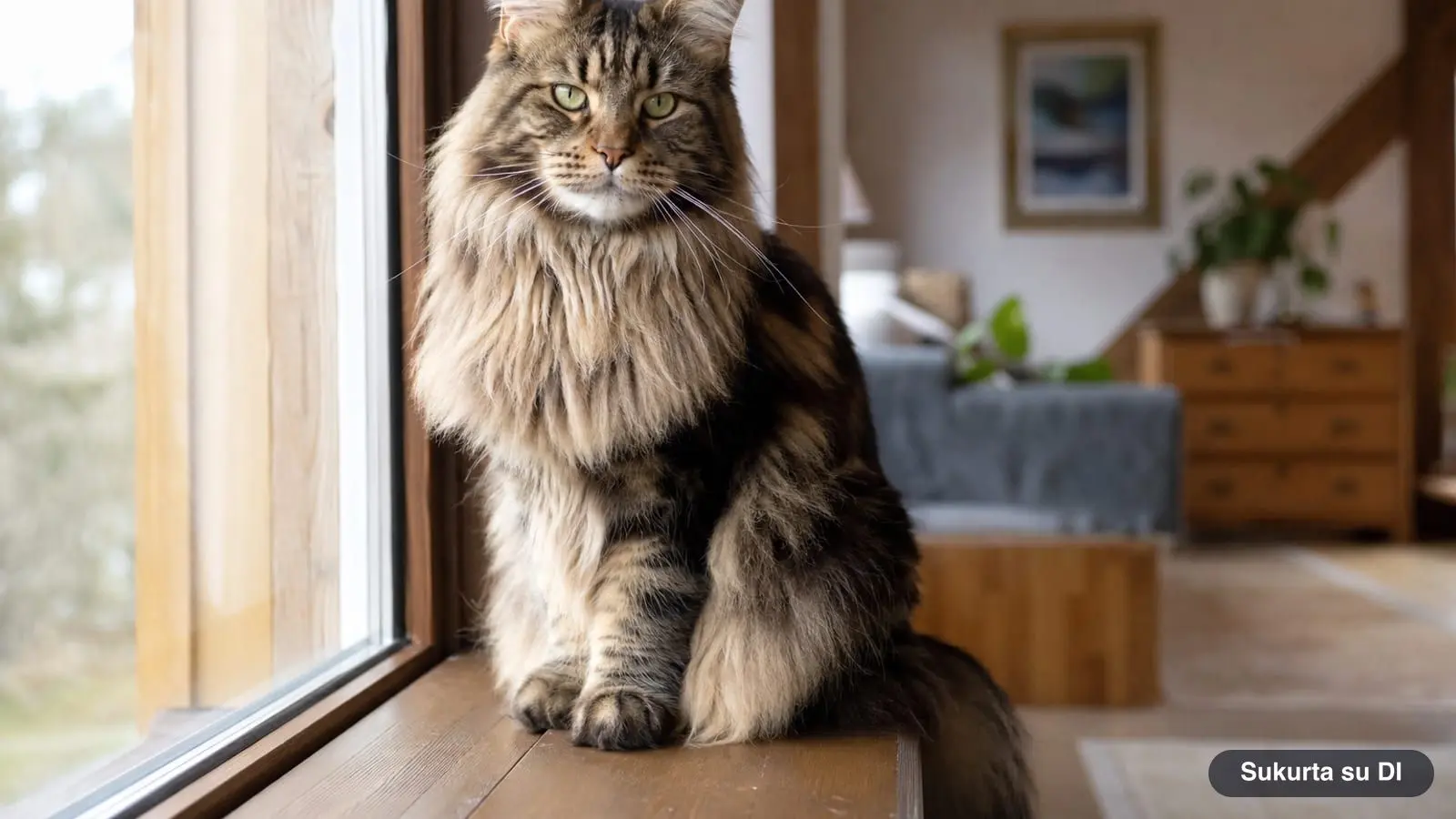
- The Maine Coon is the largest non-hybrid domestic cat breed
- Coat and body structure helped them survive Maine winters
- The gentle giant: calm, social, and playful
- Maine Coon history began on 19th-century Maine farms
- Health: HCM, hip dysplasia, and SMA are screened with tests
- Care: grooming, a large litter box, and moderate feeding
- The Maine Coon, Norwegian Forest Cat, and Siberian differ in head shape
- How to choose a Maine Coon kitten
This article is part of the 77.today cat breeds guide, prepared by the 77.today editors from the sources listed at the end.
The Maine Coon is a cat that is hard to confuse with any other: a large body, a long bushy tail, lynx-like tufts on the tips of the ears, and a fluffy ruff around the neck. It is the largest domestic cat breed that hasn't been crossed with wildcats, and also one of the calmest. In this cat breed guide profile, you will find out how much a Maine Coon weighs and how long it grows, what its temperament is like, how to care for its coat, and what health tests to ask a breeder for.
| Origin | US, Maine (natural native breed) |
|---|---|
| Recognition | CFA championship status in 1976, FIFe in 1982 |
| Weight | males 18–22 lbs, females 11–15 lbs |
| Length with tail | up to 38 inches; record holder Stewie was 48.5 inches |
| Coat | semi-long, water-resistant, with a light undercoat |
| Colors | most natural colors; brown tabby is the most common |
| Eyes | large, oval; blue is only permitted for white cats |
| Activity | moderate, playful into old age |
| Grooming | brush 2–3 times a week |
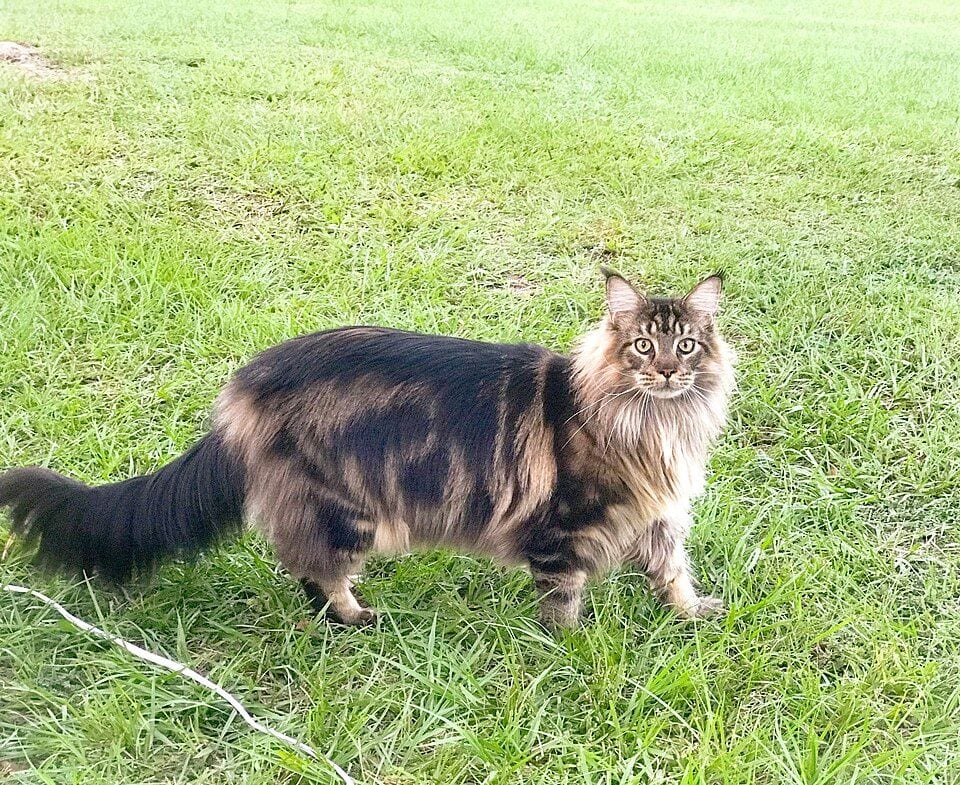
The Maine Coon is the largest non-hybrid domestic cat breed
Males usually weigh 18–22 lbs, females 11–15 lbs, and adult cats stand 10–16 inches tall at the shoulder. The longest Maine Coons can stretch to nearly 3 feet from nose to tail tip. In 2010, the Guinness World Records recognized an American Maine Coon named Stewie as the longest cat in the world—he measured 48.5 inches. Only hybrid breeds, such as the Savannah cat, whose ancestor is the African Serval, are larger than the Maine Coon.
It is important to know that the Maine Coon grows slowly. While most cats are fully grown within a year, a kitten of this breed continues to build bone and muscle for 3 to 5 years. Therefore, a one-year-old Maine Coon often still looks like a leggy teenager and only gains its true massive build later.
Coat and body structure helped them survive Maine winters
The breed developed in the harsh climate of New England, and this is evident in its appearance. The coat is shorter on the head and shoulders, but long and shaggy on the stomach, flanks, and hind legs to keep the cat from getting wet when sitting on snow or ice. The fur is silky, water-resistant, thicker in winter, and thinner in summer. Large paws with tufts of fur between the toes act as snowshoes, and the cat can wrap its long, bushy tail around its face and shoulders for extra warmth.
The head is large with a square outline, the muzzle is square, and the chin is strong. The ears are large, set high, and often feature long tufts at the tips. The body is long and rectangular, with a broad chest. Almost all natural colors are permitted, with brown tabby being the most commonly seen, along with black, silver, red, cream, and bi-colors with white. Some organizations do not recognize chocolate, lilac, and colorpoint patterns, as these would indicate crossbreeding with other breeds.
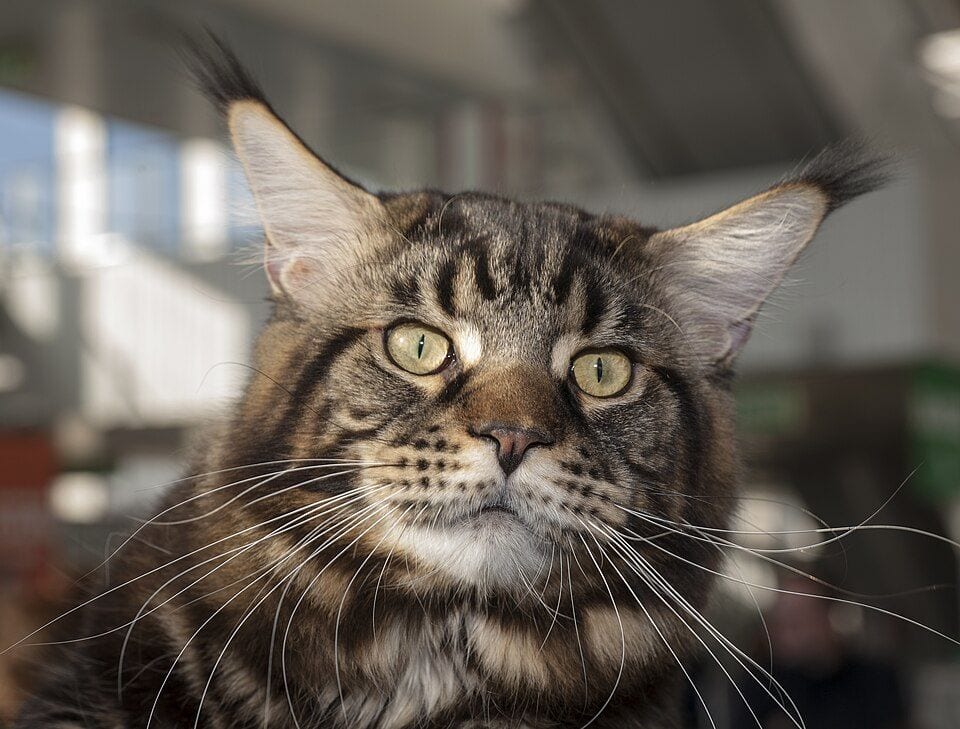
The gentle giant: calm, social, and playful
The Maine Coon is often called the "gentle giant." The FIFe standard emphasizes that despite their impressive size, these cats are kind-hearted and gentle. They love being around people and will follow their owners from room to room, but they are rarely clingy. The CFA breed profile notes that a Maine Coon usually doesn't pick just one favorite person, but interacts well with all family members.
This breed is considered quiet: instead of loud meowing, Maine Coons "talk" with short chirps and trills. Many are fascinated by water—they will watch a dripping faucet, dip their paws into a water bowl, or even wash their toys. A Maine Coon generally gets along well with children and other pets if introduced gradually, though small dogs or children might initially be taken aback by the cat's size.
They inherited their intelligence from their farm-mouser ancestors. Maine Coons quickly learn to fetch toys, open cabinets, or walk on a leash and harness. To keep them from getting bored, they need daily play and mental stimulation.
Maine Coon history began on 19th-century Maine farms
There are many legends about the origins of the Maine Coon. According to one, these bushy-tailed tabby cats originated from pairings between a cat and a raccoon, which is why they are called "coon." Another claims they are descendants of Viking ship cats, while a third suggests they were Angora cats brought to America by the French Queen Marie Antoinette. Genetic studies have debunked these stories: Maine Coons descend from cats brought to New England by colonists from Great Britain in the 17th and 18th centuries. Their resemblance to the Norwegian Forest Cat and the Siberian is not due to relation, but because all three breeds adapted to similar cold climates.
FIFe notes that the first written records of Maine Coons date back to 1861. In 1895, at the first North American cat show at Madison Square Garden in New York, a brown tabby Maine Coon named Cosey won Best in Show. In the early 20th century, fashions changed, Persian cats entered the show scene, and the Maine Coon's popularity declined so much that in the 1950s, the breed was incorrectly declared extinct. Breeder clubs revived it: the CFA granted the Maine Coon championship status in 1976, FIFe followed in 1982, and in 1985, the state of Maine declared it their official state cat.
Today, it is one of the most popular breeds in the world. In 2025, Maine Coons were once again first in the FIFe studbooks—with 24,488 registered kittens, or 25.2% of the total—and in the CFA registry in 2025, they overtook Ragdolls. In the United States, they consistently rank among the top three most registered breeds with the CFA, reflecting their enduring appeal among American cat lovers.
Health: HCM, hip dysplasia, and SMA are screened with tests
Maine Coons are generally sturdy, but there are a few hereditary diseases in the breed that responsible breeders test for before mating a cat:
- Hypertrophic cardiomyopathy (HCM) – a thickening of the heart muscle. The MYBPC3 gene mutation is associated with it; in a Washington State University laboratory study, about one-third of tested Maine Coons carried it. Since HCM can also be caused by other mutations, breeding cats undergo regular echocardiograms in addition to genetic testing.
- Hip dysplasia – a developmental disorder of the hip joint that causes lameness and arthritis. According to the Orthopedic Foundation for Animals (OFA) database in the US, dysplasia was found in 24.3% of Maine Coons x-rayed between 1974 and 2011.
- Spinal muscular atrophy (SMA) – a recessive disease caused by a mutation in the LIX1 and LNPEP genes; carriers are identified by a genetic test.
- Entropion – the edge of the eyelid rolls inward and irritates the cornea; sometimes surgery is required.
Some Maine Coons are born with extra toes (polydactyly). This hereditary trait does not harm their health, but most show standards do not allow it, so these kittens are usually sold as pets. Lifespan data varies: according to Swedish insurance data, the median exceeded 12.5 years, while a UK study found 9.7 years.
Care: grooming, a large litter box, and moderate feeding
- Coat. Due to a light undercoat, the Maine Coon's fur mats less than a Persian's, but CFA breeders recommend brushing it 2–3 times a week for 5–10 minutes. The stomach, armpits, and "britches" need the most attention. Bathing is rarely necessary.
- Space. Choose a sturdy, wall-mounted scratching post and a large litter box with a low entry: a standard box is too small for an adult male.
- Diet. Feed a growing kitten high-quality kitten food for longer than you would other breeds. Monitor an adult Maine Coon's weight: obesity increases the risk of heart and joint diseases.
- Exercise. At least 15–20 minutes of active play daily with a wand toy or balls. Many Maine Coons are happy to walk on a leash and harness.
The Maine Coon, Norwegian Forest Cat, and Siberian differ in head shape
The three large semi-longhaired breeds are often confused, although their standards differ clearly.
| Trait | Maine Coon | Norwegian Forest Cat | Siberian |
|---|---|---|---|
| Head shape | Square, square muzzle | Equilateral triangle, straight profile | Rounded, shorter |
| Origin | US, Maine | Norway | Russia |
| Coat | Uneven length, shaggy on the stomach | Double, glossy, water-resistant | Triple, very dense |
| Recognized by FIFe | 1982 | 1970s | 1997 |
How to choose a Maine Coon kitten
Because the demand for Maine Coon kittens is high, classified ads are full of "Maine Coons without papers." A true purebred kitten is proven by a pedigree issued by a recognized organization, such as the CFA or TICA. Ask to see the MYBPC3 test results for both parents, their latest echocardiogram reports, and hip x-ray evaluations. Meet the mother in person: she should be calm, healthy, and not overbred. Reputable breeders typically allow kittens to go to their new homes no earlier than 14 weeks of age, once they are fully vaccinated and socialized. General advice on how to screen a breeder and what to look for in a contract can be found at the beginning of our guide.
If you want a large but less shaggy cat, take a look at the Ragdoll, and if you are looking for minimal grooming, consider the British Shorthair.
Frequently asked questions
How much does a Maine Coon weigh?
Adult males usually weigh 18–22 lbs, and females 11–15 lbs. Some individual males can be heavier, but this high weight must come from heavy bone structure and muscle, not fat: obesity increases the risk of heart disease.
At what age does a Maine Coon stop growing?
The Maine Coon matures slowly: while most cats are fully grown within a year, this breed takes 3 to 5 years to reach its final size. Their coat also fully develops later, usually around a year and a half.
Is a Maine Coon suitable for an apartment?
Yes, as long as they get enough exercise and vertical space: a sturdy scratching post, cat shelves, and daily play. The breed is calm and not overly vocal, but due to their size, they need a larger litter box, more stable furniture, and roomier beds.
What is the lifespan of a Maine Coon?
According to Swedish pet insurance data, the median lifespan of a Maine Coon exceeds 12.5 years, with 74% of cats living to at least 10 years. A study conducted in the UK found a lower life expectancy of 9.7 years.
Can a Maine Coon be a mix between a raccoon and a cat?
No. The name comes from a myth that these bushy-tailed tabby cats originated from mating with a raccoon, but this is biologically impossible. Genetic studies show that Maine Coons descend from cats brought to New England by European colonists in the 17th and 18th centuries.
Sources
- Wikipedia: Maine Coon
- FIFe (Fédération Internationale Féline): Maine Coon breed standard
- FIFe Breeding Statistics 2025
- CFA (Cat Fanciers' Association): Maine Coon Cat breed profile
- Wikipedia: Hypertrophic cardiomyopathy (HCM)
- FIFe Breeding & Registration Rules (2.3.3 – kittens no earlier than 14 weeks)
- Wikimedia Commons photo: A one-year-old brown tabby Maine Coon with a bushy tail walking across a lawn
- Wikimedia Commons photo: Head of a brown tabby Maine Coon with lynx tips on the ears
Log in to comment
No comments yet. Be the first.