Turkish Van Cat: Temperament, Size, Care & Water Love
- Developed in Great Britain from cats brought back from Turkey by photographers Laura Lushington and Sonia Halliday in 1955 and later.
- The Van pattern: a white body with color restricted to the head between the ears and the tail; colored spots can cover no more than about 20% of the body.
- The semi-long coat lacks an undercoat, feels as soft as cashmere, and is highly water-resistant.
- Males weigh 11–20 lbs, while females weigh 7–11 lbs; they take 3 to 5 years to reach full physical maturity.
- Recognized by FIFe since 1960 and the CFA since 1994, but remains a rare breed: only 74 kittens were registered with FIFe in 2025.
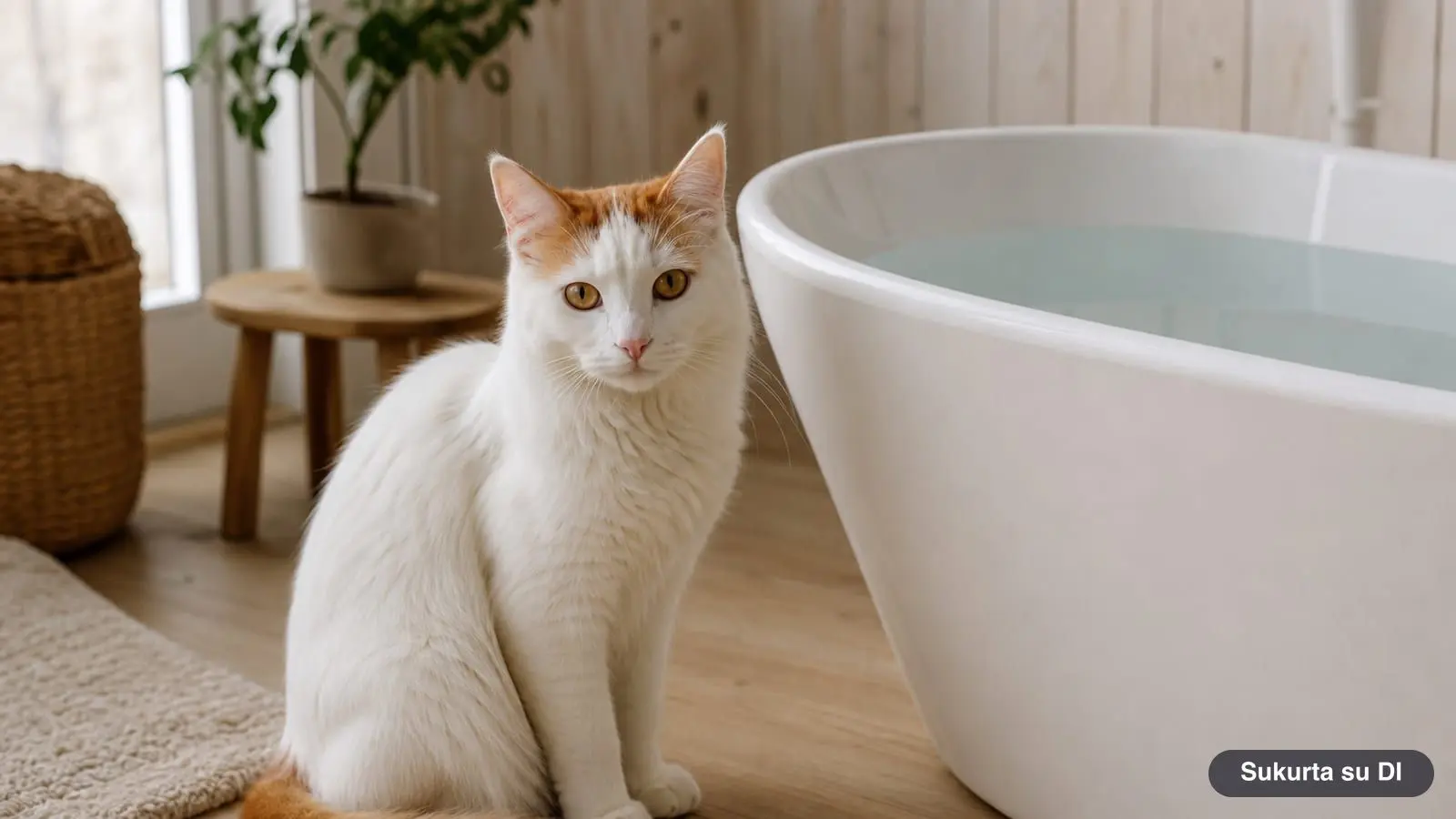
- Van pattern: color only on the head and tail
- Cashmere-soft coat with no undercoat
- History: photographers, Turkish cities, and name confusion
- Temperament: athletic, intelligent, but not a lap cat
- Health: a natural breed with no known specific diseases
- Care: one of the easiest longhairs to groom
- Turkish Van, Turkish Angora, and Van cat
- How to choose a Turkish Van kitten
This article is part of the 77.today cat breeds guide, prepared by the 77.today editors from the sources listed at the end.
The Turkish Van looks as if someone dipped it in white paint, leaving only the head and tail untouched: a chalk-white body, with red, cream, black, or blue coloring between the ears and a brightly ringed, bushy tail. This pattern is so distinctive that it is called the "Van" pattern across all breeds. The Turkish Van is also famous for legends about its love for water. In this cat breed guide profile, we explore what is true, what is a myth, and what this large, athletic cat is like in everyday life.
| Origin | Turkey (especially southeast); breed developed in Great Britain |
|---|---|
| Recognition | FIFe in 1960; GCCF in 1969; TICA in 1985; CFA championship status in 1994 |
| Weight | males 11–20 lbs, females 7–11 lbs |
| Body | large, muscular, broad-shouldered |
| Coat | semi-long, no undercoat, water-resistant |
| Pattern | Van: color on head and tail, white body |
| Colors | red, cream, black, blue; tabby and tortoiseshell |
| Eyes | amber, blue, or odd-eyed |
| Maturation | 3–5 years |
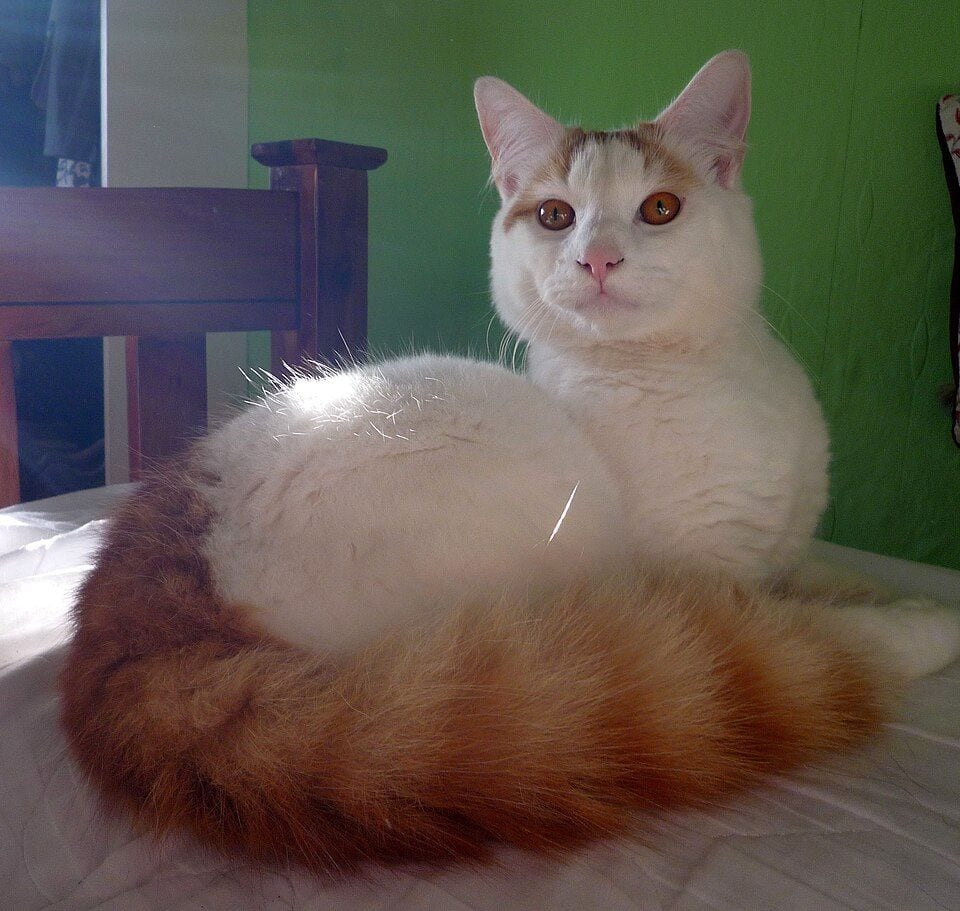
Van pattern: color only on the head and tail
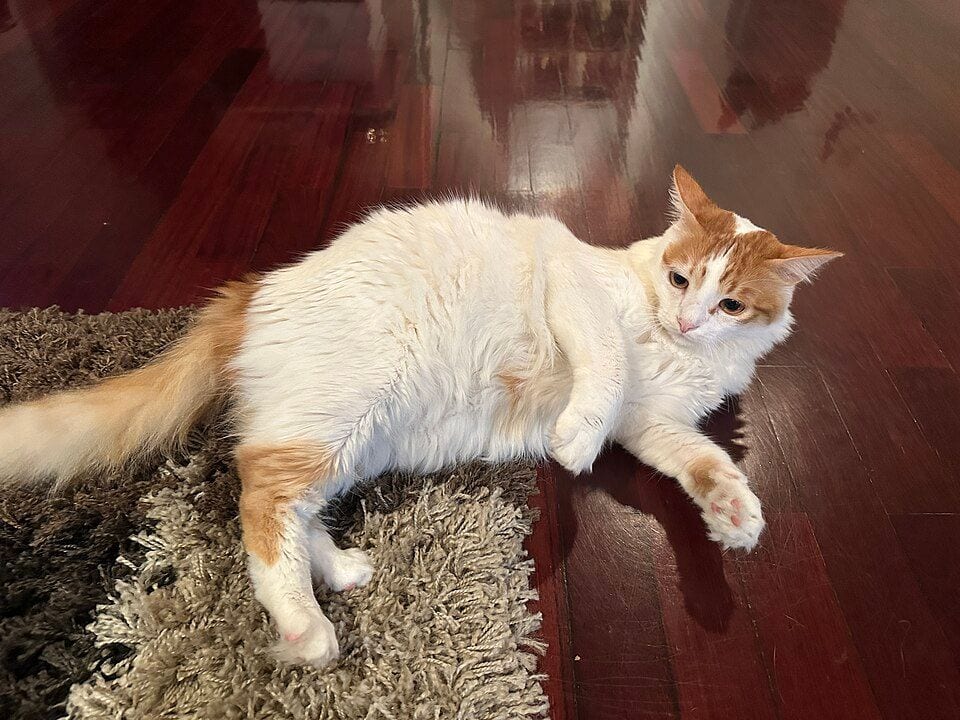
The Van pattern is caused by the white spotting gene expressed to nearly its maximum: a white background covers about 80% of the body, while colored markings remain on the head between the ears and on the tail. Breed standards allow for one or more random spots on the body, as long as the color does not exceed about a fifth of the body (the CFA limits it to 15%) and the cat does not look bicolor. The classic Van is red tabby and white, but the color on the head and tail can be red, cream, black, or blue, as well as tabby or tortoiseshell. Colorpoint markings are not recognized.
The CFA and FIFe only consider cats with the Van pattern to be true Turkish Vans. Completely white cats of Turkish Van descent are registered as a separate breed by some organizations (like the WCF and GCCF), while others consider them ineligible for showing. Importantly, Van-patterned cats are not prone to deafness: congenital deafness is most commonly associated with solid white cats that have two blue eyes.
Cashmere-soft coat with no undercoat
While most cats have multiple layers of fur, the Turkish Van has only one, with no distinct undercoat. As a result, it feels as soft as cashmere or rabbit fur, smooth and cotton-like. The coat is unusually water-resistant, making it difficult to get the cat completely wet, but it dries very quickly. In winter, the coat is long and thick; in summer, the cat sheds it and wears a shorter coat. The tail remains bushy year-round, and the ears keep their furnishings, so even in summer, the Van looks fluffy. Kittens are born shorthaired with thin tails and take 3 to 5 years to develop their full adult coat.
The body is large, muscular, and somewhat long, with broad shoulders and a short neck—the CFA compares it to an Olympic swimmer. The hind legs are slightly longer than the front legs, and the paws are large. The head is a broad, modified wedge shape, the ears are moderately large and set fairly high and wide apart, and the eyes are large and expressive—amber, blue, or odd-eyed.
History: photographers, Turkish cities, and name confusion
In 1955, British photographers Laura Lushington and Sonia Halliday, working on an assignment for the Turkish Ministry of Tourism, were given two unrelated cats. Lushington brought them back to England, and the resulting kittens were identical to their parents—chalk white with colored heads and tails. She decided to establish a standardized breed. According to her own accounts, the foundation cats were a female from the Hatay province (Iskenderun) and a male from Istanbul, joined in 1959 by cats from Antalya and Burdur. She did not actually visit Lake Van until 1963, so it remains unclear exactly why the breed was named after Van.
The GCCF recognized the breed in 1969 under the name "Turkish Cat." In 1979 in Britain and 1985 in the US, it was renamed the Turkish Van to avoid confusion with the Turkish Angora. FIFe has recognized the breed since 1960, TICA granted it championship status in 1985, and the CFA followed in 1994. In Turkey, the local, mostly all-white Van cat (Van kedisi) is considered a national treasure and is protected at the Van Yüzüncü Yıl University research center.
Temperament: athletic, intelligent, but not a lap cat
The TICA standard highlights the Van's intelligence, energy, and playfulness, which can sometimes make them quite mischievous. Muscular Vans love to climb and perch up high—the CFA notes they can easily jump from the floor to the top of a refrigerator. They are excellent hunters and, with positive reinforcement, easily learn to fetch, perform tricks, or walk on a leash. The CFA mentions that they prefer toys made of natural materials, like feathers or fur, and are talkative, though not overly loud.
FIFe notes that Vans are deeply devoted to their family members but are generally not lap cats: they will happily lie next to you and enjoy being petted, but they do not like being picked up or carried. They play well with children, but young kids need to be taught not to carry the cat or pull its tail. A 2021 Finnish study found that Turkish Vans have a higher-than-average tendency toward fearfulness and lower stress tolerance, making a calm home environment and patient socialization important for them.
Health: a natural breed with no known specific diseases
The CFA states that this healthy, natural breed has no known specific genetic problems. Van-patterned cats are not prone to deafness, but completely white cats, especially those with blue eyes, have a higher incidence of deafness, which is why some registries only accept them with a negative BAER hearing test. Because Vans are large and active, the CFA emphasizes that they need plenty of space and regular exercise—otherwise, they can easily become overweight.
Care: one of the easiest longhairs to groom
- Coat. The CFA considers Vans one of the easiest longhaired breeds to groom: without an undercoat, the fur rarely mats. In summer, a weekly brushing with a steel comb is enough, though more frequent brushing is needed during the winter shedding season.
- Bathing. Generally unnecessary—Vans are very clean, and their water-resistant coat is difficult to soak anyway.
- Heights and exercise. Provide tall cat trees, wall shelves, and daily active playtime.
- Water. If your cat loves to splash, a pet water fountain or a shallow bowl will become a favorite toy; remember to keep toilet lids closed.
Turkish Van, Turkish Angora, and Van cat
| Trait | Turkish Van | Turkish Angora | Van cat (Van kedisi) |
|---|---|---|---|
| Status | recognized breed | recognized breed | local Turkish cat |
| Body | large, muscular | slender, graceful | medium |
| Color | Van pattern | various, often white | mostly all white |
| FIFe kittens in 2025 | 74 | 88 | – |
How to choose a Turkish Van kitten
Turkish Van breeders are relatively scarce, so you may have to search for a while or even look out of state to find a kitten. Evaluate the parents' temperaments—are they calm and social?—and ask how the kittens are socialized with people. If a kitten is completely white or blue-eyed, ask for a BAER hearing test. A kitten's coat will still be short; its true magnificent fluff will only develop after a few years. Reputable breeders typically will not let kittens go to their new homes before 14 to 16 weeks of age. For general advice on finding a reputable CFA or TICA registered breeder, checking health clearances, or adopting through a rescue, see our cat breed guide introduction.
You can learn about their more graceful Turkish relative in the Turkish Angora profile, or discover another large breed with a water-resistant coat in our Norwegian Forest Cat guide.
Frequently asked questions
Do Turkish Van cats really like to swim?
Cats around Turkey's Lake Van are known as "swimming cats," and CFA breeders note that even Van kittens will willingly play and swim in pools. However, most modern Vans are indoor cats, so their love for water is more often seen splashing in water bowls or following their owners into the bathroom. Some experts believe the swimming trait is slightly exaggerated.
What is the difference between a Turkish Van and a Van cat?
The Van cat (Turkish: Van kedisi) is a local, usually all-white cat from Turkey, protected as a national treasure and bred at the Van Yüzüncü Yıl University center. The Turkish Van is a breed developed in Britain with a colored head and tail; according to the original breeder, the foundation cats came from Hatay, Istanbul, Antalya, and Burdur, not the Van region.
What is the difference between a Turkish Van and a Turkish Angora?
The CFA compares them to an Olympic swimmer and a ballerina: the Turkish Van is large, muscular, and broad-shouldered with the Van pattern, while the Turkish Angora is slender, graceful, fine-boned, and often all white. The breeds also originate from different regions of Turkey.
How much does a Turkish Van cat weigh?
Adult males weigh 11–20 lbs, and females weigh 7–11 lbs. It is one of the larger cat breeds, taking 3 to 5 years to reach full physical maturity. Some Vans can measure up to 3 feet long from the nose to the tip of the tail.
Do Turkish Van cats like to be held?
Usually no. FIFe notes that Vans are deeply devoted to their families but are generally not lap cats. They prefer to lie next to you and be petted, but they do not like being picked up or carried. Young children should be taught this early on to respect the cat's boundaries.
Sources
- Wikipedia: Turkish Van
- FIFe (Fédération Internationale Féline): Turkish Van breed standard
- CFA (Cat Fanciers' Association): Turkish Van breed profile
- Wikipedia: Van cat
- FIFe Breeding Statistics 2025 (registrations by breed and country)
- FIFe Breeding & Registration Rules (2.3.3 - kittens no earlier than 14 weeks)
- Wikimedia Commons photo: Turkish Van cat with colored head and tail
- Wikimedia Commons photo: Turkish Van cat with random spots on the body
Log in to comment
No comments yet. Be the first.